
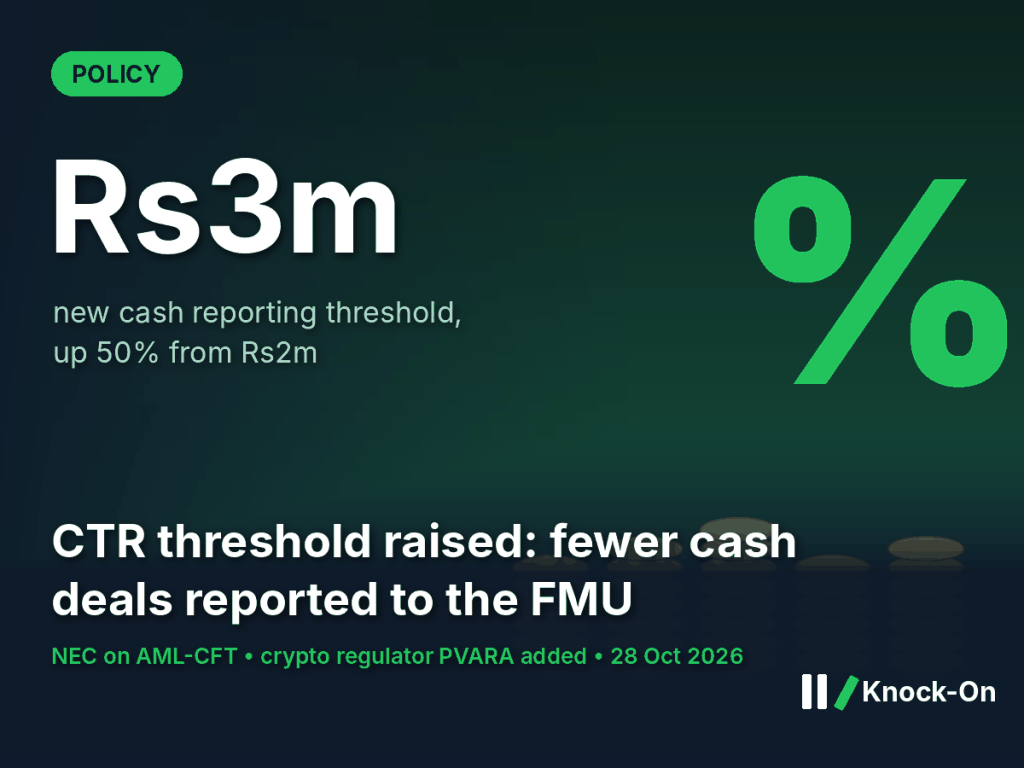
The CTR threshold in Pakistan, the cash amount at which a currency transaction report must be filed, has been raised by 50% to Rs3m from Rs2m. The National Executive Committee (NEC) on anti-money laundering and countering the financing of terrorism (AML-CFT), chaired by Finance Minister Muhammad Aurangzeb, approved the change on Tuesday, Dawn and Business Recorder reported. The same meeting brought the new crypto regulator into the anti-money laundering law and widened the list of crimes it covers. For businesses that deal in cash, it means fewer routine reports; for the financial system, it signals where enforcement is heading.
The short version
- Cash transactions of Rs3m or more now trigger a currency transaction report (CTR), up from Rs2m.
- The Pakistan Virtual Assets Regulatory Authority (PVARA) gains AML-CFT regulatory powers over virtual and digital assets.
- Maritime piracy becomes a predicate offence for money laundering.
- Provincial anti-corruption establishments can now investigate and prosecute under the AML Act.
What happened
The NEC held its 19th meeting on 27 October. According to Dawn, it approved raising the CTR threshold from Rs2m to Rs3m; the limits are set by notification in the official Gazette. Business Recorder noted that the Rs2m level dates from the Financial Monitoring Unit’s (FMU) 2021 guidelines. A CTR is filed whenever a cash transaction equals or exceeds the threshold. A suspicious transaction report (STR) is different: it is filed whenever a transaction looks linked to money laundering or terrorism financing, whatever its size.
The committee also added Section 28 of the Pakistan Maritime Zones Act 2023, which defines piracy, to Schedule I of the Anti-Money Laundering Act, and added PVARA to Schedule IV, alongside the State Bank of Pakistan (SBP), the SECP and the FBR as AML-CFT regulators. Provincial anti-corruption establishments were designated as investigating and prosecuting agencies. Aurangzeb asked for an FMU implementation roadmap with defined timelines and stronger coordination between agencies, both reports said.
Cash deals now need to reach Rs3m before a report is filed
Currency transaction report threshold, rupees, October 2026
Why it matters
A higher CTR threshold in Pakistan reduces the number of routine cash reports that banks and other reporting entities must send to the FMU. Cash transactions between Rs2m and just under Rs3m no longer need a CTR, although an STR is still required if anything looks suspicious. The Rs2m line had been in place since the FMU’s 2021 guidelines. A smaller stream of routine reports could also let the FMU focus its analysis on larger flows, in line with Aurangzeb’s call for stronger analytical capacity. The bigger structural change is PVARA: virtual-asset businesses now sit inside the same AML-CFT framework as banks, brokers and other regulated firms.
The knock-on effects
First order: fewer CTRs for cash-heavy firms
Traders, wholesalers, car dealers and property agents that handle large cash payments should see fewer of their transactions automatically reported. Bank branches will spend less time on routine filings.
Second order: crypto firms face compliance costs
With PVARA under Schedule IV, virtual-asset service providers can expect customer due diligence, record-keeping and reporting obligations similar to those in banking. That raises costs but can also make it easier for licensed firms to open bank accounts. It follows a run of regulatory changes, including the SBP’s new equity investment limits and the Companies Act amendments.
Third order: Pakistan’s standing with lenders and investors
A credible AML-CFT regime matters for correspondent banking and foreign investment. With forex reserves at a record and the government seeking more foreign capital, stronger enforcement against larger, riskier flows supports that effort.
Who could benefit
- Cash-based businesses: fewer transactions are reported automatically.
- Banks: lower volumes of routine CTR filings.
- The FMU: more room to focus on larger and suspicious flows.
- Licensed crypto firms: clearer regulatory status.
Who may face pressure
- Virtual-asset service providers: new AML-CFT obligations and costs.
- Firms under provincial anti-corruption probes: money laundering charges can now be added.
- Shipping and maritime businesses: piracy-linked funds are now a predicate offence.
What to watch
- The Gazette notification: the date from which the Rs3m threshold applies.
- FMU guidance: updated instructions for banks and other reporting entities.
- PVARA rules: AML-CFT regulations for virtual-asset firms.
- The FMU roadmap: timelines Aurangzeb asked for.
Sources
- Dawn, Govt raises threshold for currency transaction reports to Rs3m as anti-money laundering framework reviewed, 28 October 2026
- Business Recorder, Pakistan decides to tighten its AML-CFT regimes, 28 October 2026
This is analysis, not investment advice. Figures are as of 28 October 2026.



Leave a Reply