
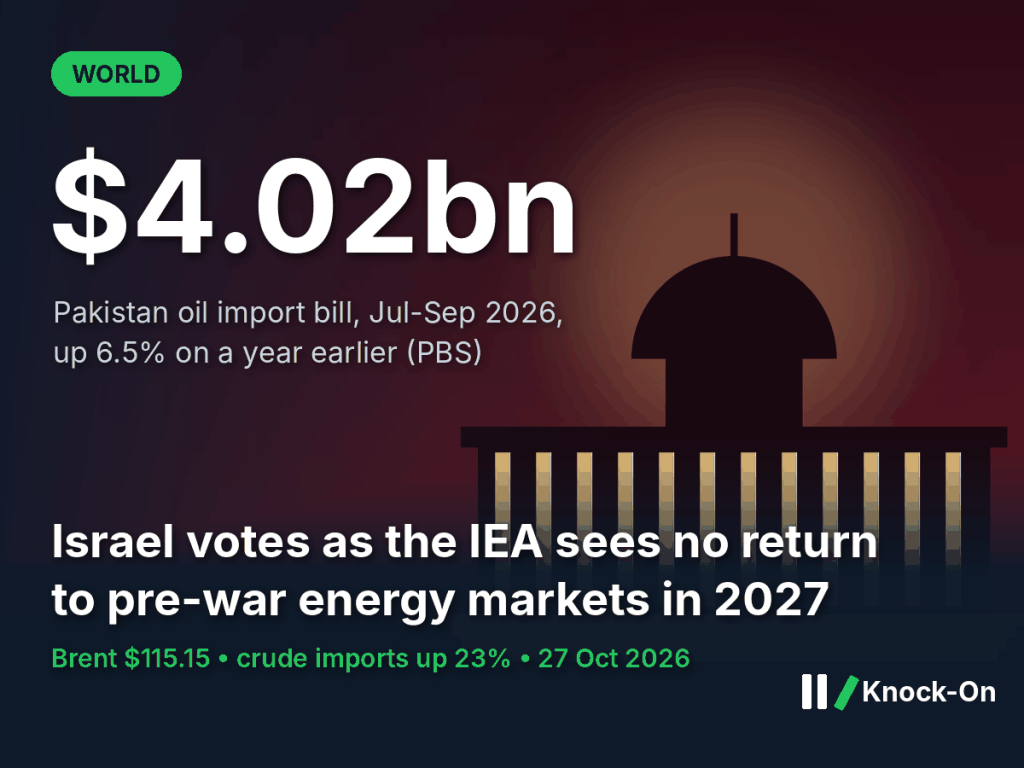
The Israel election impact on Pakistan will be felt mainly through oil. Israelis vote today, Tuesday 27 October, in the country’s first election since the 7 October 2023 attacks and the first since the United States and Israel launched the war on Iran in February, Reuters reports. A day earlier, the head of the International Energy Agency said he sees no credible path for energy markets to return to pre-war levels next year. For Pakistan, which spent $4.02bn on petroleum imports in July to September, the question is whether the result raises or lowers the risk of renewed fighting in the Gulf, and with it the cost of fuel, power and money at home.
The short version
- Israel holds its first election since the 7 October 2023 attacks today; polls suggest Prime Minister Benjamin Netanyahu’s Likud will lose seats, Reuters reports.
- IEA chief Fatih Birol said he sees no credible pathway for energy markets to return to pre-war levels in 2027.
- Brent crude was $115.15 a barrel early on 27 October, down 66 cents, after talks in Tehran eased supply fears.
- Pakistan’s petroleum import bill rose 6.5% to $4.02bn in the first quarter of FY27, with crude imports up 23%.
What happened
On the eve of the vote, US President Donald Trump posted: “Vote for Bibi Netanyahu for Prime Minister, we have to finish the job that we started!” Netanyahu said Trump would take action that would “finally, finally, remove the Iranian threat”, but only while he remains in power, and said he had instructed Israel’s Mossad and military to “bring down this regime”, according to Reuters. His main rival, Gadi Eisenkot, a former military chief of staff, accused Netanyahu of “relying on a campaign of fear-mongering, lies, and threats”. Reuters notes that major fighting with Iran has been suspended for months and that ceasefire talks have taken place without Israeli participation.
Separately, speaking in Singapore on Monday, Birol said: “I am afraid I don’t see any credible pathway that the markets will go next year,” referring to a return to pre-war conditions. He said oil was “flirting with $120 a barrel”, with product prices higher still, and that prices were hurting trade deficits in many parts of the world. He added that Qatar and the UAE cannot export gas at previous levels because of the war.
Pakistan is paying more for crude than a year ago
Petroleum group imports, US$ billion, July–September
Why it matters
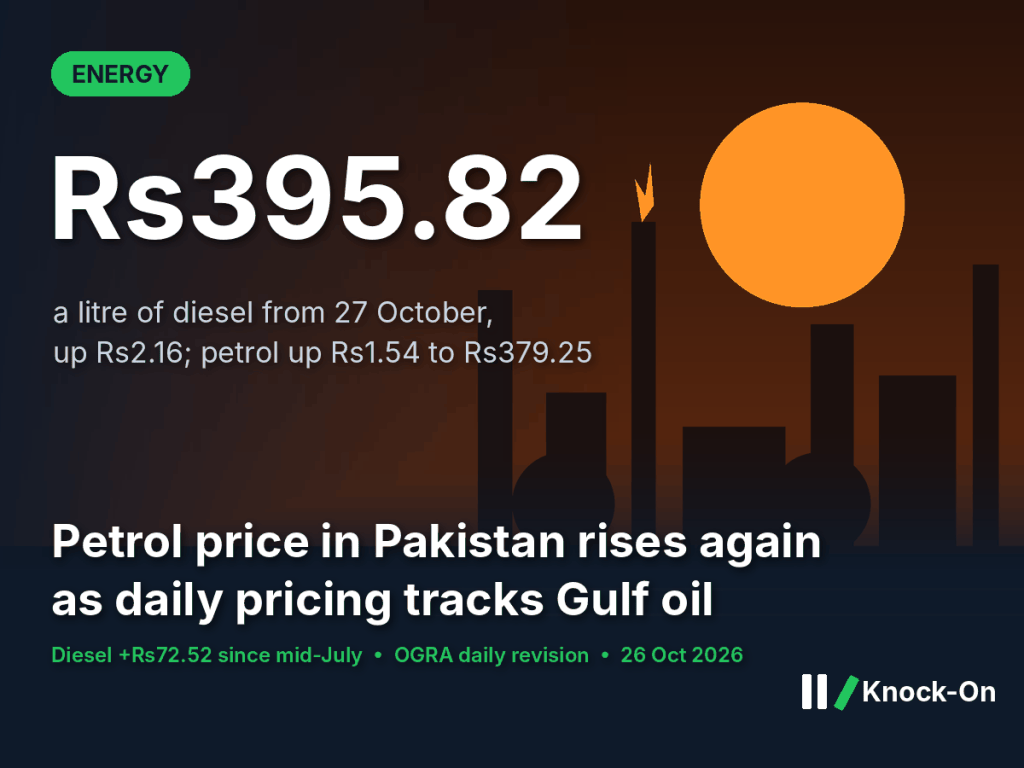
Pakistan imports most of its fuel, so any shift in the risk of renewed conflict reaches the economy quickly. According to Pakistan Bureau of Statistics data reported by APP, petroleum crude imports rose 23.1% to $1.76bn in July to September and petroleum products rose 11.6% to $1.56bn, while LNG imports fell 41.6% to $418m. The pump price followed: the government raised petrol by Rs1.54 a litre on Monday night, taking it to Rs379.25, as Knock-On reported in its petrol price update. The State Bank also raised its policy rate to 12% on Monday, citing inflation and energy prices. The Israel election itself does not set oil prices, but statements by the leading candidates on Iran are one of several signals traders weigh.
The knock-on effects
First order: Israel election impact on Pakistan’s oil import bill
Brent eased on Monday after Saudi Arabia, Turkey and Pakistan held talks with Iranian officials in Tehran, which Saudi Arabia said were aimed at preventing “a return to military escalation”. Knock-On covered those Makkah pact talks in Tehran. Any post-election signal that raises the chance of new strikes on Iran would work in the opposite direction, while continued diplomacy would support the recent dip.
Second order: gas and power
Birol’s point that Qatar and the UAE cannot export gas at previous levels matters for Pakistan’s winter supply, because Qatar is a long-standing LNG supplier. Pakistan’s LNG imports already fell 41.6% in the first quarter, PBS data show, and Islamabad is discussing long-term LNG contracts with the US. Tighter gas supply tends to mean more load-shedding for industry and CNG, or more expensive fuel substitutes for power plants.
Third order: interest rates and the external account
A higher oil bill widens the trade gap and keeps pressure on the rupee and inflation. The IMF has already set out a bad case of $130 oil next year, as Knock-On’s Iran war impact on Pakistan analysis explained. If the IEA is right that markets stay tight through 2027, borrowers should not count on quick relief from the SBP’s 12% rate.
Who could benefit
- Oil and gas producers: higher international prices lift the value of local output.
- Fuel retailers with storage: rising prices can produce inventory gains.
- Renewable energy suppliers: the IEA’s call to make energy security a priority strengthens the case for solar and other local power.
Who may face pressure
- Transport and logistics firms: fuel is their largest variable cost.
- Energy-intensive industry: textiles, cement and steel face higher power and fuel bills.
- Borrowers: persistent energy inflation makes rate cuts less likely.
What to watch
- 27–28 October: Israeli election results and early coalition talks.
- 27 October: Russian President Vladimir Putin’s meetings in Moscow with Iran’s President Masoud Pezeshkian and the Emir of Qatar, announced by the Kremlin.
- 28 October: the US Federal Reserve decision, which affects the dollar and oil.
- Houthi attacks on Saudi Arabia: the main source of supply risk this week.
Sources
- Reuters via Business Recorder, Netanyahu touts Trump endorsement on eve of vote, suggests they may restart war on Iran, 26 October 2026
- Reuters via Business Recorder, IEA’s Birol does not expect energy markets to return to pre-war levels in 2027, 26 October 2026
- UA.News, citing Channel NewsAsia, Oil prices fall amid Tehran talks, 27 October 2026
- APP, POL import bill up by 6.50% to $4.02 bln in 1st quarter, 26 October 2026
- Business Recorder, Govt increases diesel price by Rs2.16, petrol by Rs1.54 per litre, 26 October 2026
- Business Recorder, SBP hikes policy rate to 12% on inflation, energy price concerns, 26 October 2026
- Business Recorder, Putin to meet Iran’s Pezeshkian, Emir of Qatar on Tuesday in Moscow, Kremlin says, 26 October 2026
This is analysis, not investment advice. Figures are as of 27 October 2026. Knock-On is not affiliated with any political party.

Leave a Reply