
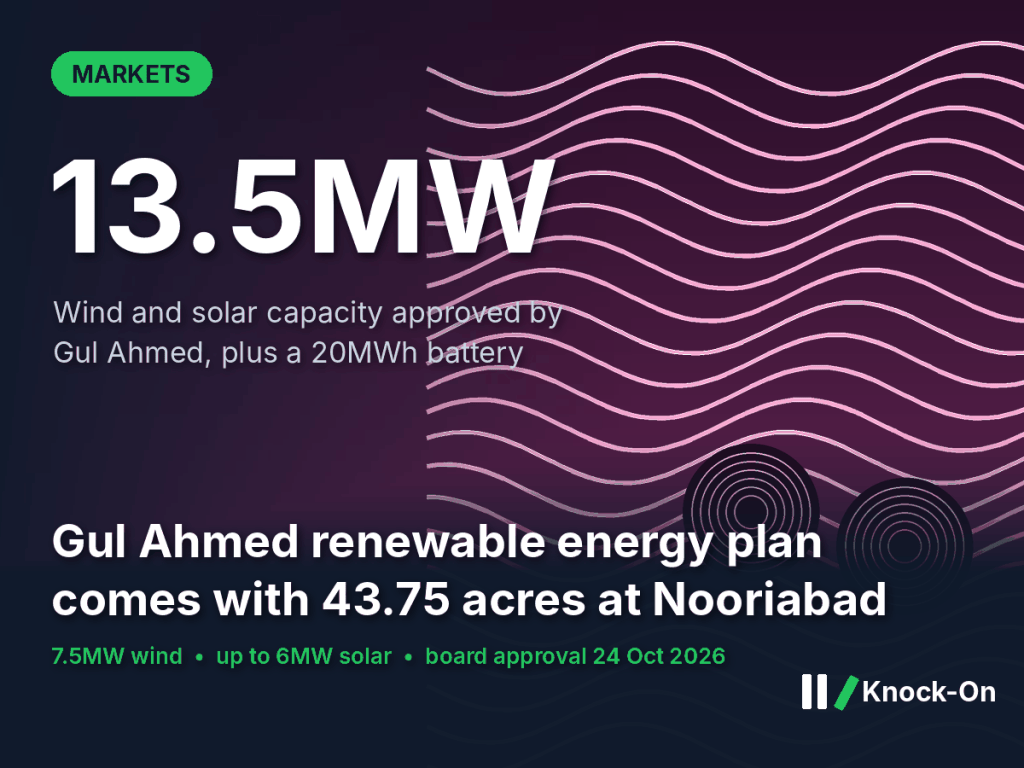
The Gul Ahmed renewable energy plan, approved by the board of Gul Ahmed Textile Mills on 24 October and filed with the Pakistan Stock Exchange on Monday, adds a 7.5MW wind turbine, a solar plant of up to 6MW and a 20MWh battery system, Business Recorder reported. The board also approved buying five more plots, totalling 43.75 acres, at SITE Nooriabad in Jamshoro district. One of Pakistan’s largest textile groups is growing its land and its own power supply at the same time.
The short version
- Gul Ahmed approved up to 13.5MW of wind and solar capacity plus a 20MWh battery.
- It approved five plots totalling 43.75 acres at SITE Nooriabad, subject to due diligence.
- It has also completed the purchase of plot A-44 there, including buildings and machinery.
- Costs and financing were not disclosed.
What happened
According to the company’s notice, the energy package has three parts. A 7.5MW wind turbine will be supplied by Goldwind through Orient Energy Systems. A solar plant of up to 6MW will use JinkoSolar panels, with local works by A2Z Energy Systems. A 20MWh battery energy storage system with a 0.5C rating will be supplied by Sungrow through Orient Energy Systems. A 0.5C rating means the battery can deliver about 10MW for two hours (Knock-On calculation).
The land plan covers plots B-80A (12 acres), B-153 (18 acres), B-236 (4 acres), A-473 (8 acres) and B-268 (1.75 acres). The approval depends on due diligence and corporate, regulatory and legal formalities. Separately, Gul Ahmed has completed the purchase of plot A-44 at SITE Nooriabad, with its land, building, plant and machinery. The notice does not say where the renewable projects will be built.
Why it matters
For exporters, power is one of the biggest controllable costs. Grid tariffs carry heavy fixed charges: Knock-On has reported that capacity payments make up more than half of the projected power purchase price for 2027. A wind-solar-battery mix lets a mill generate its own power by day, store some of it, and rely less on the grid and on fuel-based generators. The battery is the largest single piece of the plan by power output.
The battery is the biggest piece of Gul Ahmed’s energy plan by output
Approved capacity, megawatts (MW), board approval 24 Oct 2026
The knock-on effects
First order: more capacity at Nooriabad
The 43.75 acres and the completed A-44 purchase give Gul Ahmed room to expand at SITE Nooriabad. The company has not said what will be built. It follows other exporters investing in capacity, such as Interloop’s Rs6.5bn expansion.
Second order: Gul Ahmed renewable energy and lower grid use
Every unit a mill makes for itself is a unit it does not buy from the grid. As more large industrial users do this, fixed grid costs are spread over fewer units sold, which is a pressure point for power distribution companies and the tariff.
Third order: export competitiveness
Cheaper, steadier power could help Pakistani mills hold prices against regional rivals, which matters more as India’s EU trade deal raises the stakes for textile exporters. If other large exporters follow, the gap between mills with their own power and those fully on the grid could widen.
Who could benefit
- Gul Ahmed: lower and more predictable energy costs once the projects run.
- Local installers and agents: Orient Energy Systems and A2Z Energy Systems are named on the projects.
- SITE Nooriabad: new industrial land use and investment in Jamshoro district.
Who may face pressure
- Power distribution companies: large customers producing their own power buy fewer grid units.
- Smaller mills: those without capital for captive renewables keep paying full grid costs.
- Gul Ahmed’s balance sheet: costs and financing are undisclosed, at a time when the policy rate has just risen to 12%.
What to watch
- Completion of due diligence and transfer of the five Nooriabad plots.
- Any disclosure of project cost, financing and commissioning dates.
- Similar renewable filings by other listed textile companies on the PSX.
Sources
- Business Recorder, Textile giant Gul Ahmed approves acquisition of 43.75 acres, renewable energy projects, 26 Oct 2026
- Business Recorder, SBP hikes policy rate to 12% on inflation, energy price concerns, 26 Oct 2026
This is analysis, not investment advice. Figures are as of 27 October 2026.

Leave a Reply