
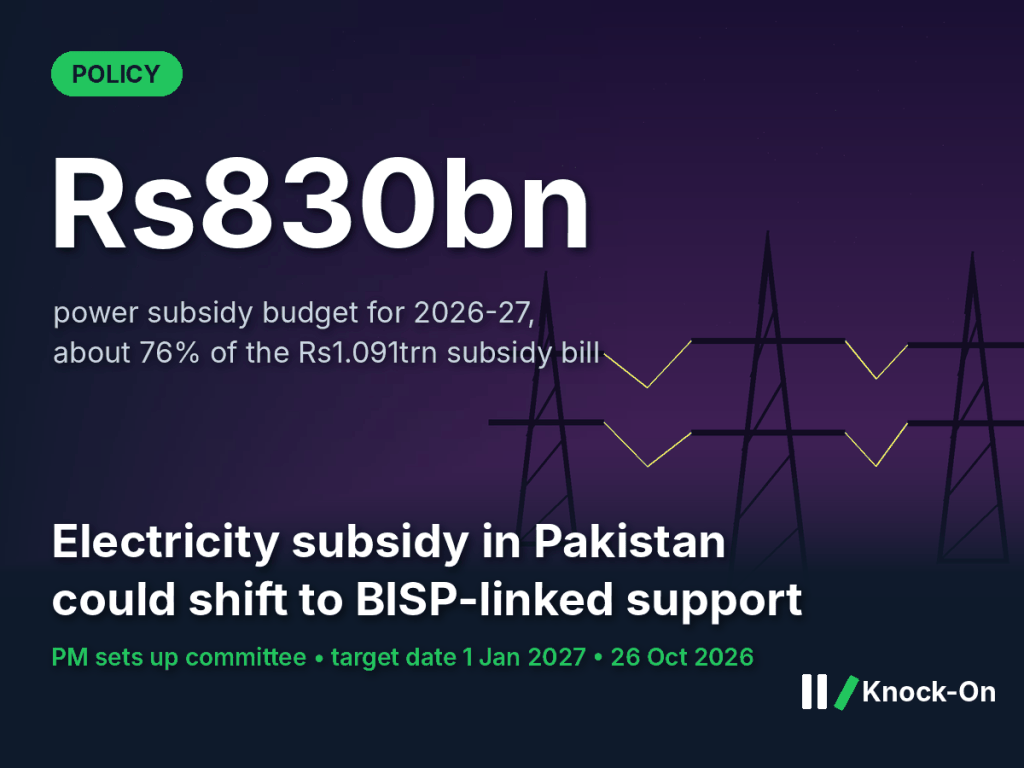
The electricity subsidy in Pakistan may soon stop following the meter and start following the household. Prime Minister Shehbaz Sharif has set up a high-level ministerial committee to design a strategy for scaling back broad power-sector subsidies and moving to targeted support linked to the Benazir Income Support Programme (BISP), Business Recorder reported on Monday. The power-sector subsidy allocation for 2026-27 is Rs830bn, and the proposed reforms would take effect from 1 January 2027. For businesses, the question is who ends up paying for the change, and how fast.
The short version
- A committee chaired by Planning Minister Ahsan Iqbal must recommend a strategy within two months of 18 October.
- The power subsidy budget is Rs830bn this year, about 76% of a total subsidy bill estimated at Rs1.091trn (Knock-On calculation).
- Relief for households using up to 200 units a month is among the items under review.
- The reforms are tied to Pakistan’s commitments under IMF and World Bank programmes.
What happened
According to Business Recorder, the committee’s members include Rana Sanaullah Khan, Sardar Awais Ahmad Khan Leghari, Dr Musaddak Malik, Ahad Khan Cheema, Shaza Fatima Khawaja, Attaullah Tarar, Muhammad Ali and Bilal Azhar Kayani, along with the Finance and Power secretaries and the chairman of NADRA. Its brief is to move from broad electricity subsidies to targeted aid for low-income households, using a system to identify and verify beneficiaries, and to base eligibility increasingly on household circumstances rather than on electricity consumption alone. Payments would be linked to BISP and its database. The report says changes would be phased in to protect vulnerable consumers from sudden bill increases, but that the beneficiary registry and verification system have not yet been finalised.
Power takes about three-quarters of Pakistan’s subsidy bill
Subsidies, Rs billion, 2026-27
Why it matters
The electricity subsidy in Pakistan is the single largest item in the government’s subsidy bill, so how it is redesigned shapes both the budget and the tariff that businesses pay. Arab News reported on 1 October that the IMF had pressed for targeted relief delivered strictly through BISP, and that officials planned to match household power consumption records against BISP’s national poverty database. The same report flagged a practical problem: many urban meters are registered to landlords rather than tenants. If the reform works, the state spends less to protect the same poor households. If verification lags, relief could be withdrawn from some households before the new support reaches them, which would show up in bill complaints and arrears for distribution companies.
The knock-on effects
First order: electricity subsidy changes for protected households
Households using up to 200 units a month currently receive slab-based relief. Under a BISP-linked model, some of them would keep support through cash, while others not on the BISP database could pay more per unit. That is a direct hit to disposable income in lower-middle-income homes that are not poor enough to qualify.
Second order: Discos and the circular debt
Distribution companies already face pressure to pass new costs to consumers, as Knock-On reported in its story on the electricity bill tax and Discos’ income. Better targeting could cut the subsidy that the Finance Division owes the power sector, but only if bills are paid. Higher bills for some users could raise non-payment in weaker Disco areas.
Third order: room for industrial tariffs
Money saved on untargeted relief could, in principle, ease the costs that sit in every tariff, including the capacity payments that make up more than half of the power purchase price for 2027. Whether savings go to industry, the budget deficit or BISP is a decision the committee has not yet made public. The government has tried a similar targeting model for fuel, with mixed results, as the recent petrol subsidy audit showed.
Who could benefit
- BISP households: support could reach them directly rather than through slabs that also benefit better-off users.
- The federal budget: a smaller subsidy bill eases pressure on the fiscal deficit and IMF targets.
- Industrial users: if savings reduce cross-subsidies, tariffs for industry could ease over time.
Who may face pressure
- Low-consumption households outside BISP: they could lose slab relief without receiving cash support.
- Tenants: meters registered to landlords make verification harder.
- Distribution companies: bill shocks could raise arrears and complaints.
- Retailers selling to lower-income households: higher power bills would compete with other spending.
What to watch
- Mid-December 2026: the committee’s recommendations, due within two months of 18 October.
- 1 January 2027: the proposed start date for the reforms.
- The beneficiary framework: how BISP, NADRA and the Power Division verify households.
- IMF review documents: any structural benchmark tied to power subsidy targeting.
Sources
- Business Recorder, Targeted power subsidies: PM sets up ministerial body to devise strategy, 26 October 2026
- Arab News Pakistan, Pakistan weighs subsidy overhaul as IMF pushes for targeted relief, 1 October 2026
This is analysis, not investment advice. Figures are as of 26 October 2026.

Leave a Reply