
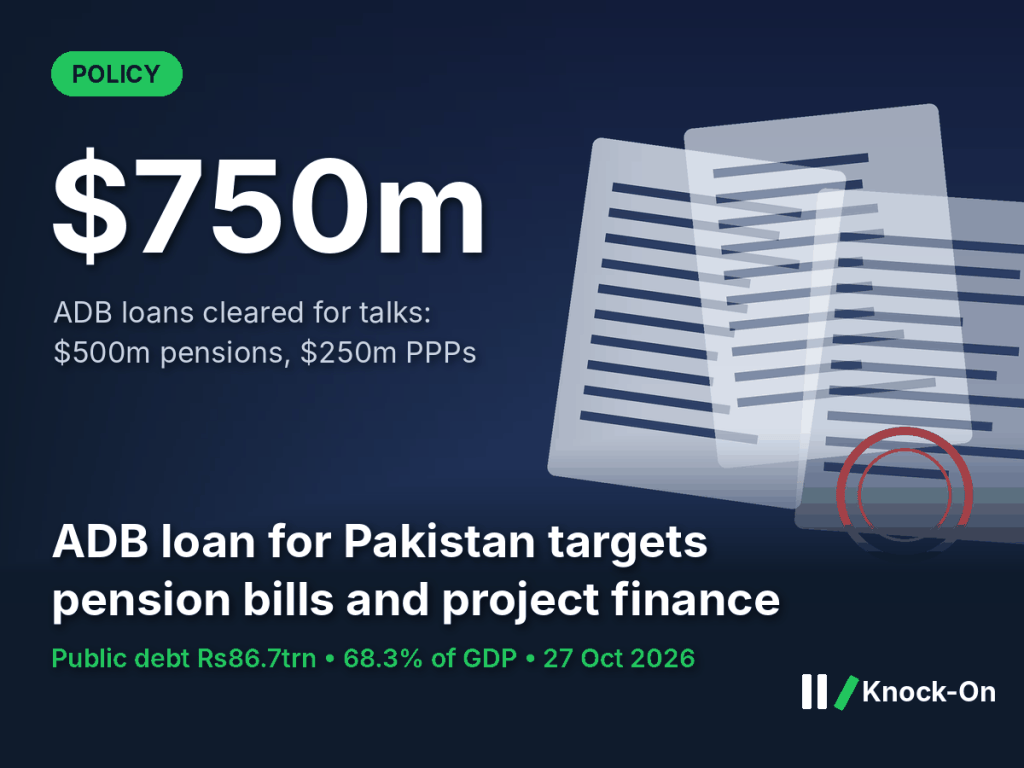
Pakistan has cleared the way to negotiate a $750 million ADB loan package, about Rs209 billion, to reform federal pensions and public-private partnerships (PPPs). The ADB loan for Pakistan was approved at concept stage by a Planning Commission committee chaired by Planning Minister Ahsan Iqbal, ProPakistani and Profit reported on 27 October. For business, the money matters less than what it is meant to fix: a pension bill that the Finance Ministry says is crowding out spending on infrastructure and other development.
The short version
- A concept clearance committee approved talks with the Asian Development Bank on two loans: $500 million for pension reform and $250 million for PPPs.
- Of the PPP loan, $200 million is on relatively expensive terms and only $50 million is concessional.
- The Planning Commission asked what earlier pension and PPP loans achieved before more money is borrowed.
- Public debt stood at Rs86.7 trillion, or 68.3% of GDP, in June 2026, according to State Bank figures cited in the reports.
What happened
The committee cleared proposals to negotiate the two ADB loans, according to officials familiar with the meeting quoted by ProPakistani. Procedural details will be settled once the committee issues formal minutes, and negotiations with the Manila-based lender are still under way.
The $500 million pension loan aims to improve the fiscal sustainability, governance and administration of the federal pension system, reduce existing pension liabilities and put a defined contribution pension scheme into operation. The $250 million PPP loan is meant to strengthen the legal and institutional framework for federal PPPs and improve public investment and financial management. Pakistan has already borrowed $250 million for similar PPP work, including amendments to the Public Private Partnership Act, 2017.
Two-thirds of the ADB package is for pensions; only $50m is concessional
Proposed ADB loans cleared for negotiation, US$ million, 27 Oct 2026
Why it matters
The Finance Ministry told the committee that rising pension spending and long-term liabilities are shrinking the fiscal space for health, education, infrastructure, climate resilience and social protection. Ahsan Iqbal asked that any savings from fiscal stabilisation be used to raise development (PSDP) spending to support growth and jobs, ProPakistani reported. That is the link to business: contractors, cement and steel makers depend on the PSDP, and a smaller pension burden is one way to protect it.
The cost of the money matters too. The Finance Ministry said about half of Pakistan’s ADB portfolio is already on relatively expensive terms and the available concessional funds are committed to other projects. This comes days after Pakistan turned down a $490m loan offer it judged too costly, and as the record $21.5bn forex reserves rest partly on foreign borrowing.
The knock-on effects
First order: the ADB loan adds to Pakistan’s debt stock
Every dollar borrowed adds to a public debt of Rs86.7 trillion. The Finance Ministry’s annual borrowing plan puts gross financing needs at more than 20% of GDP, so programme loans like this one help fill a large yearly gap.
Second order: pension rules for state employees
Putting a defined contribution scheme into operation would change how new federal employees save for retirement. Over time that could create a larger pool of long-term savings, which banks, mutual fund and pension fund managers would compete to manage.
Third order: the PPP pipeline
A clearer PPP framework is meant to bring private money into roads, power and urban projects. The Planning Commission’s request for an impact assessment of the earlier $250 million loan shows that results have yet to be proven.
Who could benefit
- Construction and materials firms if pension savings are used to raise PSDP spending, as the Planning Minister asked.
- Asset managers and pension fund operators if a defined contribution scheme starts running.
- Infrastructure investors if the PPP framework becomes faster and more predictable.
Who may face pressure
- The federal budget, which carries the interest cost of the $200 million in relatively expensive PPP financing.
- Other ADB-funded projects, since the Finance Ministry said a bigger concessional share here would take money from them.
- Future federal employees, whose retirement terms would change under a contributory scheme.
What to watch
- The committee’s formal minutes, which will set the procedural details.
- The Finance Ministry’s report on what earlier pension loans achieved.
- The final terms of the pension loan, which have not been reported.
- ADB board approval dates once negotiations finish.
Sources
- ProPakistani, Pakistan Borrows $750 Million Loan for Pension and PPP Reforms, 27 October 2026
- Profit by Pakistan Today, Govt seeks $750 million loan from ADB to cut pension liabilities, improve public-private partnerships, 27 October 2026
This is analysis, not investment advice. Figures are as of 27 October 2026.



Leave a Reply