
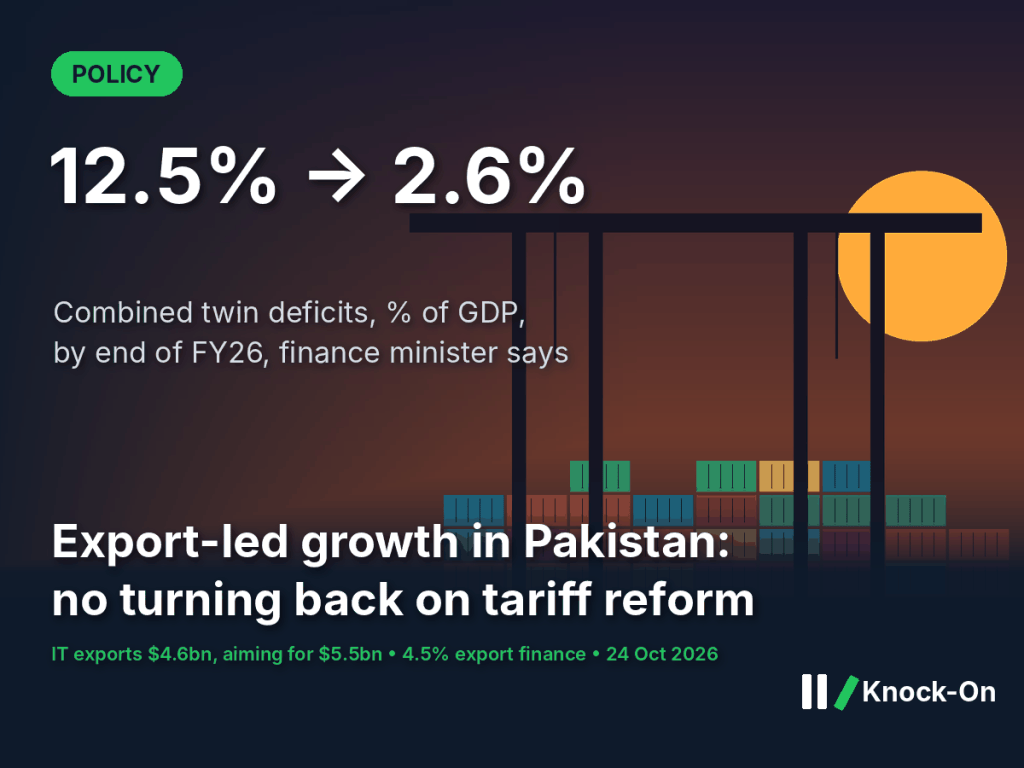
Export-led growth in Pakistan, not a consumption boom, is the only route the government will take, Finance Minister Muhammad Aurangzeb said in Lahore on Saturday. Speaking at LUMS, he said tariff reform will keep cutting the cost of imported raw materials and intermediate goods for exporters, and that domestic industries had been protected for too long without sunset clauses. “We are in year two of the tariff reform,” he said, Dawn reported, adding: “there is no turning back.” For businesses, the message is that cheap credit and import-fuelled demand are not coming back as a growth engine.
The short version
- Aurangzeb ruled out liquidity- and consumption-led growth and said tariff reform, now in its second year, will continue.
- He said combined twin deficits fell from 12.5% of GDP to 2.6% by the end of the last fiscal year.
- IT service exports have reached $4.6bn and are projected at $5.5bn this year; remittances are expected to reach $44bn.
- About $4bn of dividend and profit repatriation obligations is still outstanding, he said.
What happened
At an American Business Forum event on 24 October, Aurangzeb said the budget had pointed the economy towards export-led growth through the removal of super taxes, lower tax slabs and export financing at 4.5%. According to APP’s report carried by Business Recorder, he said excessive reliance on imports has repeatedly caused balance-of-payments crises, each followed by four to five years of recovery, and that supplying surplus electricity to industry at about Rs23 a unit had been discussed.
He set out the stabilisation record behind the strategy. The fiscal deficit reached a 22-year low with primary surpluses for three straight years, and the current account deficit narrowed to about 0.1% of GDP, Dawn reported. Foreign exchange reserves now cover more than three months of imports, against about two weeks at the low point. Pakistan has had three credit-rating upgrades since April last year, and the current IMF programme ends in October 2027.
The twin deficits are about a fifth of their earlier level
Combined fiscal and current account deficits, % of GDP, as cited by the finance minister on 24 Oct 2026
Why it matters
The choice of export-led growth in Pakistan decides who gets help and who does not. Exporters gain from cheaper inputs and concessional finance; companies that sell mainly at home behind high import duties lose some of that shelter as tariffs fall. The timing is sensitive. The State Bank’s Monetary Policy Committee meets on Monday with most analysts expecting a hike, as set out in our preview of the SBP interest rate decision, and oil above $110 is pushing up costs for every manufacturer. A minister ruling out a consumption push signals that growth support will come through exports, not demand stimulus.
IT exports are growing, but debt bills still dwarf them
US$ billions, as cited by the finance minister on 24 Oct 2026
The knock-on effects
First order: input costs fall for exporters
Lower duties on raw materials and intermediate goods reduce costs for textile, apparel, surgical and engineering exporters. Combined with 4.5% export finance, that improves margins at a time when freight and fuel costs are high.
Second order: protected industries face more competition
Domestic producers that relied on high tariffs, from parts of the auto sector to some chemicals and consumer goods, face more import competition. A separate panel is already seeking the Prime Minister’s guidance on the tariff structure of the proposed auto policy for 2025-30, Business Recorder reported, so the next fights over protection are likely to be sector by sector.
Third order: the test is whether exports can grow fast enough
Export-led growth only works if exports outpace imports for years. The official goal of $100bn of exports by 2035 needs roughly 14% annual growth, while the World Bank’s 3.8% growth forecast shows how slowly incomes are rising. The $4bn of outstanding profit repatriation obligations is another test of whether foreign investors trust the strategy.
Who could benefit
- Exporters: cheaper imported inputs and 4.5% export financing.
- IT and services firms: the sector the minister singled out, with exports projected at $5.5bn.
- Industrial power users: if surplus electricity is offered at about Rs23 a unit, as discussed.
Who may face pressure
- Import-substituting manufacturers that rely on high customs duties.
- Consumer-facing businesses hoping for a credit-fuelled demand recovery.
- Firms with floating-rate debt, if the SBP raises rates on Monday.
What to watch
- The SBP monetary policy decision on 26 October 2026.
- The next tranche of tariff cuts and any sunset clauses for protected sectors.
- The auto policy tariff structure awaiting the Prime Minister’s guidance.
- Monthly export and IT services data against the $5.5bn projection.
Sources
- Dawn, Aurangzeb rules out consumption-led growth, says tariff reforms will continue, 24 October 2026
- Business Recorder (APP), Govt focused on export-led sustainable growth, private sector facilitation: finance minister, 24 October 2026
- Business Recorder, Proposed AIDP 2025-30: Panel to seek PM’s guidance on tariff structure, 24 October 2026
- Dawn, Stakeholders see monetary tightening tomorrow, 25 October 2026
This is analysis, not investment advice. Figures are as of 25 October 2026.


Leave a Reply