
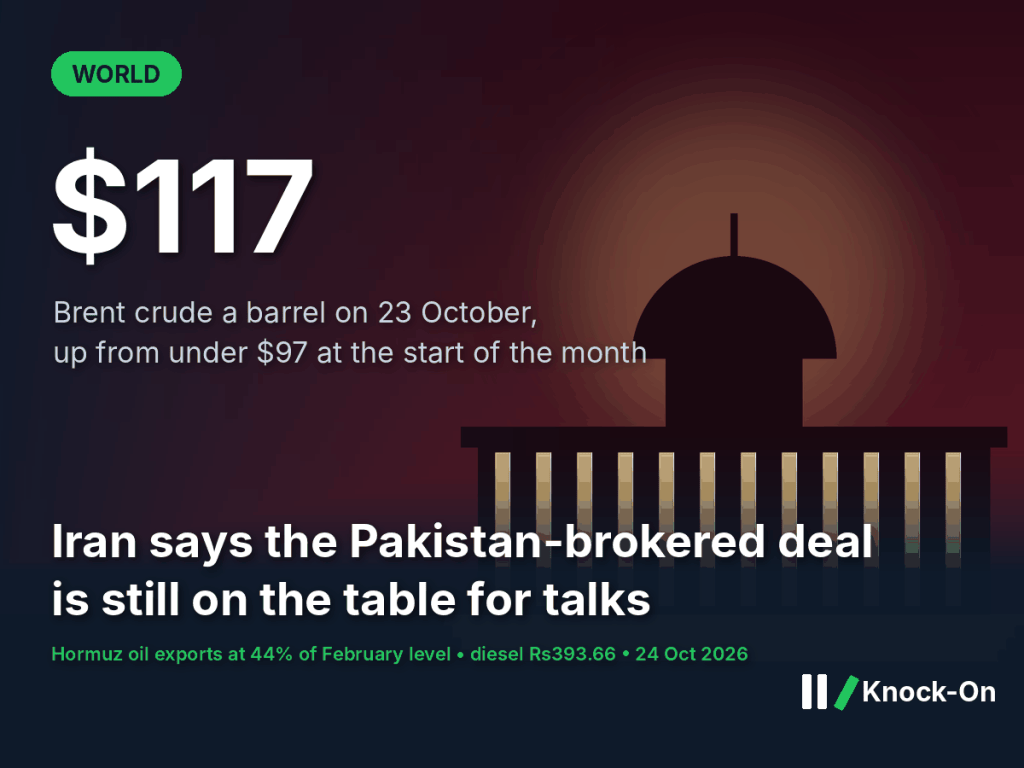
The Pakistan-brokered Iran deal is still the framework Tehran wants to use for talks with Washington, Iran’s ambassador in Islamabad said on Saturday. For Pakistani businesses, the question is not who is to blame for the stalled deal but whether it can reopen the Strait of Hormuz: Brent crude ended Friday above $117 a barrel, and diesel in Pakistan now costs Rs393.66 a litre.
The short version
- Iran’s ambassador to Pakistan, Reza Amiri Moghadam, said Tehran remains open to talks with the US under the interim deal that Pakistan and Qatar helped broker in June.
- He said Iran offered, through Pakistan, to reopen the Strait of Hormuz if the US lifted its naval blockade, and that President Donald Trump rejected it. Iran’s President Masoud Pezeshkian also blamed the US for the deal’s failure but said both sides should try again.
- Brent rose 3.5% to over $117 on Friday, up from under $97 at the start of October. Hormuz oil exports in September were about 44% of February’s level.
- Any revival of the deal would matter most to Pakistan’s fuel bill, freight costs and inflation outlook.
What happened
Speaking at a seminar in Islamabad on Saturday, Mr Moghadam said the June interim deal, which aimed to restore shipping through the Strait of Hormuz, lift the US naval blockade and start negotiations on Iran’s nuclear programme, remains the basis on which Iran is prepared to talk, the Associated Press reported. He accused Washington of undermining diplomacy and said Iranian officials had passed on their offer to reopen the strait during visits to Tehran by Pakistan’s army chief, Field Marshal Asim Munir. According to the ambassador, Mr Trump insisted that the blockade of Iranian ports would continue.
On the same day, Mr Pezeshkian said on state television that the US had caused the interim deal to collapse but that “I still think we should go and conclude it”, Reuters reported. In the US, Mr Trump told a rally in Florida that the US “may do another little Epic Fury”, the US military’s name for its operation against Iran, without giving details. He has said there would be no attack before the 3 November US midterm elections.
The ambassador also said Tehran would study the Mecca Joint Defense Agreement signed by Pakistan, Saudi Arabia and Turkey, and could support it “if it is good”. Pakistan’s Foreign Office has described the pact as a purely defensive arrangement, Business Recorder reported.
Brent crude has climbed about $20 a barrel this month
Brent crude price, US dollars per barrel, October 2026
Why it matters
Pakistan imports most of its fuel, so the price of crude flows quickly into pump prices, transport costs and inflation. The government raised the diesel price by Rs1.91 to Rs393.66 a litre for 24 to 26 October and kept petrol at Rs377.71, with OGRA citing global price movements, Business Recorder reported. Our earlier analysis of the Iran war impact on Pakistan and the IMF’s oil scenarios showed how much the outlook depends on oil. A working Pakistan-brokered Iran deal that reopened Hormuz is the clearest route to lower prices; a new round of strikes is the clearest route to higher ones.
Supply routes around the strait are under pressure too. Saudi Aramco has raised its East-West pipeline to about 7 million barrels a day to bypass Hormuz, Fortune reported, but the line has been attacked several times, and on Saturday Saudi forces said they intercepted Houthi missiles aimed at Yanbu, the Red Sea export hub at its end. Pakistan’s exposure to Saudi Arabia, both for oil and for remittances, is covered in our piece on the Saudi attacks impact on Pakistan.
The knock-on effects
First order: fuel prices follow crude
With Brent above $117, the next fortnightly fuel price reviews are likely to stay under upward pressure unless talks make progress. That is a forecast, not a certainty: the levy and the rupee also matter.
Second order: freight and food costs
Diesel drives trucking, tractors and generators. As set out in our analysis of the diesel price in Pakistan and freight costs, each increase feeds into the cost of moving goods and food.
Third order: interest rates and diplomacy
Higher oil makes it harder for the State Bank to ease rates. Pakistan’s role as a channel between Tehran and Washington also raises its diplomatic profile, which could matter for its financing partners in the Gulf.
Who could benefit
- Oil importers and transporters if talks revive and Hormuz shipping recovers.
- Exploration and production companies, whose revenue is linked to international oil prices, while prices stay high.
- Pakistan’s diplomatic standing, as both Iran and its Gulf neighbours deal with Islamabad.
Who may face pressure
- Truckers, farmers and factories that run on diesel.
- Airlines, shipping lines and importers paying higher fuel and insurance costs.
- Households facing higher transport and food prices.
What to watch
- 26 October: the State Bank’s monetary policy decision, with oil a key input.
- Late October: the next fuel price review after the current prices expire on 26 October.
- 3 November: the US midterm elections, before which Mr Trump has said there will be no attack.
- Next week: Mr Pezeshkian’s planned meeting with Russia’s President Vladimir Putin in Moscow.
Sources
- ABC News / Associated Press, Iran remains open to talks with US under Pakistan-brokered deal, envoy says, 24 October 2026
- Business Recorder / Reuters, Iran’s Pezeshkian blames US for interim deal failure, urges new try, 24 October 2026
- Business Recorder / Reuters, Donald Trump says US may do another military operation against Iran, 24 October 2026
- CBS News, Live Updates: Iran warns that U.S. military not allowed in Gulf, 23–24 October 2026
- Fortune, Aramco’s plan to supersize Hormuz bypass pipeline could take years, 23 October 2026
- Business Recorder / AFP, Saudi forces say intercepted two Houthi missiles targeting Yanbu, Taif, 24 October 2026
- Business Recorder, Govt raises diesel price by Rs1.91 per litre, keeps petrol unchanged, 23 October 2026
- Business Recorder, FO says Makkah pact purely defensive arrangement, 24 October 2026
This is analysis, not investment advice. Figures are as of 24 October 2026. Knock-On is not affiliated with any political party.

Leave a Reply