
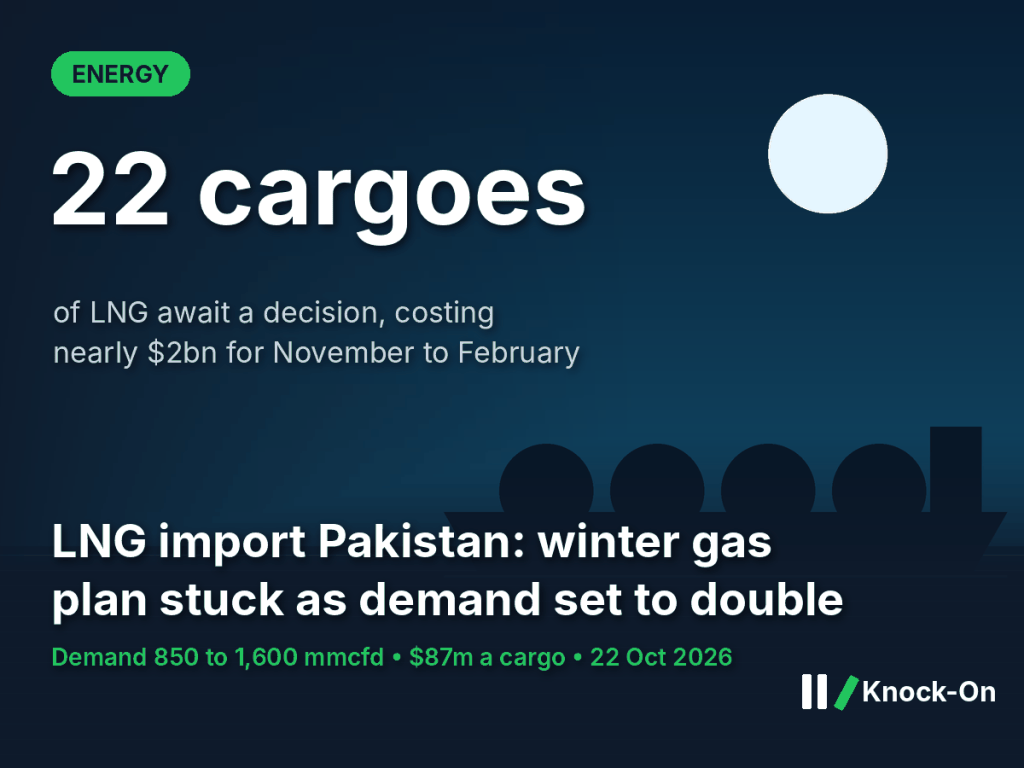
Pakistan’s LNG import plan for this winter is still waiting for a decision. A Petroleum Division summary asking to buy 22 cargoes of liquefied natural gas, at a cost of nearly $2bn for November to February, has not yet been taken up by the Cabinet Committee on Energy (CCOE), the Express Tribune reported on 22 October. The ministry wanted the first cargoes arranged in the first week of October. It now warns that further delay could mean cutting gas to industry, power plants, fertiliser factories, CNG stations and cement makers, so that rationed supplies to homes can continue.
The short version
- 22 LNG cargoes, averaging $87m each, are awaiting CCOE approval: 9 for power and 13 for homes.
- Winter gas demand is projected to almost double, from 850 to 1,600 million cubic feet a day (mmcfd).
- Deadlines for cargoes from Azerbaijan, PSO and a US-nominated supplier have passed; Qatar has extended force majeure until November.
- Households come first under the draft plan; industry, power and fertiliser get gas only when available, and CNG faces cuts in December and January.
What happened
The Petroleum Division sent its gas load management summary to the CCOE last month, after agreeing winter demand with the Task Force on Power Sector Reforms and the National Coordination and Management Council. It sought approval to begin buying 12 of the 22 cargoes from 7 to 10 October. Prime Minister Shehbaz Sharif has chaired several meetings on the exact quantity, but no formal decision has been taken, according to the report. Some officials favour only 15 cargoes; sources warned that would deepen shortages at the peak of winter.
The supply plan has also come apart. Pakistan hoped for at least 11 cargoes from Qatar under a long-term deal, but Doha has extended force majeure until November. Four cargoes from Azerbaijan through Pakistan LNG Limited had a 10 October deadline that lapsed; four via Pakistan State Oil and three from a US government-nominated firm were due to be arranged by 7 October and have not materialised. The original estimate was $1.5bn, including Qatari supply at about $12 per mmBtu. Spot purchases are now likely to be the main source, and a senior official said cost was a major reason for the delay.
Winter gas demand is set to almost double
Projected gas demand, million cubic feet a day (mmcfd), now vs winter 2026-27
Why it matters
Every month without an LNG import decision makes spot cargoes harder to secure before December and January, when demand peaks. At $87m a cargo, the full 22 would cost about $1.91bn; the smaller plan of 15 would cost about $1.31bn (Knock-On calculation). That saving matters to a country whose gross official reserves are just over $21bn after $3bn of Eurobond borrowing, as Knock-On reported on the reserves build-up. But the Petroleum Division argues the trade-off cuts the other way: by its estimate, importing LNG costs more foreign exchange for only one month compared with importing urea and paying subsidies if fertiliser plants shut.
The knock-on effects
First order: LNG import delays put industrial gas at risk
Under the draft priorities, homes get gas from 5am to 10pm at cooking-hour pressure, while industry, power and fertiliser are supplied on an as-and-when-available basis. In extreme cold, or if LNG or northern gas is unavailable, CNG, cement and industry would be cut to divert gas to households. Exporters running captive gas generation face the most direct risk.
Second order: fertiliser and food prices
At least two fertiliser plants on the SNGPL network face suspension. The food ministry says closing Fauji Fertiliser Bin Qasim, FatimaFert and Agritech could cut urea supply by 109,000 tonnes a month, just as farmers buy for the rabi wheat crop.
Third order: households turn to costly LPG
Gas shortages are already pushing homes and small businesses to LPG. In Hyderabad, retailers charge Rs550 to Rs580 a kilogram against an OGRA price of Rs279.34, the Express Tribune reported. Higher fuel costs feed into food and transport prices, and gas costs already weigh on a sector where circular debt reached Rs3.63trn by June.
Who could benefit
- Households: they are first in line for gas under the draft plan.
- Spot LNG sellers: a late, urgent buyer has less bargaining power.
- LPG producers and distributors: demand rises as piped gas falls short.
Who may face pressure
- Fertiliser makers on SNGPL: possible suspension of gas supply.
- CNG stations and cement plants: first to be cut in extreme conditions.
- Gas-reliant manufacturers and power producers: supply only when available, as set out in Pakistan’s winter gas load shedding plan.
What to watch
- The next CCOE meeting: whether it approves 22 cargoes or a smaller number.
- November: whether Qatar lifts force majeure when the current extension ends.
- Month-end: whether the deal with the US-nominated supplier is finalised.
- December and January: CNG curtailment and any cuts to industry and fertiliser plants.
Sources
- Express Tribune, Govt mulls $2b LNG import decision, 22 October 2026
- Express Tribune, LPG prices hit Rs580/kg amid gas shortages, 22 October 2026
This is analysis, not investment advice. Figures are as of 22 October 2026.


Leave a Reply