
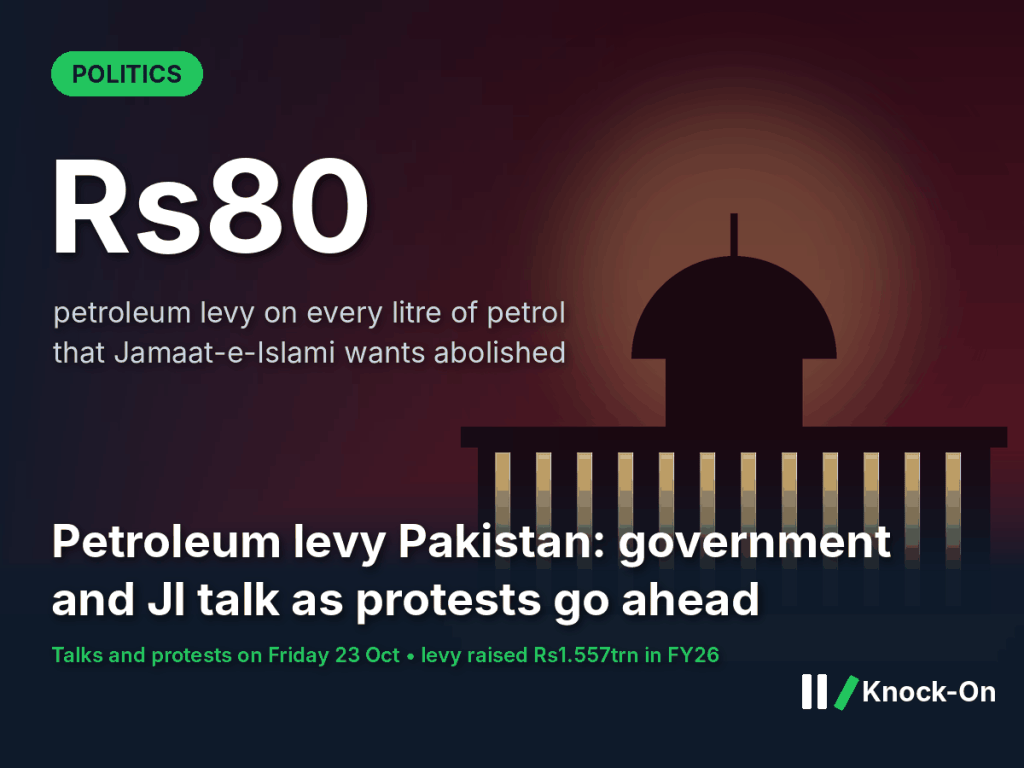
The petroleum levy in Pakistan, currently Rs80 on every litre of petrol, will be discussed again on Friday 23 October, when negotiating committees of the federal government and Jamaat-e-Islami (JI) meet in Islamabad, the Express Tribune reported. JI wants the levy abolished and has called nationwide protests for the same day. The government says it is trying to give consumers relief while working within the limits of its IMF programme. For businesses, the talks matter because the levy is the largest fixed part of the fuel price and one of the government’s biggest sources of revenue.
The short version
- Government and JI committees meet on 23 October; JI protests go ahead the same day.
- The petroleum levy is Rs80 a litre on petrol and diesel, plus a Rs5 climate support levy.
- The levy raised Rs1.557trn in 2025-26, above its Rs1.468trn target.
- A Planning Ministry proposal to cut it to Rs5-10 a litre would need about Rs1.5trn a year from other sources, and IMF approval.
What happened
JI Deputy Emir Liaquat Baloch said on Thursday that Friday’s meeting was arranged in a telephone call with Planning Minister Ahsan Iqbal. Prime Minister Shehbaz Sharif is also expected to meet JI Emir Hafiz Naeemur Rehman during the talks. “Negotiations and protests will continue side by side,” Baloch said, adding: “The people must receive relief and economic activity must continue.” JI says its protests will continue until the government agrees to withdraw the levy.
The dispute has run since 16 August, when JI began sit-ins in Karachi, Lahore, Peshawar and Quetta. It held a nationwide shutdown strike on 3 September and submitted six proposals at the first round of talks on 7 September. Later rounds did not produce an agreement: the government cited economic constraints and IMF commitments, while JI held to abolition. A JI long march that began on 20 September was suspended in Multan after the prime minister asked for time to hold talks.
Meanwhile the petrol price itself keeps moving daily. From 22 October petrol is Rs379.31 a litre, down Rs2.71, and diesel Rs390.11, up 31 paisas, ProPakistani reported. As Knock-On’s breakdown of the petrol price showed, levies make up about 22% of a litre.
Abolishing the levy would take up to Rs80 off a litre of petrol
Petrol price per litre at different petroleum levy levels, rupees, based on 22 October 2026 price
Why it matters
The petroleum levy is a fixed charge per litre, so it does not fall when oil prices fall. It has also risen this year: on 1 July it was Rs66.64 on petrol, reaching Rs80 by 11 July, and diesel reached Rs80 on 20 August, ProPakistani reported. The minister said then that any cut would depend on commitments to international lenders, fiscal space and oil markets. A Planning Ministry proposal circulated in September would bring the levy down to Rs5-10 a litre and replace about Rs1.45trn of revenue with roughly Rs1.5trn from higher duties on luxury imports, better enforcement, fewer exemptions and spending cuts. It notes that any cut needs IMF approval and that FBR taxes, unlike the levy, are shared with the provinces. The IMF is separately pressing Pakistan to trim Rs2.35trn of tax exemptions.
The knock-on effects
First order: protest days disrupt trade
JI’s earlier shutdown strike on 3 September showed the levy dispute can close markets for a day. Retailers, transporters and wholesale markets in the main cities face the most direct disruption from Friday’s protests.
Second order: a petroleum levy cut would lower costs but open a fiscal gap
Any cut would reduce fuel costs for fleets, farms and factories almost rupee for rupee. But the revenue would have to come from somewhere else, and the Planning Ministry’s own list points at importers of luxury goods and expensive vehicles, and at sectors that benefit from exemptions.
Third order: inflation and interest rates
Lower fuel prices would ease inflation, which analysts see near 10% ahead of the State Bank’s 26 October rate decision. A larger fiscal gap would push the other way. The planning proposal itself estimates that a 100 basis point rate cut could save Rs350-500bn a year in interest.
Who could benefit
- Transporters and logistics firms: fuel is their biggest variable cost.
- Farmers: diesel powers tractors, tubewells and haulage.
- Consumers: lower fuel costs would feed into transport fares and food prices.
Who may face pressure
- The federal budget: the levy is not shared with provinces, so replacing it is harder.
- Luxury importers and car buyers: higher duties are among the proposed replacement measures.
- City traders: sales lost on protest days.
What to watch
- 23 October: the government-JI meeting in Islamabad and nationwide protests.
- A meeting between the prime minister and the JI emir: expected during the talks, with no date given.
- 26 October: the SBP interest rate decision.
- IMF: any sign the Fund would accept a lower levy with replacement revenue.
Sources
- Express Tribune, Govt, JI negotiating committees to meet over petroleum levy tomorrow, 22 October 2026
- ProPakistani, Petrol Falls Below Rs. 380, 21 October 2026
- Business Recorder, Petrol price hiked by 88 paise, HSD’s by 53 paise, 21 October 2026
- ProPakistani, Government Plans Petroleum Levy Cut While Seeking Rs. 1.5 Trillion Elsewhere, 12 September 2026
- ProPakistani, Govt Aims to Collect Rs. 1.6 Trillion From Petroleum Levy in FY27, 22 August 2026
This is analysis, not investment advice. Figures are as of 22 October 2026. Knock-On is not affiliated with any political party.

Leave a Reply