
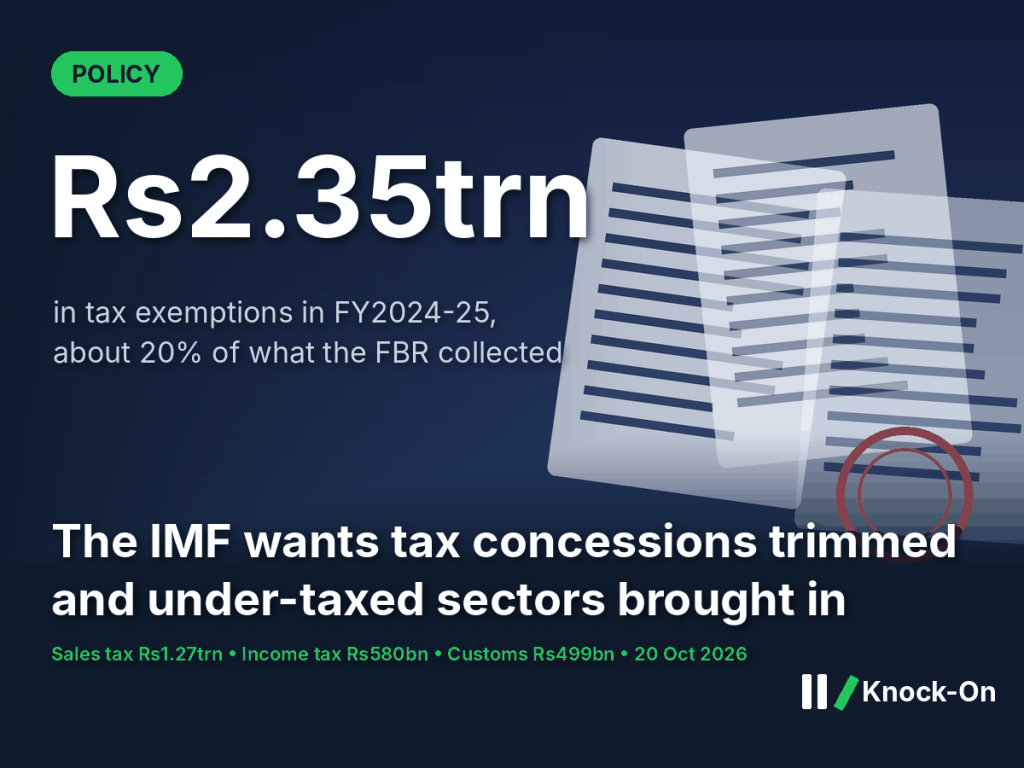
Tax exemptions in Pakistan are back at the top of the reform agenda. At a two-day workshop that opened in Islamabad on Tuesday 20 October, Jihad Azour, Director of the IMF’s Middle East and Central Asia Department, urged the government to rationalise tax concessions, bring under-taxed sectors into the net and strengthen revenue administration, Business Recorder reported. The bill for those concessions is large: the FBR’s own estimate puts tax exemptions and reduced rates at Rs2.35trn in FY2024-25, equal to 2.07% of GDP. For businesses, the question is which breaks go, and how fast.
The short version
- The IMF wants Pakistan to trim tax concessions, tax under-taxed sectors and improve tax administration.
- Tax exemptions in Pakistan cost Rs2,352.81bn in FY2024-25, about 20% of FBR collection, the FBR estimates.
- Sales tax concessions make up 54% of the total, worth Rs1,273.98bn.
- Finance Minister Muhammad Aurangzeb promised businesses fewer surprises from one budget to the next.
What happened
The Ministry of Finance and the IMF are jointly hosting the workshop, titled “Reforms for a Modern and Growth-Friendly Tax System in Pakistan”, on 20 and 21 October. Its six sessions cover taxation and growth, modernising the system, a unified sales tax across the federation and provinces, a simpler income tax, tax administration and digitalisation, and provincial revenues, according to ARY News and Business Recorder.
Azour said Pakistan had made “important progress” on stability, but warned that “many countries have strong reform ideas, but few translate them into durable results.” He said the next step was to turn stabilisation into stronger growth, while higher energy and food prices, trade disruption and tighter global financing raise the need to protect what has been gained. Arab News reported that he linked those risks to the conflict involving the US and Iran.
Aurangzeb said tax design should be “led by economic value considerations, not by making the math work.” He told the audience that “we cannot continue to give surprises to private-sector investment at every single budget.” He said the tax-to-GDP ratio has risen from 8.8% to 10.3%, with 0.9 percentage points coming from enforcement and 0.6 points from new policy measures, and that growth has recovered to about 3.65-3.7%, in line with the revised Pakistan GDP growth figure for last year.
More than half of Pakistan’s tax breaks are in sales tax
Tax expenditure by tax type, FY2024-25, Rs billion
Why it matters
Every rupee of tax exemptions in Pakistan is revenue that must be raised elsewhere, usually from the firms and salaried workers already paying. The FBR’s Tax Expenditure Report 2026 shows the total fell 3.4% from Rs2,434.73bn in FY2023-24, which the FBR puts down to a refined method, not fewer breaks. Customs concessions fell 23.5%, while income tax breaks rose 6.3% and sales tax breaks rose 3.0%. Narrowing these concessions is one of the few ways to raise revenue without lifting headline rates, which matters for an economy where SBP reserves have only just been rebuilt to $21.5bn.
The knock-on effects
First order: tax exemptions in Pakistan face review
Sectors that rely on exempt or reduced sales tax rates are the most exposed, because sales tax is the largest block of concessions. Any change would most likely come through the next budget or a mid-year measure agreed with the IMF; no specific cuts were announced on Tuesday.
Second order: a wider net, more enforcement
Bringing under-taxed sectors in means more registration, documentation and digital monitoring, building on steps such as the FBR’s production monitoring of industries. Undocumented competitors would lose a cost advantage over compliant firms.
Third order: predictability and investment
The minister’s pledge of fewer budget surprises, if kept, would help firms plan multi-year investment. The test is whether concessions are phased out on a published timetable rather than removed overnight. A unified sales tax across provinces, on the workshop agenda, could also cut compliance costs for firms selling nationwide.
Who could benefit
- Compliant taxpayers: a wider base could, over time, ease pressure for higher rates on those already paying.
- Documented businesses: fewer advantages for untaxed rivals.
- Firms operating across provinces: a single sales tax regime would simplify filing.
Who may face pressure
- Sectors on exempt or reduced sales tax rates: the largest share of concessions sits here.
- Under-taxed sectors: the IMF named none, but more of them are likely to be pulled into the net.
- Importers using customs concessions: Rs499bn of duty breaks remain in place.
What to watch
- The workshop’s closing panel on 21 October, which is due to set priority next steps.
- IMF Executive Board consideration of the staff-level agreement on the fourth review of the $7bn Extended Fund Facility.
- Any timetable for phasing out sales tax and customs concessions before the FY2027-28 budget.
Sources
- Business Recorder, IMF calls for Pakistan to rationalise tax concessions, bring under-taxed sectors into net, 20 Oct 2026
- Arab News Pakistan, IMF warns Pakistan of rising energy costs, trade disruptions amid Mideast tensions, 20 Oct 2026
- ARY News, Aurangzeb calls for taxpayer trust, policy stability to encourage private investment, 20 Oct 2026
- FBR, Tax Expenditure Report 2026, 2026
This is analysis, not investment advice. Figures are as of 20 Oct 2026.

Leave a Reply