
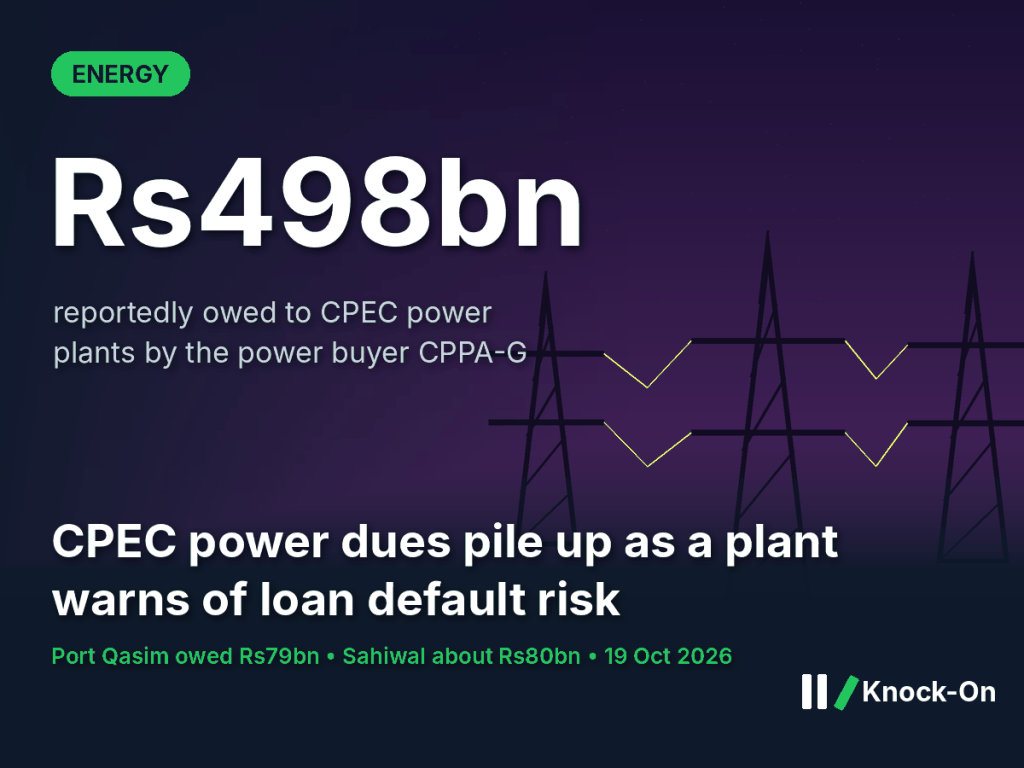
CPEC power dues have built up to about Rs498bn, Business Recorder reported on 19 October, citing sources. That is the amount Chinese-backed power plants built under the China-Pakistan Economic Corridor are said to be owed by the Central Power Purchasing Agency-Guarantee (CPPA-G), the state body that buys electricity on behalf of distribution companies. CPPA-G cannot clear the liabilities because of “financial constraints”, according to the report. One plant has now warned that the delays could push it into default on its loans, a risk that would reach the government through its sovereign guarantee.
The short version
- CPEC power projects are reportedly owed Rs498bn by CPPA-G.
- Port Qasim Electric Power Company says it is owed Rs79bn ($285.4m), with payments delayed for more than six months.
- The Sahiwal coal plant, owned by China Huaneng, is reportedly owed about Rs80bn.
- Port Qasim has asked four federal ministers to intervene.
What happened
In a letter dated 29 September 2026, Port Qasim Electric Power Company (PQEPC), which runs a 1,320MW coal plant near Karachi, put its receivables at Rs79bn, Business Recorder reported. Its chief executive, Wang Dongfeng, wrote to the ministers for finance, revenue, planning and power, warning that the delays could trigger defaults under its loan agreements and the government’s sovereign guarantee. The company’s Chinese and Qatari sponsors have reportedly expressed “significant discontent”. The 1,320MW Sahiwal coal plant is owed about Rs80bn, according to sources, and its owner China Huaneng has accused authorities of pressing it into a “give-and-take” arrangement over capacity payment deductions, a dispute said to have run for about four years. Together the two plants account for about a third of the CPEC power dues reported.
Two coal plants hold about a third of the CPEC backlog
Dues reportedly owed by CPPA-G to CPEC power projects, Rs billion, latest reported
Why it matters
Unpaid bills to power producers are part of the power sector’s circular debt, and they rarely stay inside the sector. When CPPA-G falls behind, plants struggle to pay for fuel and service debt, and the cost of fixing the backlog eventually lands on consumers through tariffs or on taxpayers through the budget. The timing is awkward: generation costs are already rising. Arif Habib Limited, using NEPRA data, estimates the average fuel cost of generation at Rs9.35 a unit in September, up 32% from Rs7.09 a year earlier, as cheaper hydro and RLNG gave way partly to imported coal and furnace oil. That is behind the Rs2.56 a unit fuel charge that distribution companies want on November bills. For Chinese lenders and sponsors, overdue CPEC power dues also bear on confidence in future projects.
The knock-on effects
First order: CPEC power dues strain plant finances
Plants owed tens of billions of rupees must fund coal imports and loan repayments without the cash they are owed. Port Qasim says this is now a default risk, not just a cash-flow problem.
Second order: the bill moves to the state or to consumers
Clearing Rs498bn needs money from somewhere: the budget, new borrowing or higher tariffs. That is the same pressure behind the push for DISCO privatisation to stop an Rs850bn yearly drain.
Third order: investor confidence in Pakistan’s power sector
Persistent arrears make foreign and local investors more cautious about new generation, transmission and privatisation deals, or push them to demand higher returns, which in turn raises long-term power costs.
Who could benefit
- CPEC plants and their lenders: if the government steps in with a payment plan, receivables would fall.
- Low-cost generators: a fuel-cost squeeze strengthens the case for running cheaper local-coal, nuclear and hydro capacity first.
Who may face pressure
- Industrial and commercial power users: any settlement funded through tariffs would raise their bills.
- The federal budget: paying down arrears competes with development spending.
- Coal-fired IPPs: delayed payments while fuel bills rise squeeze working capital.
What to watch
- The ministers’ response: whether finance and power officials agree a payment schedule with Port Qasim and Sahiwal.
- NEPRA’s ruling on the September fuel charge: the Rs2.56 a unit request for November bills.
- China Huaneng’s dispute: whether the Prime Minister’s Office intervenes on capacity payment deductions.
Sources
- Business Recorder, CPEC power projects await Rs498bn dues from CPPA-G, 19 October 2026
- Profit (Pakistan Today), Pakistan’s power generation rises 5% in September as fuel costs surge 32%, 19 October 2026
This is analysis, not investment advice. Figures are as of 19 October 2026.

Leave a Reply