
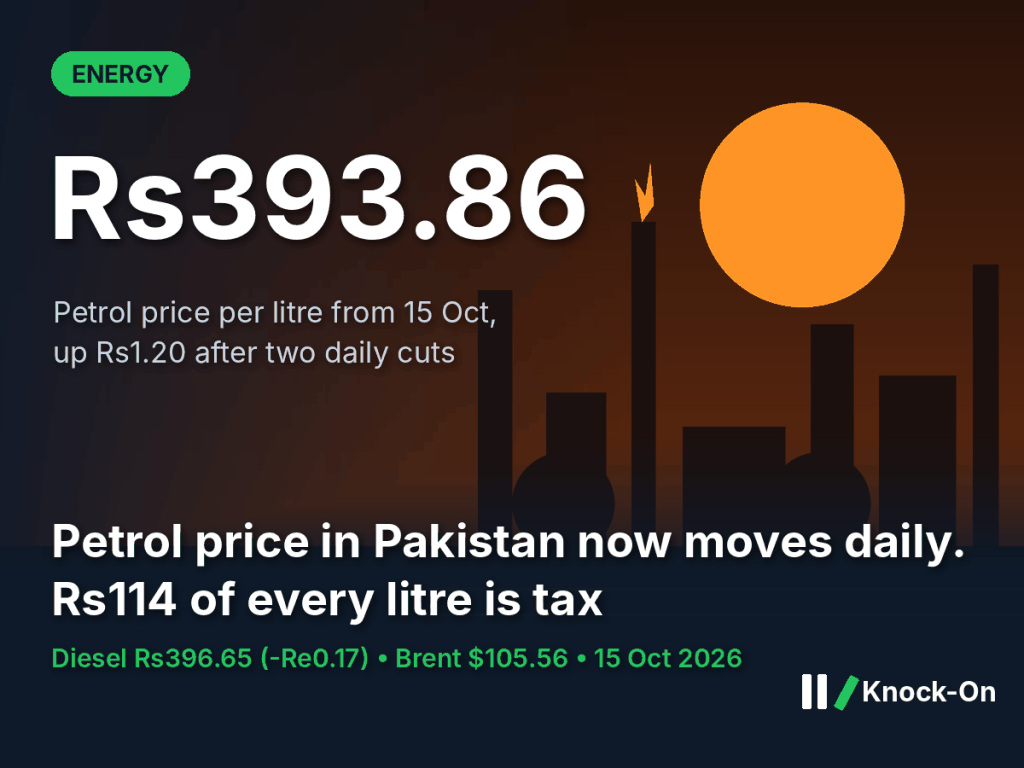
The petrol price in Pakistan rose by Rs1.20 to Rs393.86 a litre from Thursday 15 October, the Petroleum Division announced late on Wednesday, while high-speed diesel fell by Re0.17 to Rs396.65. The rise reverses part of two cuts earlier this week. Prices are now set every day, so for transporters, factories and shopkeepers fuel has become a cost that changes overnight rather than once a week.
The short version
- Petrol is Rs393.86 a litre and diesel Rs396.65 from 15 October, according to the Petroleum Division.
- Prices have been reset daily by OGRA since July, following global benchmark prices, premiums and incidentals.
- Taxes and duties of Rs114 a litre on petrol and Rs100 on diesel stay fixed, so they make up roughly a quarter or more of the pump price.
- Petrol is about 14% below its April peak but still about 48% above early March (Knock-On calculation).
What happened
According to Business Recorder and Dawn, the Oil and Gas Regulatory Authority (OGRA) revised ex-depot prices under the federal pricing mechanism, and the Petroleum Division cited “global developments, including movements in Platts rates, premiums and incidentals.” The petrol price in Pakistan had fallen by Rs2.93 to Rs395.37 on 13 October and by Rs2.71 to Rs392.66 on 14 October before Thursday’s rise.
Dawn reports that the cabinet handed OGRA the job of setting prices daily after Petroleum Minister Ali Pervaiz Malik announced the change on 17 July, following renewed hostilities between Iran and the US. Before that, prices had been revised weekly since early March. Petrol rose from Rs266 a litre in the first week of March to a peak of Rs458.41 on 3 April, while diesel peaked at Rs520.35 the same day.
Petrol is 14% below its April peak, but 48% above early March
Petrol price in Pakistan, rupees per litre, 2026
Global markets explain the latest move. Business Recorder, citing Reuters, reported Brent crude at $105.56 a barrel on Wednesday afternoon after an attack on Saudi Arabia’s state oil company headquarters and Iranian comments about targeting ships. That is the same Gulf risk that has pushed Pakistan to look at crude oil from Libya.
Why it matters
A Rs1.20 change is small on its own. What matters is the pattern: the petrol price in Pakistan can now move every night, in either direction, with the Gulf conflict. The government’s own share is the stable part. Rs114 of taxes and duties is about 29% of the petrol price and Rs100 is about 25% of the diesel price (Knock-On calculation), so any relief at the pump depends mostly on world oil prices rather than on Islamabad. On Wednesday, Finance Minister Muhammad Aurangzeb told the IMF’s Nigel Clarke in Bangkok about targeted fuel subsidies for vulnerable groups, according to the finance ministry, a sign that broad price cuts are not on the table.
The knock-on effects
First order: daily fuel budgets
Fleet operators, couriers and ride-hailing drivers now face a slightly different fuel bill each day. Diesel, which moves goods trucks and much farm machinery, eased marginally, so freight costs are broadly unchanged this week.
Second order: pricing and contracts
Businesses that quote fixed delivery or transport rates carry more risk when fuel can move overnight. More firms may add fuel-adjustment clauses or shorten quote periods. Higher fuel costs also feed the IMF’s 9.9% inflation forecast for Pakistan, which in turn keeps borrowing costs high.
Third order: demand for cars and bikes
Running costs shape what people buy. The government’s relief scheme, announced on 13 September, targets motorcycles, rickshaws and vehicles up to 800cc. Fuel costs are one more factor for an industry where car sales slowed in September.
Who could benefit
- Diesel users: goods transporters and farmers see a small, if marginal, saving this week.
- Small-vehicle owners: those covered by the targeted relief scheme are partly shielded from daily swings.
- Fuel-efficient options: smaller cars, motorcycles and electric two-wheelers gain appeal when fuel prices are volatile.
Who may face pressure
- Commuters and ride-hailing drivers: petrol users pay more from today.
- Fuel retailers: daily resets complicate stock valuation and margins at petrol pumps.
- Firms on fixed-price contracts: they absorb any fuel increase until contracts are repriced.
What to watch
- The next daily OGRA price notification, usually announced the evening before it takes effect.
- Brent crude and Gulf shipping risk after the Aramco headquarters attack and the sinking of a container ship near Hormuz.
- Any detail on the targeted fuel subsidies discussed with the IMF in Bangkok on 14 October.
- October inflation data from the Pakistan Bureau of Statistics in early November.
Sources
- Business Recorder, Govt raises petrol price by Rs1.20, cuts diesel by Re0.17 per litre, 14 Oct 2026
- Dawn, Govt raises petrol price by Rs1.20 per litre, reduces high-speed diesel rate by Re0.17, 14 Oct 2026
- Dawn, Govt reduces petrol price by Rs2.71 per litre, high-speed diesel rate by Re0.03, 13 Oct 2026
- Dawn, Petrol price down by Rs2.93 per litre, high-speed diesel rate up by Re0.61, 12 Oct 2026
- Dawn, Aurangzeb discusses targeted fuel subsidies in meeting with senior IMF official, 14 Oct 2026
This is analysis, not investment advice. Figures are as of 15 Oct 2026.




Leave a Reply