
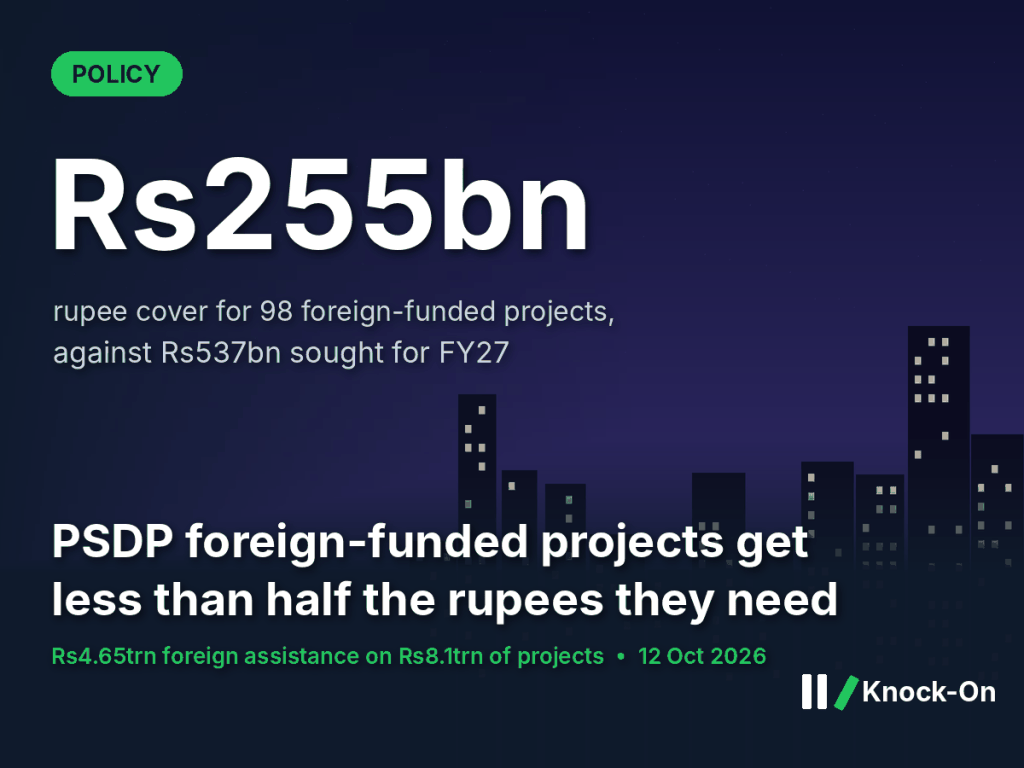
Pakistan’s PSDP foreign-funded projects will receive Rs255bn of local currency this year, less than half the Rs537bn the government’s own departments asked for. Planning officials told a Senate committee on Monday that the cut reflects a shortage of matching funds in rupees, while donor financing for flagship schemes such as the Sukkur-Hyderabad motorway is now in place. For contractors, cement and steel suppliers and the banks that lend to them, that local cash decides how fast work moves and how quickly bills are paid.
The short version
- 98 foreign-funded projects in the 2026-27 development budget (PSDP) have a total estimated cost of about Rs8.1trn, including Rs4.65trn of foreign assistance.
- Their rupee cover was set at Rs255bn, against Rs537bn demanded and Rs425bn proposed by the Economic Affairs Division.
- The overall PSDP is Rs1trn, against demand of Rs2.9trn.
- The Sukkur-Hyderabad (M6) motorway now has $705m of foreign financing, with contract awards expected in November and December.
What happened
Planning Secretary Dr Tahir Noor’s team briefed the Senate Standing Committee on Planning, Development and Special Initiatives, chaired by Senator Quratulain Marri, on 12 October. According to Dawn, the foreign-funded portfolio for the current fiscal year was cut from Rs537bn to Rs255bn because of a shortage of matching funds in local currency. The National Economic Council approved the Rs1trn PSDP on 10 June and allocated Rs255bn to these projects because of fiscal constraints.
Most foreign-funded projects need a government rupee contribution alongside the donor money, for land, local costs, taxes and counterpart staff. When that local share is short, the foreign money cannot be fully drawn. Committee members said domestic resources should take priority because dollar loans carry interest and repayment costs, and that foreign-funded projects need adequate rupee cover to avoid delays. Officials said most projects due for completion this year were expected to finish on time.
Foreign-funded projects got less than half the rupees sought
Rupee cover for 98 foreign-funded PSDP projects, 2026-27, Rs billion
Why it matters
The rupee cover for PSDP foreign-funded projects is 47.5% of what was sought (Knock-On calculation). Foreign assistance makes up about 57% of the portfolio’s total cost, so these projects carry much of the country’s large infrastructure pipeline. Slower local funding means slower construction, while, as committee members pointed out, the dollar loans behind these projects still carry interest and repayment obligations. Fiscal room is tight under the IMF programme, and the finance minister is relying on privatisation and other sources of financing, as covered in our look at Aurangzeb’s growth forecast.
The knock-on effects
First order: slower work and later payments
Contractors on donor-backed roads, power lines and water schemes may see work orders stretched and payments delayed when the local share runs short. Smaller subcontractors, who depend on prompt payment, are usually hit first.
Second order: softer demand for building materials
Public works are a major source of demand for cement, steel and bitumen. Cement makers are already passing on higher costs, as shown in our analysis of the cement price in Pakistan. A slower government programme removes one buffer against weak private construction.
Third order: more weight on private finance
The M6 shows the likely direction. Sections I and II are being processed as public-private partnerships, with the Asian Development Bank advising and a concession award targeted for February 2027. The Islamic Development Bank has committed $475m for sections IV and V and the OPEC Fund $230m for section III. More projects may move to this model, or to donor programmes that pay against results, such as the World Bank’s proposed KP loan.
Who could benefit
- Contractors bidding for M6 sections, with awards for three sections expected in November and December 2026.
- Firms on projects near completion, which officials expect to finish this year and the committee wants monitored closely.
- Infrastructure advisers and PPP sponsors, if more projects move to private financing.
Who may face pressure
- Contractors and subcontractors on slower-moving donor projects.
- Cement, steel and bitumen suppliers that rely on public works orders.
- Banks with working-capital exposure to government contractors.
What to watch
- October 2026: opening of bids for M6 section V.
- November-December 2026: contract awards for M6 sections III, IV and V.
- December 2026-January 2027: targeted completion of the M-1 project.
- Mid-year PSDP review: whether rupee cover for foreign-funded projects is raised or cut further.
Sources
- Dawn, Foreign-funded project portfolio halved, 13 October 2026
- PK Revenue, Senate panel questions reliance on foreign loans for development projects, 12 October 2026
This is analysis, not investment advice. Figures are as of 13 October 2026.





Leave a Reply