
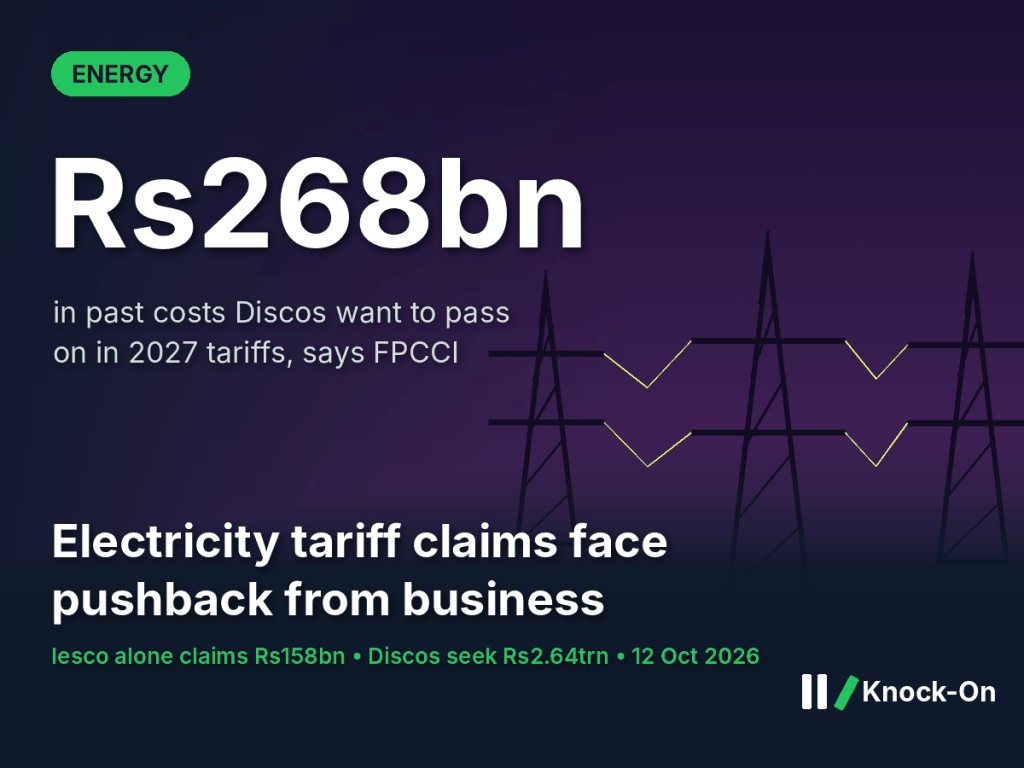
The next electricity tariff in Pakistan is being shaped now, and the country’s main business lobby says it is being loaded with costs that should never reach consumers. The Federation of Pakistan Chambers of Commerce and Industry (FPCCI) has asked the power regulator, NEPRA, to reject about Rs268bn in “prior-year adjustments” that the former Wapda distribution companies (Discos) want built into their 2027 tariffs, Dawn reported on Monday. For factories and households already struggling with power bills, the outcome will decide whether those bills carry a fresh layer of old costs.
The short version
- Ten Discos have asked NEPRA to set their 2027 tariffs, claiming a combined Rs2.64trn revenue requirement for distribution and supply.
- The FPCCI says about Rs268bn of that comes from prior-year adjustments that are old, disputed or were already disallowed.
- Islamabad’s Iesco has the largest claim, Rs158bn, which the FPCCI says is more than twice its annual distribution and supply margin.
- No hearing dates or per-unit impact have been published yet.
What happened
The ten Discos have filed petitions with the National Electric Power Regulatory Authority to index their multiyear tariffs for 2025-30 for calendar year 2027, along with other consumer-end adjustments. Prior-year adjustments, or PYAs, are meant to true up the gap between what a company was allowed to recover and what it actually spent. The FPCCI set up an Energy Advisory Committee to review the filings line by line, covering working capital, power purchase prices, PYAs and returns on the asset base.
Its conclusion, according to Dawn, is that many of the claims are retrospective, contested by third parties, previously disallowed by NEPRA, calculated inconsistently with the companies’ own formulas, or disclosed too thinly to verify. “These are not routine formula-based true-ups and ought not to be approved as such,” the FPCCI said. Examples it cited include 11-year-old post-retirement benefits at Faisalabad Electric, Rs33bn of seven-year-old input tax claims at Peshawar Electric, and Rs17bn at Gujranwala Electric linked to 19-year-old receivables from Azad Jammu and Kashmir.
Iesco’s claim dwarfs every other Disco’s
Prior-year adjustment claims in 2027 tariff petitions, Rs billion, as reported 12 October 2026
Why it matters
Any PYA that NEPRA accepts is recovered from consumers through the electricity tariff. The FPCCI’s figures show how large these claims are relative to the companies’ own earnings: Iesco’s PYA is over 212% of its distribution and supply margin, Sukkur’s 113% and Faisalabad’s 91%, with Multan at 68% and Quetta at 60%. Lahore Electric, which seeks the highest revenue requirement at Rs759bn, has a smaller PYA of about Rs33bn, but the FPCCI wants Rs27bn of it rejected as unverified.
The timing matters too. The government is trying to move large industrial users onto an open power market, where grid charges for factories that skip the auction are roughly three times higher. Old costs added to Disco tariffs would make the regulated grid even less attractive for the firms that stay on it.
The knock-on effects
First order: the size of the 2027 electricity tariff
NEPRA’s decisions on each petition will set how much of the Rs268bn reaches bills. The FPCCI has asked for lump-sum claims to be rejected outright and for every component to be justified in writing before hearings.
Second order: industrial costs and prices
Power is a major input for textiles, steel, cement and food processing. Higher tariffs feed into producer prices, which are already running ahead of consumer inflation.
Third order: the credibility of tariff-setting
Businesses want predictable power prices. If years-old costs keep resurfacing, firms are more likely to invest in captive solar or leave the grid where they can, shrinking the base that pays for the system. Tariff disputes are already reaching the courts, as in K-Electric’s challenge to its tariff cut.
Who could benefit
- Discos, if NEPRA accepts the claims, as long-standing receivables turn into cash.
- Rooftop and captive solar suppliers, as higher grid tariffs strengthen the case for self-generation.
- Consumers and industry, if NEPRA disallows a large share of the PYAs.
Who may face pressure
- Manufacturers on the grid, especially energy-intensive exporters competing on price.
- Households and small businesses in the Iesco, Sukkur and Faisalabad areas, where claims are largest relative to margins.
- The government, which must balance tariff relief against the circular debt.
What to watch
- NEPRA’s hearing schedule for the ten Disco petitions (dates not yet announced).
- Written responses from the Discos to the FPCCI’s objections.
- NEPRA’s decisions on how much of each PYA is allowed, and the resulting per-unit impact.
- The K-Electric court case, with a hearing due on 15 October.
Sources
- Dawn, Rs268bn power tariff burden on consumers opposed, 12 October 2026
- Bloom Pakistan, FPCCI Urges NEPRA to Reject Rs. 268 Billion Burden on Consumers, 12 October 2026
This is analysis, not investment advice. Figures are as of 12 October 2026.






Leave a Reply