
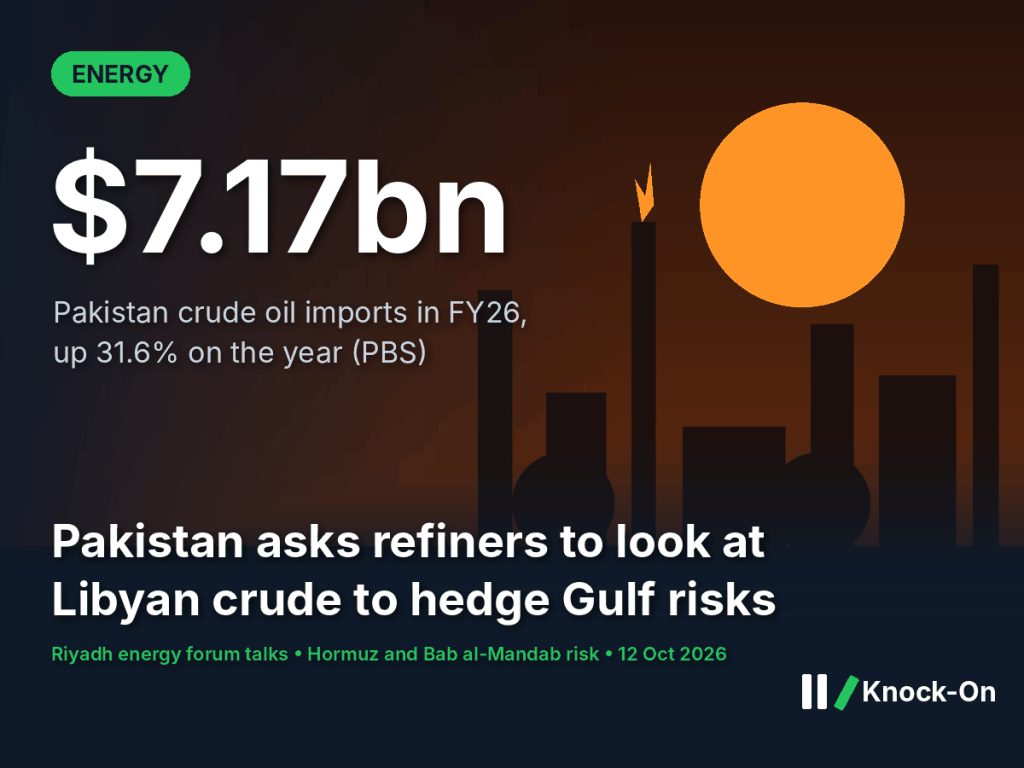
Pakistan crude oil imports could soon carry a new origin. Petroleum Minister Ali Pervaiz Malik said on Monday that the government has encouraged domestic refineries to explore buying Libyan crude, so that the country keeps supply options open if shipping through the Strait of Hormuz or the Bab al-Mandab Strait is disrupted. The remarks, made at an energy ministers’ meeting in Riyadh, matter because crude has become the single largest item in Pakistan’s fuel import bill.
The short version
- Pakistan has asked its refineries to explore Libyan crude imports, the petroleum minister said in Riyadh on 12 October 2026.
- Libya’s oil minister said he would encourage Libya’s national oil company to allocate more crude to Pakistani companies. No volumes or prices were announced.
- Crude oil imports rose 31.6% to $7.17bn in FY26, the largest part of a $16.86bn petroleum import bill, according to PBS data.
- The move is about supply security rather than cheaper fuel, at least for now.
What happened
Mr Malik was speaking on the sidelines of the 17th International Energy Forum Ministerial Meeting in Riyadh, which he attended at the invitation of Saudi Energy Minister Prince Abdulaziz bin Salman. According to Business Recorder and The Express Tribune, he met Libya’s Minister of Oil and Gas, Khalifa Rajab Abdulsadek, and told him Pakistan had encouraged its refineries to look at Libyan crude. Radio Pakistan reported that the two sides agreed to “facilitate crude oil imports” and to share expertise on upgrading refineries.
The minister also held a breakfast meeting with Qatar’s Energy Minister Saad Sherida Al-Kaabi on LNG cooperation, and Türkiye’s Energy Minister Alparslan Bayraktar said he plans to visit Pakistan next month to hand over a Turkish Petroleum (TPAO) seismic vessel that will begin collecting data in the Indus Basin. In his plenary speech, Mr Malik described an “unprecedented global energy supply shock of 2026” that reached shipping and insurance, and said Pakistan had avoided rationing major fuels with support from Saudi Arabia, Qatar and Kuwait.
The numbers explain the urgency. Pakistan crude oil imports were worth $7.17bn in the year to June 2026, up from $5.45bn a year earlier, according to Pakistan Bureau of Statistics figures reported by Profit. Over the same period, LNG imports fell 36.1% to $2.22bn.
Crude is now Pakistan’s biggest fuel import
Petroleum group imports by type, FY26 (July 2025 to June 2026), US$ billion
Why it matters
Pakistan has relied mainly on Gulf suppliers, especially the UAE and Saudi Arabia, for its crude, according to Arab News. The main exception so far has been a few US cargoes bought by Cnergyico, the country’s largest refiner, from late 2025. A second supplying region gives refiners a fallback if tankers cannot move through Hormuz, a risk that feels closer after the Houthi attacks on Saudi Arabia covered in our analysis of why the Saudi attacks are a business risk for Pakistan.
Libya does not remove all route risk. Cargoes from the Mediterranean normally reach the Arabian Sea through the Suez Canal and the Red Sea, which means passing Bab al-Mandab, unless ships take the far longer route around Africa. Libyan supply is therefore a better hedge against trouble in Hormuz than in the Red Sea. Security also has a price: in April, PSO told OGRA that premiums on its fuel product imports had reached about $34 a barrel over benchmark, against about $12 before, according to an Express Tribune report cited by Oilprice.com.
The knock-on effects
First order: refiners get an option, not an order
Refineries decide what they buy. They will compare Libyan grades with their current crude on price, freight and how well it suits their units. Trial cargoes would normally come before any regular flow, and no volumes have been announced.
Second order: freight and insurance become the swing cost
Longer voyages tie up tankers for longer and raise freight and insurance per barrel. If those costs outweigh any saving on premiums, the gain is resilience, not price. For transporters and fuel retailers, pump prices will keep tracking global benchmarks, as our look at daily petrol and diesel pricing in Pakistan shows.
Third order: a stronger hand with existing suppliers
A credible second source can strengthen Pakistan’s position in talks with existing suppliers on premiums and payment terms, and it fits the government’s stated push on strategic reserves, bonded storage and domestic exploration with Türkiye. Gas talks run in parallel; see our analysis of the Qatar LNG price review.
Who could benefit
- Flexible refiners that can process different crude grades and use the new option in price talks.
- Shipping, storage and tank-farm operators, given the minister’s emphasis on strategic and bonded reserves.
- Energy-intensive industry, which gains indirectly if supply disruptions and rationing are avoided.
Who may face pressure
- Refiners with less flexible units, if new grades need blending or upgrades.
- Fuel importers and the relief budget, if longer routes raise landed costs.
- Existing suppliers’ term pricing, which could face more competition over time.
What to watch
- Whether any Pakistani refinery confirms a Libyan trial cargo, and on what terms.
- PBS monthly trade data for September and October 2026 for any shift in crude import values.
- The Turkish seismic vessel’s arrival, expected in November 2026.
- Shipping conditions around Hormuz and Bab al-Mandab after the Houthi attacks on Saudi Arabia.
Sources
- Business Recorder, Pakistan seeks Libyan crude as it diversifies oil supplies amid Middle East supply disruptions, 12 Oct 2026
- The Express Tribune, Pakistan stands shoulder to shoulder with Saudi Arabia: petroleum minister, 12 Oct 2026
- Radio Pakistan, Pakistan, Libya agree to enhance bilateral energy ties, 12 Oct 2026
- Profit, Pakistan fuel imports jump 5.76% to $16.86B in FY26, 31 Jul 2026
- Arab News, Pakistan’s top refiner mulls more US crude oil imports as second shipment arrives, 10 Nov 2025
- Oilprice.com, Pakistan Is Now Paying a Record Premium for Fuel Imports, 21 Apr 2026
This is analysis, not investment advice. Figures are as of 12 October 2026.






Leave a Reply