
Petrol got 66 paisas cheaper on Friday, the first cut since September, according to ProPakistani. It is a rounding error against the bigger picture: since Pakistan moved to daily fuel pricing in July, petrol has risen by about Rs87.59 a litre and diesel by Rs72.94. For businesses that move goods or people, the question is no longer the price on any one day but how to plan around a cost that now changes almost every day.
Update, 14 Oct 2026, 9:05 am PKT: The petrol price in Pakistan is Rs392.66 a litre for Wednesday, 14 October, after a Rs2.71 cut, and high-speed diesel is three paisas cheaper at Rs396.82, Dawn reported. Petrol is still about Rs81.95 a litre (26%) above its pre-daily-pricing level of Rs310.71, and diesel about Rs73.52 above Rs323.30 (Knock-On calculation). At a meeting of the Senate Standing Committee on Petroleum on Monday, members questioned why prices had been cut by only a few paisas when consignments had arrived and stocks were sufficient, Business Recorder reported; OGRA and the Petroleum Division briefed the panel on the daily pricing mechanism. Fuel costs have not stopped vehicle demand recovering: Pakistan car sales rose 43% last quarter.
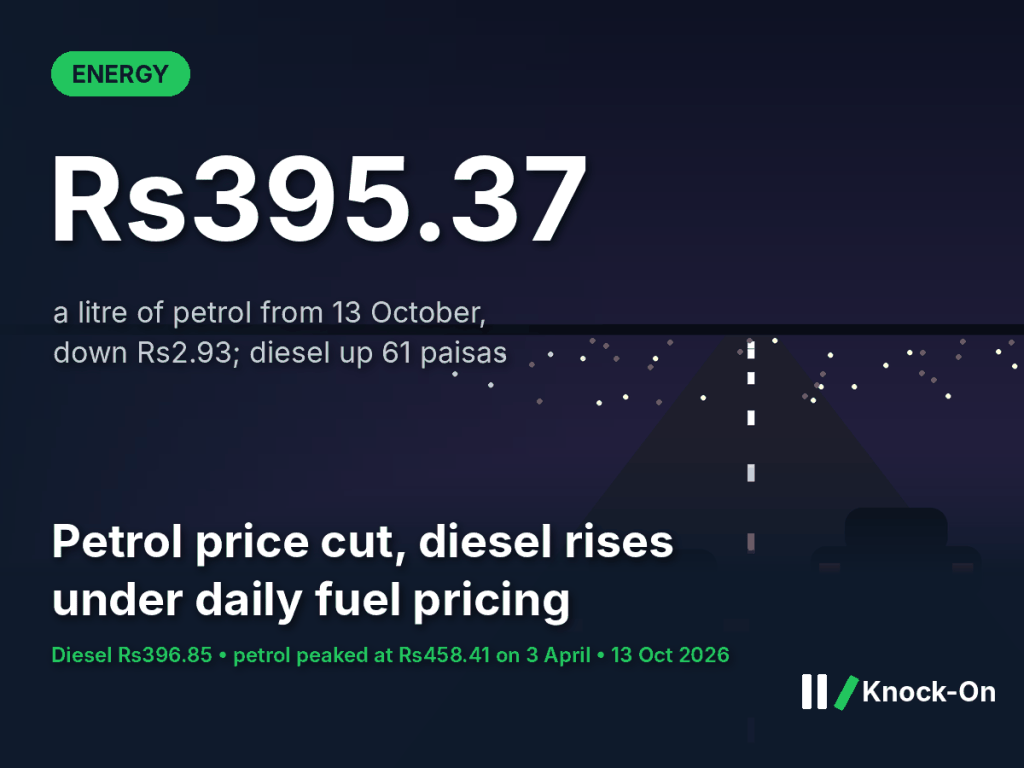
Update, 13 Oct 2026, 7:50 am PKT: The petrol price in Pakistan is Rs395.37 a litre from Tuesday, 13 October, after a Rs2.93 cut, while high-speed diesel rose 61 paisas to Rs396.85, according to the Petroleum Division notification reported by The Express Tribune and Dawn. Petrol is still about Rs84.66 a litre (27%) above its pre-daily-pricing level of Rs310.71, and diesel about Rs73.55 above Rs323.30 (Knock-On calculation). The Tribune counts 35 petrol price rises and 22 cuts since daily pricing took effect, and reports Brent at about $106.76 a barrel after attacks on Saudi Arabia. The government still collects Rs114 a litre in taxes and duties on petrol and Rs100 on diesel, Dawn reported.
The short version
- Petrol is Rs398.30 a litre and high-speed diesel Rs396.24 from 10 to 12 October, after a 66-paisa petrol cut and a 52-paisa diesel rise.
- Before daily pricing began in mid-July, petrol was Rs310.71 and diesel Rs323.30. That is a rise of about 28% and 23% respectively (Knock-On calculation).
- Diesel has eased from its 17 September peak of Rs424.92, but petrol is close to its highest level since the system began.
- Brent crude was still above $103 a barrel on Friday morning.
What happened
The Petroleum Division notified new prices on Friday, 9 October, for 10 to 12 October. Petrol fell by 66 paisas to Rs398.30 a litre and high-speed diesel rose by 52 paisas to Rs396.24, according to The Express Tribune. A day earlier, petrol had risen by Rs2.31 and diesel by 78 paisas.
Prices have been reviewed and notified daily since 17 July, replacing the old system of periodic revisions. When the change was announced, Petroleum Minister Ali Pervez Malik said OGRA would set prices using the average international oil price over the previous seven days, and that the aim was to make pricing clearer, ARY News reported. The government also cited volatility in global oil markets linked to US-Iran tensions.
Petrol has climbed steadily under daily pricing
Petrol price, rupees per litre, selected dates, July to October 2026
Why it matters
Fuel is a direct cost for transporters, logistics firms, farmers and any business that runs a fleet or generators. A rise of close to Rs88 a litre on petrol and Rs73 on diesel in under three months is large in itself. Daily pricing adds a second problem: businesses that quote fixed freight rates or delivery charges now carry the risk of prices moving between the quote and the trip.
Because Pakistan imports most of its petroleum, the domestic price tracks global oil and the shipping risks around the Gulf. Brent fell 0.5% to $103.76 a barrel early on Friday after US President Donald Trump described talks with Iran as “productive”, The Express Tribune reported. With a seven-day averaging formula, that kind of easing only reaches the pump gradually.
The knock-on effects
First order: freight and commuting costs
Goods transporters, ride-hailing drivers, courier firms and bus operators face higher running costs. Diesel’s partial retreat from its September peak offers some relief to trucking, but petrol-heavy urban delivery does not get the same benefit.
Second order: prices on the shelf
Transport costs feed into food and retail prices. This week’s data already showed wholesale inflation running ahead of consumer prices, and higher fuel costs make it harder for retailers to absorb increases. Supply risk is part of the picture too: the government is nudging refiners to consider Libyan crude to reduce reliance on Gulf routes.
Third order: spending power and policy
The government’s relief scheme offers Rs100 a litre off petrol for motorcycles, rickshaws and cars up to 800cc, covering about 11.8 million expected beneficiaries. That protects some low-income users, but the cost of a sustained subsidy falls on the budget, while businesses outside the scheme pay the full price.
Who could benefit
- Oil marketing companies with strong inventory and pricing systems, which can adjust daily.
- Electric and hybrid vehicle sellers, as running-cost comparisons shift in their favour.
- Logistics firms with fuel-indexed contracts, which can pass through costs.
Who may face pressure
- Small transporters and delivery businesses working on fixed rates.
- Farmers heading into the rabi sowing season, who rely on diesel for tractors and tubewells.
- Retailers and restaurants, already working under the government’s early closing times, as costs rise and customers cut back.
What to watch
- The next price notification, due after the current rates expire on 12 October.
- Brent crude and any progress in US-Iran talks, which will feed into the seven-day average.
- The future of the Rs100-a-litre relief scheme and its cost to the budget.
- October inflation data from the Pakistan Bureau of Statistics, due in early November.
Sources
- Dawn, Govt reduces petrol price by Rs2.71 per litre, high-speed diesel rate by Re0.03, 13 October 2026
- Business Recorder, Panel concerned over nominal petrol price cuts, 13 October 2026
- The Express Tribune, Govt cuts petrol by Rs2.93, increases diesel by 61 paisas for Oct 13, 12 October 2026
- Dawn, Petrol price down by Rs2.93 per litre, high-speed diesel rate up by Re0.61, 12 October 2026
- The Express Tribune, Govt cuts petrol by 66 paisas, increases diesel by 52 paisas till Oct 12, 9 October 2026
- ProPakistani, Petrol cheaper first time since September, 9 October 2026
- ARY News, Petrol, diesel prices to change daily as OGRA gets pricing authority, 17 July 2026
- Business Recorder, Govt further increases petrol price by Rs2.31, diesel by Re0.78 per litre, 8 October 2026
This is analysis, not investment advice. Figures are as of 10 October 2026.






Leave a Reply