
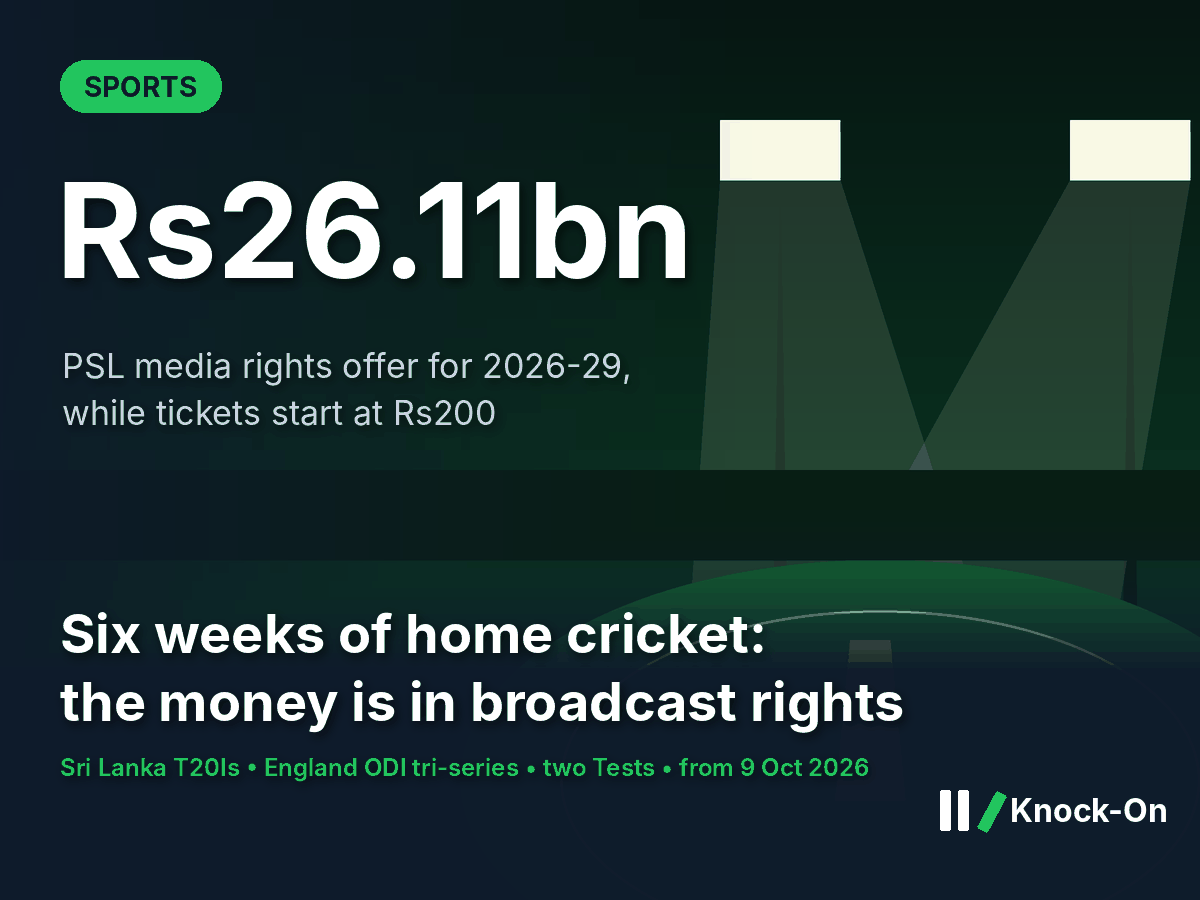
A busy stretch of home international cricket starts today in Rawalpindi. Over the next six weeks Sri Lanka and England will play 12 international matches in Rawalpindi and Lahore. For most fans it is a cricket story. For businesses, it is a test of how much a full home season is worth, and of whether the twin cities can host it while political tension builds on the roads around them.
Update, 12 Oct 2026, 9:25 pm PKT: Pakistan beat Sri Lanka by 82 runs in Rawalpindi on Sunday to take the T20I series 2-0 with a match to spare, and a reported 17,535 spectators attended, described as a record for the venue, according to Yahoo Sports. The crowd supports the case that fans will turn out, but even if every spectator had paid the top Rs1,000 VIP price, gate receipts would have been about Rs17.5m (Knock-On calculation), which underlines that broadcast and sponsorship carry the economics. The third T20I is on 13 October. The bigger logistics question for the twin cities is now security after emergency rule in Khyber Pakhtunkhwa.
The short version
- Sri Lanka play three T20Is in Rawalpindi on 9, 11 and 13 October.
- An ODI tri-series with England and Sri Lanka follows from 18 to 31 October: three matches in Rawalpindi, three in Lahore and a final at Gaddafi Stadium on 31 October.
- Sri Lanka then play two Tests, in Rawalpindi (9 to 13 November) and Lahore (17 to 21 November).
- Tickets for the T20Is cost Rs200 to Rs1,000. The real revenue sits in media rights and sponsorship.
What happened
Sri Lanka arrived in Pakistan on 4 October for a multi-format tour. The Pakistan Cricket Board opened ticket sales for the T20Is from 5 October through a private courier company acting as its ticketing partner. Tri-series tickets go on sale online from 10 October and at physical outlets from 14 October.
Lahore’s police chief has ordered what he called foolproof security for players, officials and spectators during the tri-series.
Why it matters
Gate money is small. General-enclosure seats for the first two T20Is cost Rs300 and VIP seats Rs1,000, and prices fall to Rs200 and Rs800 for the third match. Even full stadiums generate modest sums at those prices.
Even the best seat costs Rs1,000
Ticket prices, Pakistan v Sri Lanka T20Is, Rawalpindi, October 2026 (Rs)
The value of a home season lies elsewhere:
- Media rights. Broadcasters pay for live matches because they can sell advertising around them. The scale of that market is clear from the PSL. In February the PCB announced an offer of Rs26.11 billion from Walee Technologies for the league’s TV and streaming rights in Pakistan for 2026 to 2029, which it called the biggest broadcast deal in Pakistan cricket’s history.
- Sponsorship. Shirt, ground and title sponsors buy visibility with a large domestic audience.
- Reputation. Each completed tour strengthens the case that Pakistan is a safe and reliable host. That matters for future bilateral tours, ICC events and the PSL’s ability to attract overseas players.
The knock-on effects
First order: spending in Rawalpindi and Lahore
Visiting squads, officials, broadcast crews and travelling media fill hotels and use local transport, catering and security services for six weeks. Match days also bring trade to food vendors, transport operators and retailers near the stadiums.
Second order: advertising demand
Live cricket is one of the few events that reliably gathers a mass television and streaming audience in Pakistan. Brands in telecoms, banking, food and beverages, and fintech typically concentrate spending around such series, which supports broadcasters’ revenue.
Third order: a test for the twin cities
The T20Is and the first three tri-series matches are in Rawalpindi, next to Islamabad. The PTI’s long march is moving through Khyber Pakhtunkhwa, and authorities have blocked routes into the capital with containers. Any closure of roads around Rawalpindi on match days would affect spectators, teams and the businesses that depend on them.
Who could benefit
- The PCB, through media rights, sponsorship and a stronger record as a host.
- Broadcasters and streaming platforms, through advertising inventory.
- Hotels, transport and catering businesses in Rawalpindi and Lahore.
Who may face pressure
- Local businesses near the stadiums if security cordons or protest-related closures reduce footfall.
- Organisers if political disruption forces changes to logistics.
What to watch
- Crowd numbers at the Rawalpindi T20Is.
- Tri-series ticket sales from 10 October.
- Road access in the twin cities as the long march develops.
- Any announcement of future tours, which would show whether this season is building confidence.
Sources
- The Nation (APP), Pakistan to host England, Sri Lanka for ODI tri-series in October, 19 August 2026
- Pakistan Observer, Online sale of tickets for Pakistan-Sri Lanka T20Is starts, 6 October 2026
- Business Recorder, Security arrangements during tri-nation cricket series reviewed, 8 October 2026
- Pakistan Cricket Board, Biggest broadcast rights deal in the offing for HBL PSL 2026-29 cycle, 28 February 2026
- Yahoo Sports, Record attendance at Rawalpindi as Maaz Sadaqat’s 96, Imran Randhawa’s 3/11 headline Pakistan’s T20I series win vs. SL, 11 October 2026
This is analysis, not investment advice. Figures are as of 9 October 2026.
One response to “Six weeks of home cricket begin today. The money is in broadcast rights, not the gate.”
[…] and it is busy: Pakistan play the final T20I against Sri Lanka there tonight. As we noted when six weeks of home cricket began, the bigger money in the game is in broadcast rights, but a second venue in the capital would give […]