
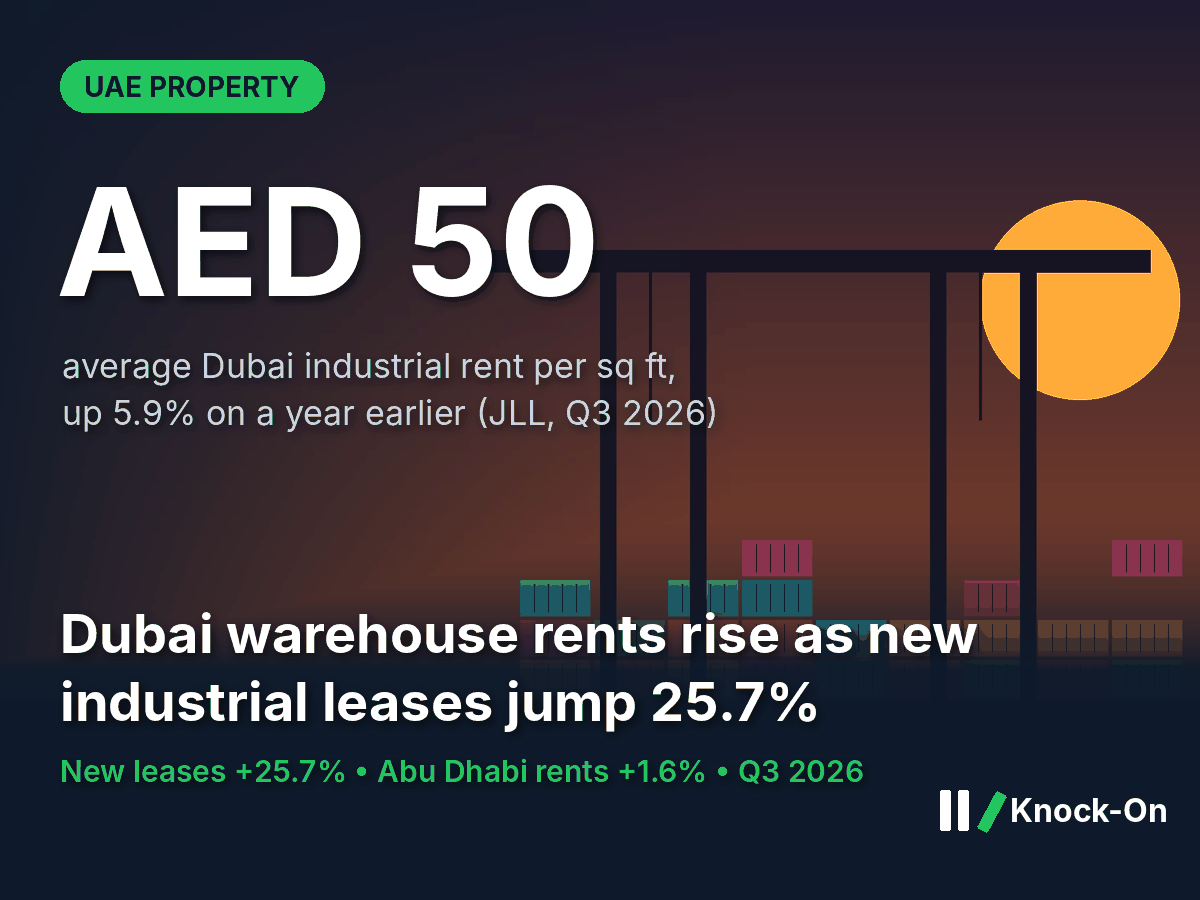
Dubai warehouse rents are rising again, and new space is getting harder to find. According to JLL’s third-quarter 2026 UAE property report, the average industrial rent in Dubai reached AED 50 per sq ft, up 5.9% on a year earlier, while new industrial lease contracts jumped 25.7%. For importers, retailers, e-commerce sellers and logistics firms that need storage in the UAE, the message is simple: plan for higher costs and longer searches, and lock in space early.
The short version
- JLL says Dubai’s average industrial rent reached AED 50 per sq ft in Q3 2026, up 5.9% year on year.
- New industrial lease contracts in Dubai rose 25.7% on a year earlier and 16.8% on the previous quarter.
- Abu Dhabi rents rose a slower 1.6% to AED 489 per sq m, held back by rules that limit rent increases.
- Prime industrial areas in both cities are close to full occupancy, so tenants have little choice of modern space.
What happened
JLL’s latest UAE real estate report, published this week and reported by Khaleej Times and Arabian Business, shows demand for warehouses running ahead of supply. In Dubai, new industrial lease contracts rose 25.7% year on year in the third quarter. Renewals rose 9.5% on a year earlier but fell 8.9% on the previous quarter, which suggests more occupiers were signing for new space rather than staying put.
The average Dubai industrial rent reached AED 50 per sq ft, up 5.9% on a year earlier and 1.8% on the second quarter. In Abu Dhabi, the average rent was AED 489 per sq m (about AED 45 per sq ft, Knock-On calculation), up 1.6% on the year and 0.6% on the quarter. The report says prime industrial locations in both emirates are approaching full occupancy.
Leasing demand in Dubai is growing four times faster than rents
Change on a year earlier, Q3 2026, %
Why it matters
Warehousing is a cost that runs through almost every business that sells physical goods in the UAE. JLL links the demand to e-commerce and logistics operators, new companies entering the market, and businesses reassessing their supply chains by holding larger stocks and favouring more reliable overland routes. Those trends need more space, while the supply of modern, well-located Grade A warehouses remains limited. JLL also warns that rising construction costs could delay new deliveries, which would keep Dubai warehouse rents firm for longer.
The pattern fits other recent data. UAE non-oil foreign trade grew 10.1% in the first nine months, and freight volumes helped lift Aramex’s third-quarter results. More goods moving through the country means more goods that need somewhere to sit.
The knock-on effects
First order: tenants pay more and choose less
Firms whose leases expire in 2027 face higher asking rents and fewer modern options. A business renting 20,000 sq ft at today’s Dubai average would pay about AED 1m a year, roughly AED 56,000 more than a year earlier (Knock-On calculation). Landlords of prime space have the upper hand in negotiating terms and lease length.
Second order: developers and free zones build
Tight occupancy encourages new projects. The report points to DP World’s Grade A logistics centre at Jebel Ali Free Zone, the Terralogix park in Warsan and multi-unit warehouses at Dubai Investments Park. In Abu Dhabi, KEZAD and JD.com are developing 150,000 sq m of automated warehousing, Axione is building a 37,000 sq m cold-chain hub at Abu Dhabi Food Hub, and KEZAD Logistics Park 7 adds 88,135 sq m.
Third order: rail changes where warehouses go
The AD Ports Group and Etihad Rail bonded corridor and the Hafeet Rail link to Sohar Port in Oman could pull some storage demand towards rail-connected sites. Along with the wider GCC railway project, that may ease pressure on Dubai’s established clusters over time, and lift values near rail terminals.
Who could benefit
- Industrial landlords and REITs with modern, well-located space, who can raise rents on renewal.
- Logistics park developers and free zones in Jebel Ali, Dubai Investments Park and KEZAD, where new space can be pre-leased.
- Contractors and warehouse automation suppliers, as owners build denser, automated sites.
- Third-party logistics firms that already hold space and can sell storage to smaller shippers.
Who may face pressure
- Small importers and online sellers renting short-term space, who are most exposed to higher rents.
- Retailers and distributors carrying more stock, which raises both storage and working capital costs.
- New market entrants who need Grade A space quickly and may have to accept older buildings or longer commitments.
What to watch
- Q4 2026 data: JLL’s next quarterly report, expected in early 2027, will show whether rent growth is speeding up.
- New deliveries: progress on the Jebel Ali, Warsan and KEZAD projects, and any delays from higher construction costs.
- Rail links: the start of operations on the Etihad Rail bonded corridor and the Hafeet Rail link.
- Lease renewals in 2027: how much of the rise reaches existing tenants as contracts roll over. See more in our UAE property coverage.
Sources
- Khaleej Times, UAE warehouses near full occupancy despite 5.9% rise in Dubai rents, 11 November 2026
- Arabian Business, Dubai warehouse rents rise as industrial leasing jumps 25.7% amid supply squeeze, 12 November 2026
- Emirates 24|7, UAE warehouse demand surges: New industrial leases in Dubai up 25.7% as occupancy nears full, says JLL, 12 November 2026
This is analysis, not investment advice. Figures are as of 12 November 2026.

Leave a Reply