
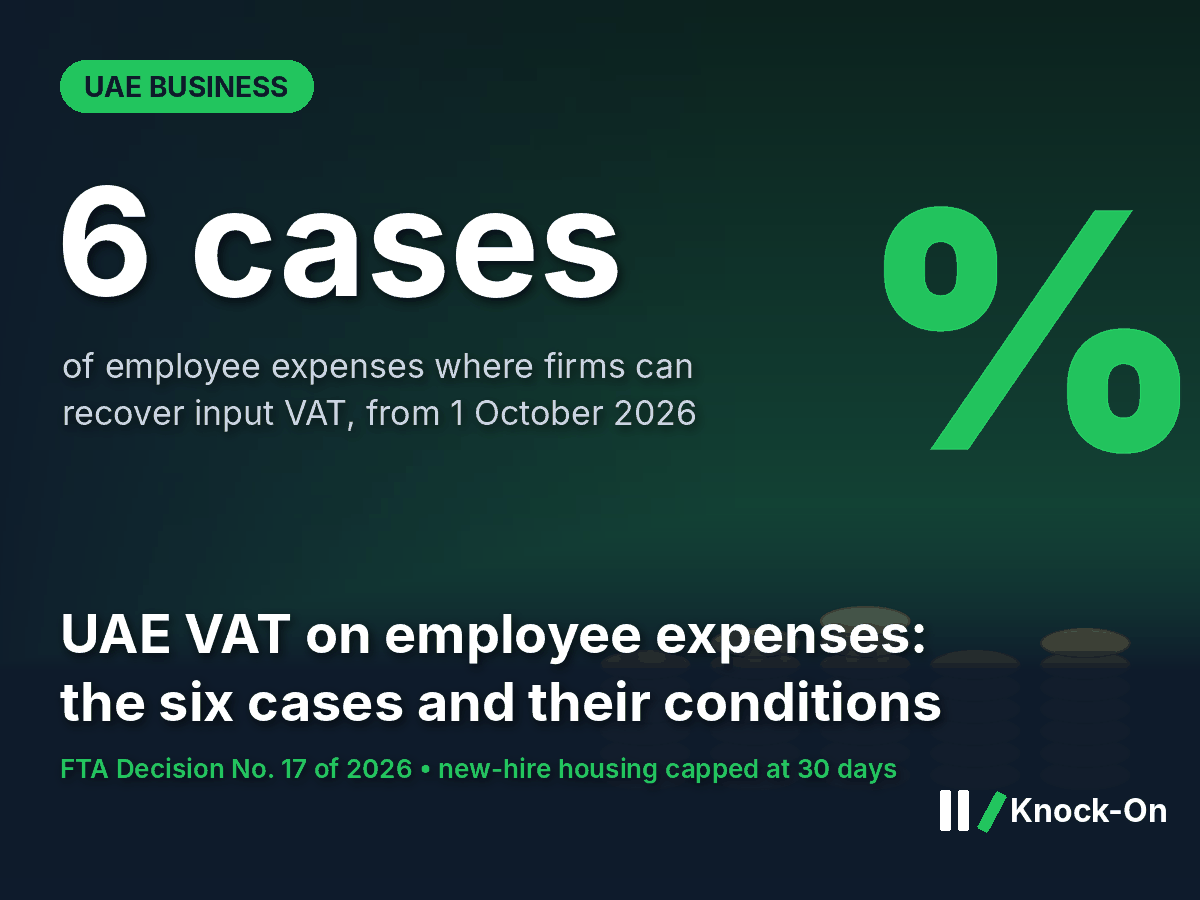
UAE VAT on employee expenses now follows a much narrower rulebook. Under FTA Decision No. 17 of 2026, in force since 1 October, VAT-registered companies can recover input tax on free benefits given to staff in six defined cases only: transport, meals, work-required accommodation, temporary housing for new hires, phones and internet, and parking. Each case has its own conditions, and all of them must be met. For finance and HR teams in the UAE, a staff policy that simply promises a benefit is no longer enough to claim the VAT back.
The short version
- The Federal Tax Authority (FTA) issued Decision No. 17 of 2026 on 9 September; it applies from 1 October 2026.
- Input VAT on free employee benefits is recoverable in six cases, each with conditions that must all be met.
- Offering staff cash instead of transport, meals or accommodation blocks recovery for those benefits, according to tax advisers.
- Temporary housing for new hires qualifies for up to 30 days; phones and parking need written policies and records.
What happened
The FTA’s legislation page lists “FTA Decision No 17 of 2026 on Cases and Conditions for Input Tax Recovery on Employee Expenses”, issued on 9 September and published on 28 September. Emirates 24|7 reported on 8 November that the six categories are transport, meals, work-related accommodation, temporary housing, telecoms and parking. KPMG says the decision applies under Article 53(1)(c)(2) of the VAT Executive Regulation from 1 October 2026, and that a contractual obligation or documented policy alone no longer establishes the right to recover.
According to summaries by advisers NR Doshi & Partners and Naqood, the conditions are:
- Transport: home-to-work travel, trips to clients or other job-related journeys, with no personal benefit and no cash alternative.
- Meals: only where staff live or work in a remote or isolated area with no suitable food options nearby.
- Work-required accommodation: where the job requires living near the site, for the employee only, basic in standard and with no cash alternative.
- New-hire housing: temporary accommodation for up to 30 days.
- Phones, data and home internet: needed for the job, with only incidental personal use, a written policy and reasonable monitoring.
- Parking: solely for business, under a written reimbursement policy, with receipts showing date, time, amount and tax paid.
New-hire housing qualifies only up to day 30
Days of temporary accommodation for a new employee, illustrative stays against the limit, from 1 October 2026
Why it matters
Staff benefits are a large cost for many UAE employers, especially in construction, hospitality, logistics and sales. Where a benefit falls outside the six cases, or a condition is missed, the VAT paid on it becomes a cost the business cannot reclaim. KPMG also notes that where staff pay part of the cost through a salary deduction, that is treated as a taxable supply and falls outside the decision. The change lands while finance teams are already preparing for e-invoicing, after UAE e-invoicing penalties were capped at AED 50,000 a year.
The knock-on effects
First order: policies and contracts get rewritten
Employers that offer staff a choice between a benefit and a cash allowance will need to decide which matters more: flexibility for staff or VAT recovery. Phone, internet and parking policies need to be written down, approved and applied in practice.
Second order: more record-keeping
Monitoring phone use, keeping parking receipts and tracking new-hire hotel stays by day adds work for HR and accounts teams, and demand for expense-management software and tax advisers.
Third order: higher net cost of some benefits
Benefits that no longer qualify, such as meals in city offices, now carry VAT the company cannot recover. Some employers may reprice or redesign packages, which matters for recruitment in a tight market where business costs are already rising.
Who could benefit
- Tax advisers and accountants, from policy reviews and clarification requests.
- Expense and fleet software providers, as firms need cleaner records.
- Employers with remote sites, whose meals and housing fit the defined cases.
Who may face pressure
- Companies paying cash allowances in place of transport, meals or housing.
- Firms with long relocation stays for new hires beyond 30 days.
- Small businesses without written staff policies.
What to watch
- 30 November 2026: VAT return deadline shown on the FTA website, which for many businesses covers the first period under the new rules.
- Coming months: any FTA guidance defining terms such as “remote” areas or “reasonable monitoring”.
- 1 January 2027: employers rethinking driver transport and shifts under the UAE nine-hour driving limit.
Sources
- Federal Tax Authority, Legislation: FTA Decision No 17 of 2026 on Cases and Conditions for Input Tax Recovery on Employee Expenses, published 28 September 2026
- Emirates 24|7, UAE companies can recover VAT on six employee expense categories under new FTA rules, 8 November 2026
- KPMG, Conditions for input VAT recovery on employee expenses, 2026
- NR Doshi & Partners, FTA Decision No. 17 of 2026: When Can You Recover Input VAT on Employee Expenses?, 28 September 2026
- Naqood, FTA Decision 17 of 2026: Input VAT on Employee Expenses from 1 Oct, 28 September 2026
This is analysis, not tax or investment advice. The official Arabic text of the decision governs; businesses should check it with their tax adviser. Figures are as of 10 November 2026.
Leave a Reply