
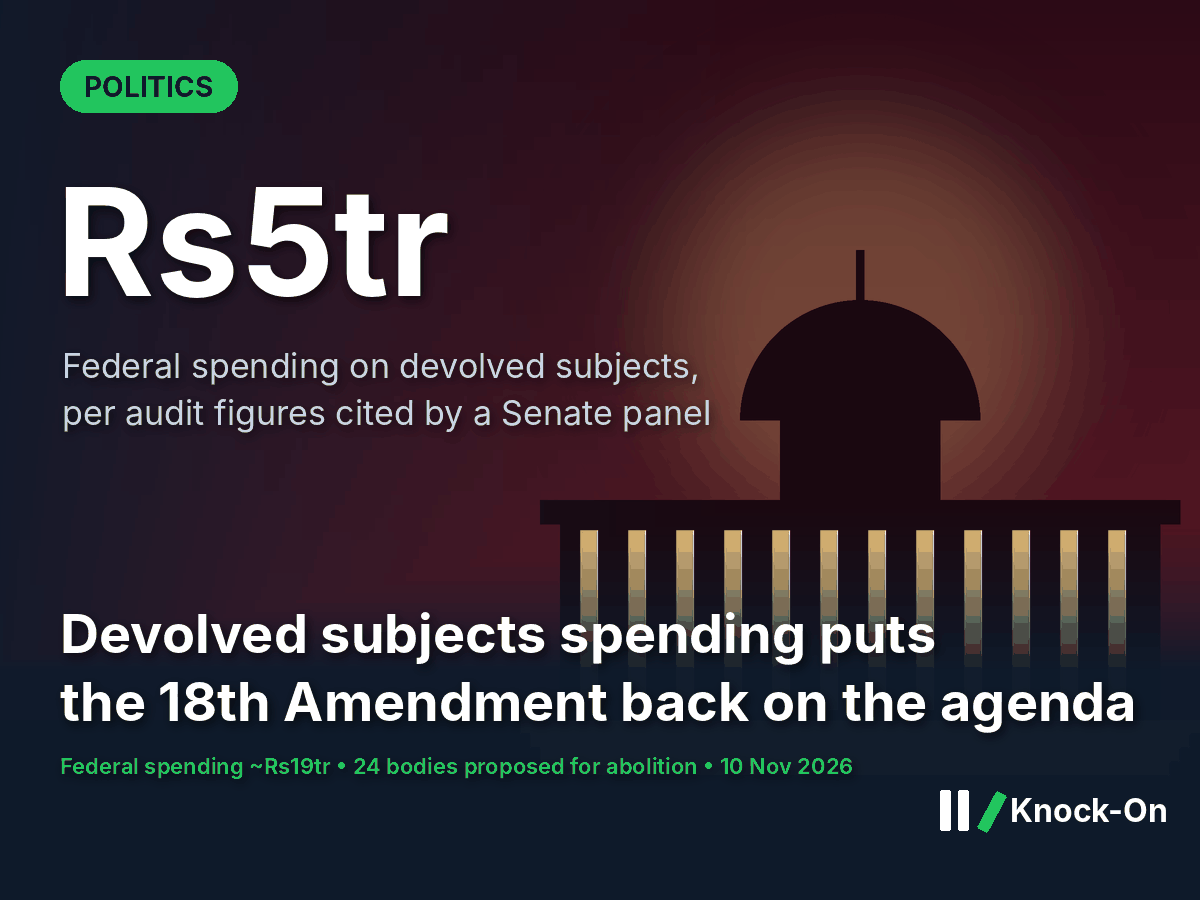
Devolved subjects spending by the federal government has exceeded Rs5 trillion, more than $18 billion, according to Senator Barrister Zamir Hussain Ghumro of the PPP, who chairs a sub-committee of the Senate Functional Committee on Devolution. He cited the Auditor General of Pakistan’s report and told the panel on Monday that the spending, on subjects handed to the provinces under the 18th Amendment, breached the Constitution, Dawn reported. For businesses, the dispute matters because it goes to the heart of how Pakistan’s Rs19 trillion federal budget is split, and where cuts or new taxes could come from.
The short version
- A Senate sub-committee chair says the Centre spent more than Rs5tr on devolved and CCI-related subjects, citing the Auditor General.
- He set that against federal spending of about Rs19tr and total revenue of Rs20tr.
- Summaries to abolish 24 ministries and institutions have gone to the Prime Minister, who has not responded, the senator said.
- The panel also flagged federal job-quota shortfalls of more than 30,000 for Balochistan and 80,000 for Sindh.
What happened
At Monday’s meeting in Islamabad, Senator Ghumro said that, according to the Auditor General’s report, more than Rs5tr had been spent on provincial subjects and ministries that fall under the Council of Common Interests (CCI). He said the Cabinet Division and the CCI had sent summaries to the Prime Minister to abolish 24 ministries and institutions, but no response had come. He directed that a fresh note be sent to the Prime Minister, citing Article 154 of the Constitution read with Article 97. Dawn’s report did not carry a response from the federal government.
Ghumro also said that if the 18th Amendment had been implemented in full, Pakistan would not need IMF support. He said the IMF had lent Pakistan $15bn over 15 years, while the government had spent $18bn to $20bn on devolved ministries and institutions. These are his figures; Dawn did not give a year-by-year breakdown of the Rs5tr.
The disputed Rs5tr is about a quarter of yearly federal spending
Figures cited at the Senate devolution sub-committee, Rs trillion, 10 November 2026
Why it matters
The argument over devolved subjects spending is really an argument about who pays for what. If the Centre keeps funding health, education and other provincial areas while handing most divisible taxes to provinces under the NFC award, it has to borrow more or squeeze taxpayers it can reach, such as salaried workers and documented companies. If it stops, provinces may be asked to fund those services from their own budgets. Either way, the outcome feeds into the next budget, the IMF programme’s fiscal targets, and the wider debate on reshaping federal-provincial roles, including the proposal for 12 provinces and a referendum.
The knock-on effects
First order: pressure to rightsize federal ministries
The panel’s push adds to existing plans to close or merge federal bodies. Contractors, suppliers and staff linked to the 24 named ministries and institutions face uncertainty until the Prime Minister decides.
Second order: a sharper NFC debate
Claims that the Centre is paying for subjects the Constitution assigns to provinces bear directly on how revenue is shared under the NFC award. If the dispute feeds into talks on that formula, provincial development budgets, which drive construction and services demand, could change in either direction.
Third order: tax and borrowing choices
Any saving would ease the Centre’s need to borrow and raise taxes, alongside the asset sales set out in Knock-On’s look at Pakistan’s privatisation target. Without it, the burden stays on existing taxpayers.
Who could benefit
- Federal taxpayers: lower duplicate spending could reduce pressure for new federal taxes.
- Provincial service providers: clearer provincial ownership of health and education could mean steadier budgets.
- Job seekers in Sindh and Balochistan: if federal quota shortfalls are filled as the panel demands.
Who may face pressure
- Federal ministries and their contractors: abolition or merger would cut programmes and contracts.
- Provincial finance departments: they may have to pick up costs the Centre now carries.
- Firms in former Fata and Pata: the same Senate panel is probing a Rs730.80bn gap between duty-free imports and consumption certificates for those areas.
What to watch
- The Prime Minister’s response to the summaries on abolishing 24 ministries and institutions.
- 16 November: the panel’s next, in-camera meeting.
- Late November: the FPSC and federal government’s grade-wise job data, due within the 15 days the panel set.
- Any NFC award talks and IMF review discussions on federal spending.
Sources
- Dawn, Centre spent Rs5tr on devolved subjects in violation of Constitution, Senate panel head says, 10 November 2026
This is analysis, not investment advice. Figures are as of 10 November 2026. Knock-On is not affiliated with any political party.

Leave a Reply