
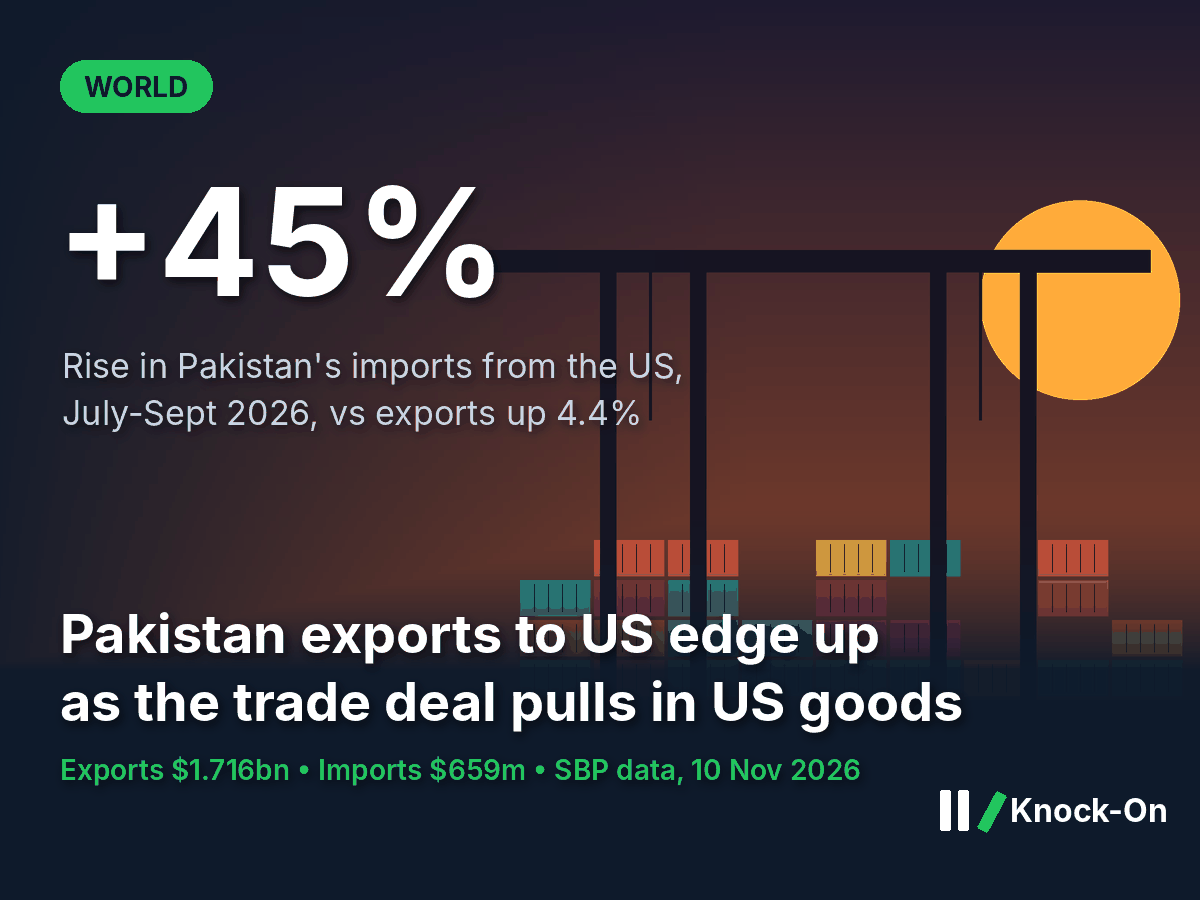
Pakistan exports to US markets grew only modestly in the first quarter of 2026-27, while imports from the United States rose far faster. State Bank of Pakistan data reported by Dawn show exports to the US up 4.44% to $1.716bn in July-September 2026, and imports from the US up 45.44% to $659.23m. The gap reflects a deliberate policy: under an agreement with Washington, Pakistan has committed to buying more American goods to narrow its trade surplus, at a time when US tariff policy is reshaping who sells what to America.
The short version
- Exports to the US rose 4.44% to $1.716bn in July-September 2026, from $1.643bn a year earlier.
- Imports from the US rose 45.44% to $659.23m, from $453.28m.
- Pakistan’s quarterly surplus with the US narrowed to about $1.06bn from about $1.19bn (Knock-On calculation).
- Dawn says Pakistan will import additional US goods under a new agreement to balance the trade gap.
What happened
According to State Bank data compiled by Dawn, Pakistan’s exports to North America grew 4.65% to $1.826bn in the first quarter, from $1.745bn a year earlier, while imports from the region rose 60.58% to $841.31m. The US made up about 94% of those exports. For the full 2025-26 fiscal year, exports to the US rose just 1.55% to $6.125bn while imports from the US climbed 38.93% to $3.265bn. Exports to Canada rose 7.53% to $109.72m in the first quarter, after falling 2.3% in 2025-26.
Imports from the US are growing ten times faster than exports to it
Pakistan–US goods trade, July-September, US$ billion
Why it matters
At more than $6bn a year, Pakistan exports to US buyers are a major source of dollar earnings, so the direction of this trade matters. Dawn reports that President Donald Trump has imposed additional tariffs on trading partners while extending limited relief to Pakistan under a reciprocal arrangement, and that Islamabad has agreed to import more from the US to ease the imbalance. On Knock-On’s arithmetic, the surplus with the US fell from about $3.68bn in 2024-25 to about $2.86bn in 2025-26, and it narrowed again in the first quarter. That fits the deal’s aim, but it also means fewer net dollars from the relationship, at a time when Pakistan’s services exports are rising and its deficit with China and the region keeps widening.
The knock-on effects
First order: Pakistan exports to US barely keep pace
Export growth of 4.44% is small after a flat 2025-26. Exporters keep their US market access, but the data do not yet show the tariff relief turning into a sales surge.
Second order: more US goods in Pakistan
Rising imports from the US give local importers and distributors of American goods more business. They also mean more demand for dollars on the import side, which matters for the trade balance and the rupee.
Third order: the deal becomes a balancing act
If imports keep growing much faster than exports, the surplus that underpins the arrangement shrinks. That could strengthen Pakistan’s hand in keeping tariff relief, or test how much more it can afford to buy. This is a scenario, not a forecast.
Who could benefit
- Importers of US goods, whose volumes rose 45% in a quarter.
- Exporters to the US, which keep tariff relief that competitors may not have.
- Ports and logistics firms handling two-way US trade, as Karachi Port traffic rises.
Who may face pressure
- The external account, as the surplus with a $6bn-a-year export market narrows.
- Exporters counting on growth in the US market, where sales rose only slightly.
- Local producers competing with additional US imports.
What to watch
- October trade data by country from the State Bank, due in the coming weeks.
- Any change in US tariff policy or in the terms of Pakistan’s reciprocal arrangement.
- Whether export growth to the US picks up in the second quarter (October-December).
Sources
- Dawn, Modest rise in exports to US, imports surge, 10 Nov 2026
This is analysis, not investment advice. Figures are as of 10 November 2026. Knock-On is not affiliated with any political party.
Leave a Reply