
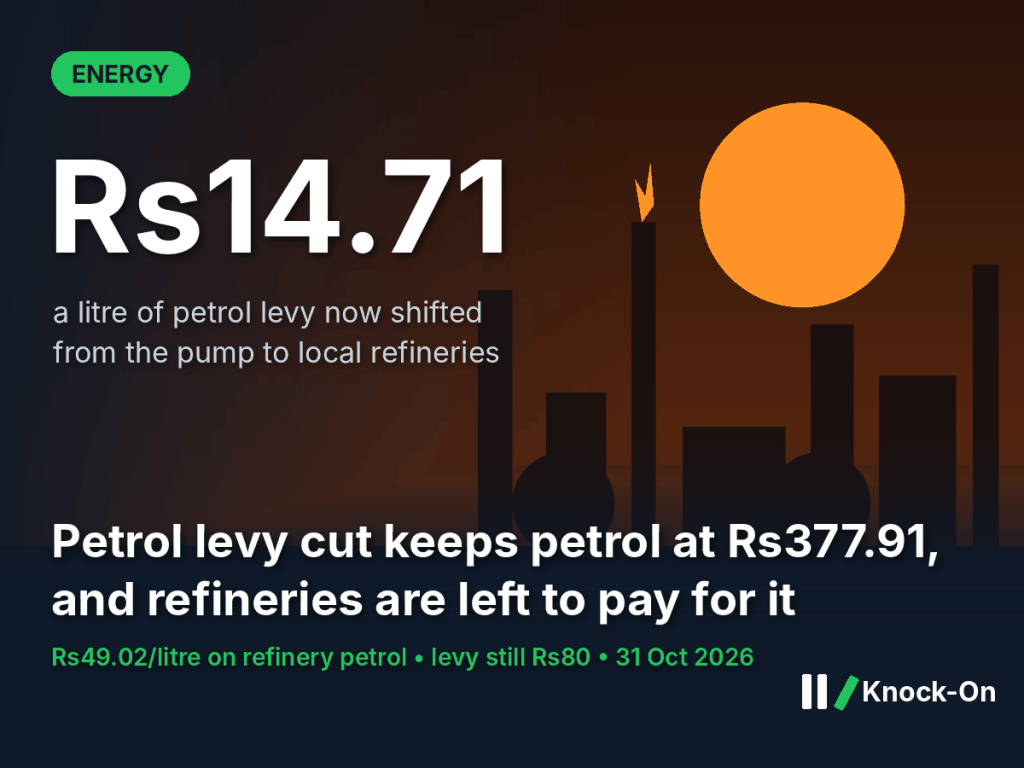
The petrol levy cut announced with the 31 October fuel prices is being paid for by Pakistan’s oil refineries, not by motorists or the budget. The government reduced the levy collected at the pump on petrol by Rs14.71 a litre, from Rs80 to Rs65.29, and kept petrol at Rs377.91. Refineries must now hand over the difference, which they say turns petrol into a loss-making product for them. For transporters and households, pump prices held; for refiners, a policy that was meant to fund upgrades has changed again.
The short version
- The petrol levy collected at the pump fell by Rs14.71 to Rs65.29 a litre; the total notified levy stays at Rs80.
- Refineries must recover the gap at about Rs49.02 a litre on the petrol they supply, PakWheels reports, citing Topline Research.
- Petrol stayed at Rs377.91 a litre until 2 November; diesel rose Rs2.29 to Rs402.96.
- Refiners say they were not consulted and that margins may turn negative.
What happened
Petrol import costs rose by Rs14.71 a litre in the latest pricing round, PakWheels reported, citing Topline Research and the fuel price notification effective 31 October. The import premium, including freight, rose from $19.88 to $25.52 a barrel. Instead of passing that on, the government cut the petrol levy collected through the price by the same Rs14.71, and kept petrol at Rs377.91 a litre. High-speed diesel went up by Rs2.29 to Rs402.96, with both prices valid until 2 November, Bloom Pakistan reported.
The Express Tribune reports that the federal cabinet took the decision on Friday night. Under a Petroleum Division letter dated 30 October, for the next 30 days the ex-refinery price of petrol will be worked out with premium, incidentals and customs duty fixed at their 7 March 2026 levels. The gap between that price and the import price, based on Pakistan State Oil’s actual costs, must be paid into the petroleum levy account.
A Rs14.71 levy cut at the pump becomes Rs49 a litre for refiners
Petroleum levy on petrol, Rs per litre, prices effective 31 October 2026
Why it matters
The petrol levy cut is concentrated on a few companies. Local refineries supply about 30% of Pakistan’s petrol, so recovering Rs14.71 on every litre sold means about Rs49.02 on each litre they produce, according to the PakWheels report. Topline’s preliminary estimate puts the cost to refineries at Rs10bn to Rs15bn a month, based on annual petrol output of about 2.6 million tonnes, and it says the figures still need confirming. The Express Tribune reports a similar Rs49 total from the industry: about Rs35 from pricing petrol on pre-war premiums and incidentals and about Rs14 from customs duty recovery redirected to cut the levy. Without the change, petrol would have been about Rs392.62 a litre (Knock-On calculation: Rs377.91 plus Rs14.71).
The knock-on effects
First order: petrol users are shielded for now
Motorcyclists, ride-hailing drivers and delivery firms avoid a rise of about Rs15 a litre. Diesel users get no such relief: freight costs keep climbing, as our report on the Hormuz mines impact on Pakistan’s diesel price explains.
Second order: refinery margins and upgrade plans
The vice chairman of Cnergyico told The Express Tribune that its gross refining margins “can go into negative territory”. Attock Refinery’s chief executive, Adil Khattak, said refineries had already accepted caps on their diesel spread twice, and that the decision “strikes at the very foundation” of the Brownfield Refineries Up-gradation Policy, which directs 10% customs duty proceeds to refinery accounts. Weaker cash flows could delay upgrades meant to cut furnace oil output.
Third order: the levy debate continues
The headline levy is still Rs80, so revenue is protected while the pump share falls. That matters for the talks on the petroleum levy in Pakistan, now before a joint committee, and for the budget’s levy target. The arrangement lasts 30 days; what replaces it is not yet known.
Who could benefit
- Petrol users: commuters, two-wheeler riders and delivery fleets avoid an increase of about Rs15 a litre.
- The budget: the total levy stays at Rs80 a litre.
- Fuel importers: imported petrol is priced on actual costs, while refinery petrol is priced on the March baseline.
Who may face pressure
- Refineries: an estimated Rs10bn to Rs15bn a month, per Topline’s preliminary figures.
- Refinery shareholders and lenders: weaker margins and uncertain upgrade funding.
- Diesel users: freight, farming and industry still pay Rs402.96 a litre. See our earlier report on the diesel price climbing as petrol was cut.
What to watch
- 2 November: the end of the current price period and the next petrol and diesel notification.
- Late November: the end of the 30-day mechanism, and whether it is extended.
- Refinery response: any formal challenge or request to the Petroleum Division.
- Brent: it settled at $117.64 on Friday for the expiring December contract, EnergyNow reported, up 13.6% in October.
Sources
- The Express Tribune, Refineries to sell petrol ‘below cost’, 1 November 2026
- PakWheels Blog, Government Shifts Petrol Price Increase Burden to Refineries, 31 October 2026
- Bloom Pakistan, Govt Increases Diesel Price, But Keeps Petrol Unchanged for 2 Days, 30 October 2026
- EnergyNow, Oil Climbs More Than 2% Friday as Middle East Attacks Intensify, 30 October 2026
This is analysis, not investment advice. Figures are as of 1 November 2026.

Leave a Reply