
Pakistan Afghanistan tensions sharpened again on Saturday, when Pakistan’s information ministry rejected the Afghan Taliban’s claim that Islamabad’s “wrong policies” are blocking a settlement. The ministry said the Taliban’s “persistent refusal to address terrorism remains the principal obstacle to normal relations”, Dawn reported. For exporters, transporters and traders in the border provinces, the exchange means one thing: the trade crossings shut since 12 October 2025 are unlikely to reopen soon.
The short version
- Taliban spokesperson Zabihullah Mujahid said Pakistan does not want to resolve the conflict through talks; Islamabad replied that the problem is terrorism from Afghan soil.
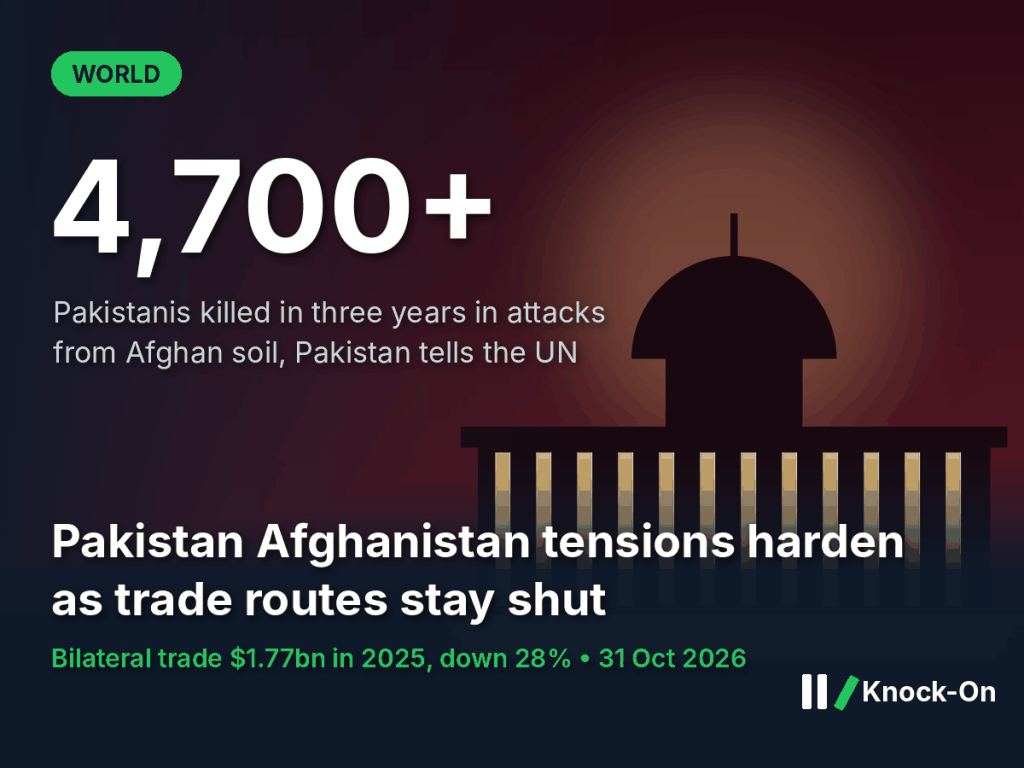
- At the UN, a Pakistani diplomat said more than 4,700 Pakistanis had died in three years in attacks from Afghan territory.
- Bilateral trade fell 28% to $1.77bn in 2025, according to a PIDE report cited by Business Recorder.
- Neither side has signalled new talks, so businesses should plan for a closed border.
What happened
In an interview aired by Hurriyat Radio on Saturday, Mujahid said “Pakistan does not want to resolve the conflict with Afghanistan through talks” and that Islamabad “lacks the necessary readiness for a peaceful resolution of differences”, according to Dawn. He said Kabul was not the cause of Pakistan’s counterterrorism problems.
The information ministry responded the same evening. It said the remarks exposed the “regime’s deeply misguided approach”, that Pakistan “will not tolerate terrorist sanctuaries across its borders”, and that it reserves the right to “take all necessary measures, in accordance with international law” against threats to its security. It described terrorism as a red line.
A day earlier, Pakistan’s Counsellor at the UN, Muhammad Jawad Ajmal, told the General Assembly’s Third Committee that more than 4,700 Pakistanis had died over the past three years in attacks from Afghan territory, The Express Tribune reported. He named the TTP, the Balochistan Liberation Army, Majeed Brigade, ISIL-K and ETIM, and urged the Taliban to take “decisive action” against them. The Afghan Taliban have consistently rejected Pakistan’s claim that Afghanistan is a base for attacks.
More than a quarter of Pakistan-Afghanistan trade disappeared in a year
Bilateral trade and Pakistani exports, US$ billion
Why it matters
Afghanistan used to be a market Pakistani firms could reach by road in a day. In the six months before the closure, Pakistani exports there were worth $832m, according to World Bank data cited by Amu TV. Knock-On reported two weeks ago that Pakistan Afghanistan trade fell 28% as the border stayed shut, and that Kabul is replacing Pakistani goods through Central Asia. Saturday’s exchange shows the political gap behind that trade loss is widening, not closing. The longer the Pakistan Afghanistan tensions last, the more permanent the new Afghan supply routes are likely to become.
The knock-on effects
First order: Pakistan Afghanistan tensions keep the crossings shut
With both sides restating fixed positions, there is no near-term route back to normal trade through Torkham and Chaman. Exporters of fruit, vegetables, cement and food staples that relied on the Afghan market have to keep selling elsewhere or not at all. Afghan demand has also been shrinking in the regional figures: exports to Afghanistan have almost vanished from Pakistan’s regional trade data.
Second order: the border economy and security costs
Khyber Pakhtunkhwa and Balochistan host the main crossings, so transporters, warehouses and clearing agents there carry most of the cost. Pakistan’s statement that it may act against threats “wherever they originate” signals continued security spending and risk in the border districts, which can raise insurance and logistics costs for firms operating there.
Third order: transit trade and regional routes
Karachi’s role as Afghanistan’s main port weakens while Afghan traders use routes through Central Asia and Iran. Once new suppliers and contracts are in place, they may stay even after any reopening. That is a risk, not a certainty.
Who could benefit
- Central Asian exporters, which are filling the Afghan market for flour, wheat and other goods.
- Pakistani exporters with other buyers, who can redirect goods to the Gulf, China or domestic markets.
Who may face pressure
- Perishable-goods traders who depended on quick road access to Afghan buyers.
- Transporters and clearing agents in Khyber Pakhtunkhwa and Balochistan.
- Karachi port and logistics firms that handled Afghan transit cargo.
What to watch
- The Foreign Office’s next weekly briefing for any change in tone or any mention of mediation.
- Any reply from the Taliban government to the information ministry’s statement.
- Any announcement on reopening Torkham or Chaman to trade, or on transit cargo.
- Security incidents in the border districts, which tend to harden both sides’ positions.
Sources
- Dawn, Pakistan slams Afghan Taliban for ‘shifting blame’, ‘persistent refusal’ to address terrorism issues, 31 Oct 2026
- The Express Tribune, Pakistan urges Afghan Taliban to take ‘decisive action’ against terrorist groups, 31 Oct 2026
- Business Recorder, Afghan border closure inflicts USD4.5bn loss on Pak exporters: report, 22 Aug 2026
- Amu TV, Afghanistan’s trade with Pakistan remains stalled for over 300 days, 9 Aug 2026
This is analysis, not investment advice. Figures are as of 1 Nov 2026. Knock-On is not affiliated with any political party.

Leave a Reply