
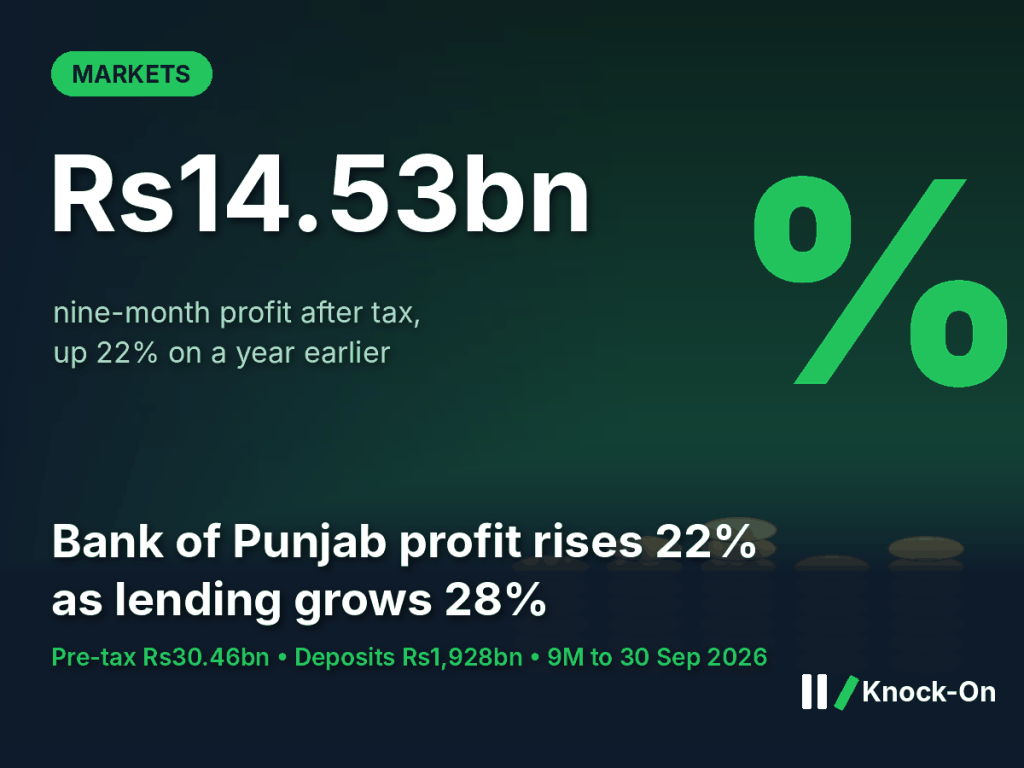
Bank of Punjab profit after tax rose 22% to Rs14.53bn in the nine months to 30 September 2026, the Punjab government-owned lender said after its board approved the unaudited accounts on Monday. Pre-tax profit rose 15% to Rs30.46bn. The results land a day after the State Bank raised its policy rate to 12%, a change that tends to shape bank earnings for the quarters that follow.
The short version
- BOP’s profit after tax rose 22% to Rs14.53bn in January–September 2026; profit before tax rose 15% to Rs30.46bn.
- Net interest income, the bank’s core lending margin, grew 19% to Rs69.40bn.
- Gross advances rose 28% to Rs1,073bn, and deposits stood at Rs1,928bn.
- The bank did not announce a dividend with the results, according to the reports.
What happened
A bank spokesperson told Dawn that the board met on Monday, 26 October, and approved the financial statements for the nine months ended 30 September. A release reported by Business Recorder gave more detail: net interest income of Rs69.40bn (up 19%), total deposits of Rs1,928bn and gross advances of Rs1,073bn, up 28% on a year earlier. Neither report gave earnings per share or quarterly figures.
The prior-year figures were not published with the release, so the comparison below is a Knock-On calculation that works backwards from the growth rates the bank reported.
Bank of Punjab grew profit faster than its core income
Nine months to 30 September, Rs billion; 2025 figures implied by reported growth rates
Why it matters
The Bank of Punjab profit figures show a bank that is lending more, not just earning on government bonds. Gross advances of Rs1,073bn against deposits of Rs1,928bn imply an advances-to-deposits ratio of about 56% (Knock-On calculation). With advances up 28%, BOP is putting more of its balance sheet into loans to businesses and households at a time when many companies have been repaying bank debt. The timing also matters: the State Bank raised the SBP interest rate to 12% on 26 October, which changes both what banks earn on loans and what they pay depositors.
The knock-on effects
First order: a stronger earnings base for BOP
Profit after tax grew faster than pre-tax profit (22% against 15%), which suggests a lower effective tax charge than last year, although the bank did not explain the gap. Core income, measured by net interest income, grew 19%.
Second order: higher rates cut both ways
A higher policy rate can lift what banks earn on floating-rate loans, but it also raises borrowing costs for clients and can increase the risk of bad loans. A bank that has grown its loan book by 28% will feel both effects more than one that mainly holds government securities.
Third order: a signal for bank results season
Listed banks are reporting September-quarter results over the coming days. BOP’s numbers give investors an early read on how lending growth and rates are feeding into earnings, after the KSE-100 recovered 664 points on the day of the rate decision.
Who could benefit
- BOP shareholders, including the Punjab government: higher profit strengthens the bank’s capital and its capacity to pay dividends later.
- Borrowers in Punjab: a fast-growing loan book means more credit available to businesses and households.
- Depositors: higher policy rates usually feed through to better returns on savings accounts.
Who may face pressure
- Borrowers on floating rates: the 50bp hike will raise repayments on loans linked to KIBOR.
- Weaker corporate clients: higher rates combined with high fuel and power costs can strain repayment.
- Banks with slower loan growth: BOP’s 28% lending growth sets a high bar for peers’ results.
What to watch
- BOP’s full quarterly accounts on the PSX, for earnings per share, provisions and the September-quarter figures.
- Results from other listed banks over the coming days.
- How quickly banks reprice loans and deposits after the 26 October rate hike.
Sources
- Business Recorder, BOP powers ahead with strong nine-month 2026 operating performance, 27 October 2026
- Dawn, Bank of Punjab earns Rs14.5bn, 27 October 2026
- Business Recorder, SBP hikes policy rate to 12% on inflation, energy price concerns, 26 October 2026
This is analysis, not investment advice. Figures are as of 27 October 2026.

Leave a Reply