
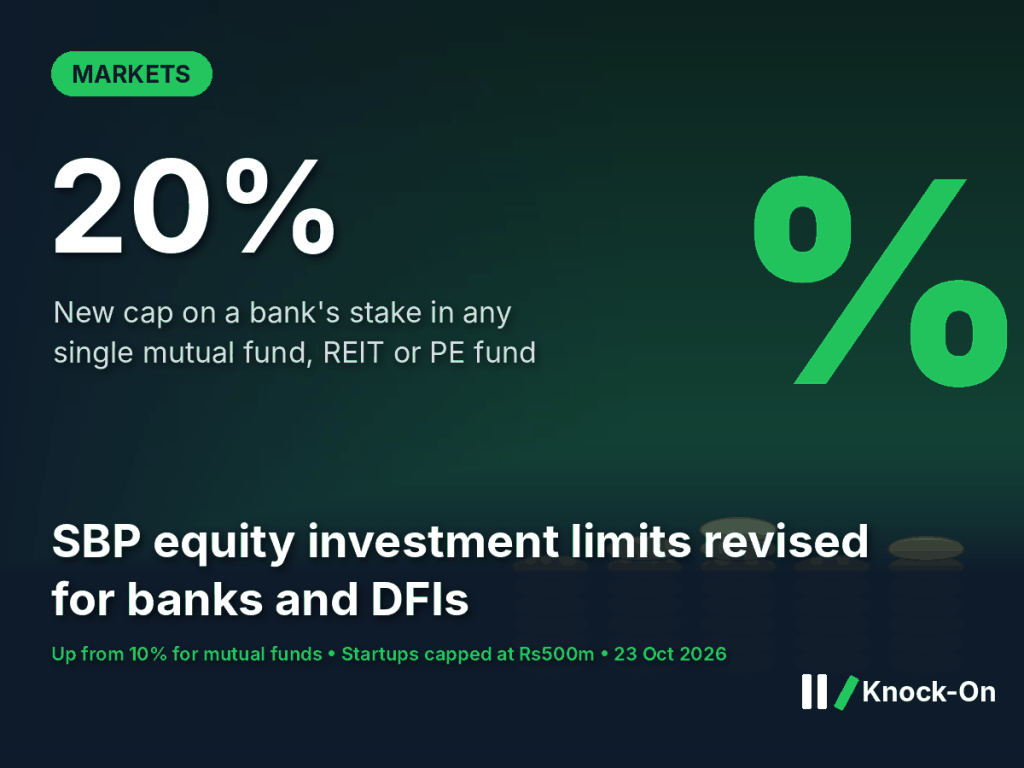
The State Bank of Pakistan has rewritten the SBP equity investment limits that decide how much of a single company, start-up or fund a bank can own. Under BPRD Circular Letter No. 22, issued on 23 October, banks and development finance institutions (DFIs) can now hold up to 20% of the units of any single mutual fund, REIT or private equity fund, subject to an overall cap of 5% of their Tier-I capital. The limits for listed company shares and start-ups stay where they were. The change lands one day before the SBP’s interest rate decision, with the stock market in a fearful mood.
The short version
- A bank’s stake in one mutual fund, REIT or private equity fund is now capped at the lower of 5% of its Tier-I capital or 20% of the fund’s units.
- Under the 2022 rules, the fund cap was 10% of units for mutual funds and 15% for REITs.
- Single-company shares stay at the lower of 5% of Tier-I capital or 10% of paid-up shares; start-ups at the lower of 5% or Rs500m.
- Every bank and DFI needs an approved equity investment policy, including an exit strategy.
What happened
Business Recorder reported on 25 October that the SBP amended paragraphs 1(A) and 1(B)(iv) of Regulation R-6 of its prudential regulations. That regulation was last changed by BPRD Circular Letter No. 04 of 2022, which set a 10% cap for mutual fund units (the same as for company shares) and a 15% cap for REITs. The new text puts mutual funds, REITs and private equity funds into one category with a 20% cap. Strategic investments and fund units count toward the aggregate limits, and National Investment Trust units remain excluded until NIT is privatised. As PakTribune noted, the two tests are not a menu: “The percentages are not alternatives from which an institution can select the more generous allowance.” The lower figure always applies.
Banks can now own twice as much of a single mutual fund
Maximum holding by a bank or DFI in one investee, % of its shares or units (the 5% of Tier-I capital cap also applies)
Why it matters
Banks are sitting on more money than they lend. Across the industry, deposits grew three times faster than loans, and the new SBP equity investment limits widen one route for that cash into the capital market. A bank can now be a bigger anchor investor in a new equity fund, REIT or private equity vehicle without breaching the per-fund cap. That matters for asset managers and property developers trying to raise money while the KSE-100 is falling: the index closed at 162,374.88 on 23 October, down 0.95%, with the PSX Fear and Greed index at 21, “extreme fear”, according to Mettis Global market data.
The knock-on effects
First order: room for bigger bank stakes in funds
Fund managers, REIT sponsors and private equity firms can take larger tickets from a single bank. The ceiling is not an obligation: a bank still needs its own approved policy, risk appetite and exit plan before it invests.
Second order: start-ups get no new headroom
The Rs500m per-start-up cap, already in the 2022 rules, is unchanged. Start-ups and fintechs are more likely to feel the change indirectly, if banks back private equity or venture funds that then invest in them.
Third order: interest rates still decide the flow
A higher cap only matters if equities look better than government paper. With analysts split on whether the SBP will hold or raise its policy rate on 26 October, treasury desks may wait before using the new room. This is a judgement, not a forecast of bank behaviour.
Who could benefit
- Asset management companies: can raise larger seed or anchor money from one bank.
- REIT sponsors and developers: the per-REIT cap rises from 15% to 20%.
- Private equity and venture funds: now named explicitly in the fund category.
Who may face pressure
- Bank compliance teams: must update policies and track aggregate exposure, including strategic stakes.
- Smaller banks: the 5% of Tier-I capital test will bind sooner for them than the 20% unit test.
- Start-ups seeking direct bank equity: the Rs500m ceiling is unchanged.
What to watch
- 26 October: the SBP Monetary Policy Committee decision.
- Next PSX sessions: whether the KSE-100 recovers from last week’s 2.4% fall.
- Bank half-year and annual accounts: disclosures of new fund and REIT holdings.
Sources
- Business Recorder, SBP revises equity investment limits for banks, DFIs, 25 October 2026
- Investify (Mettis Global), SBP revises investment limits for banks in shares, startups and mutual funds, 24 October 2026
- PakTribune, SBP revises banks’ equity limits, setting separate startup and fund caps, 25 October 2026
- State Bank of Pakistan, BPRD Circular Letter No. 04 of 2022
This is analysis, not investment advice. Figures are as of 25 October 2026.


Leave a Reply