
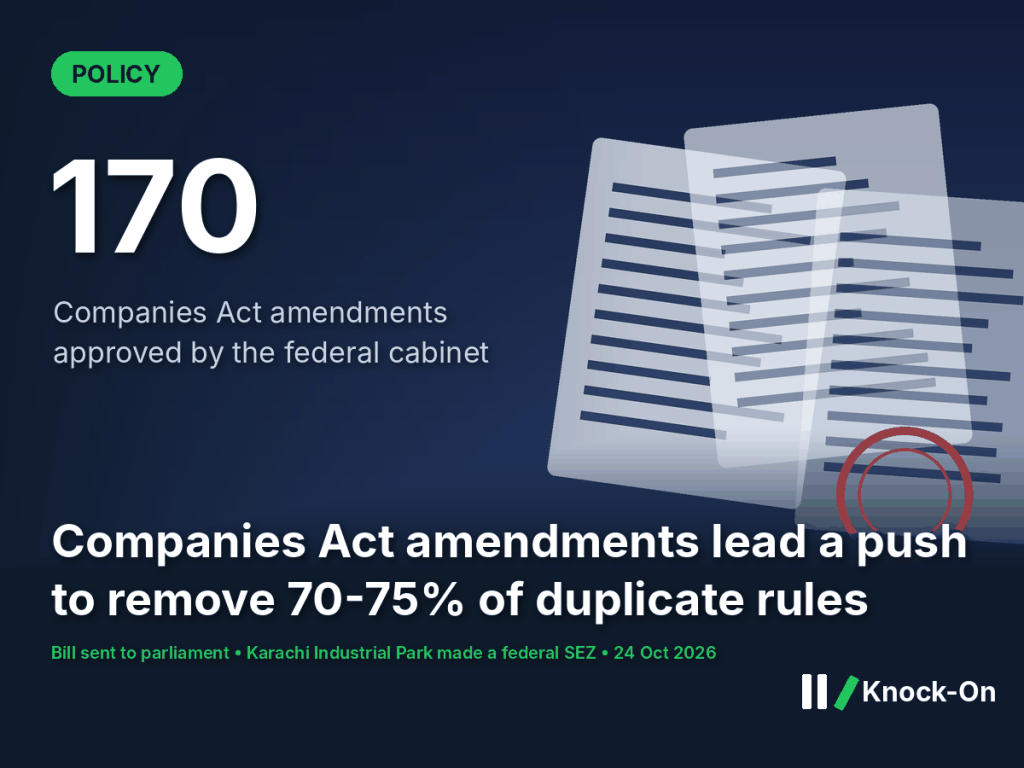
Pakistan’s federal cabinet has approved 170 Companies Act amendments and forwarded the bill to parliament, Haroon Akhtar Khan, the Prime Minister’s Adviser on Industries and Production, told a press conference in Islamabad on Friday 23 October. He presented the Companies Act amendments as one part of a wider review in which institutions have proposed scrapping, on average, 70–75% of unnecessary or duplicated business regulations. The same day, a board chaired by Finance Minister Muhammad Aurangzeb made Karachi Industrial Park a federal special economic zone (SEZ).
The short version
- Cabinet has approved 170 amendments to the Companies Act, 2017; the bill is now with parliament, and its full text has not been published.
- A review of regulators and rules is 60–70% complete, the adviser says, with proposals to remove 70–75% of duplicated requirements.
- Karachi Industrial Park is now a federal SEZ, and the government may pay for roads and utilities up to private zones’ boundaries.
- The push comes as profits sent abroad by foreign investors ($2.31bn in FY26) exceeded net FDI ($1.64bn).
What happened
Khan, speaking alongside the Gilgit-Baltistan chief minister, said the Companies Act amendments are meant to make it easier to register and run a company and to modernise corporate regulation, Business Recorder and Dawn reported. Neither report lists the individual changes. He said the government had studied the systems of Delaware in the US, the UK and Canada, and had hired a senior international consultant with regulatory reform experience in 135 countries. Prime Minister Shehbaz Sharif is overseeing the agenda through review meetings every two weeks, Khan said.
Beyond company law, the government is drafting an Asaan Karobar Act to simplify procedures and cut compliance costs, and is reviewing rules in dairy, maritime, beverages, oil refining, pharmaceuticals and restaurants. Khan said businesses face repeated inspections from labour, environment, fire safety, building and boiler departments, and that an integrated single-window portal is planned so firms can deal with federal and provincial regulators in one place. “Our objective is to make investment easier, reduce the cost of doing business,” he said.
Separately, the 11th meeting of the SEZ Board of Approvals approved Karachi Industrial Park as a federal SEZ. It also approved criteria under which the government can fund utilities, road access and other services up to the “zero point” of privately built zones, case by case, and a land lease policy for public-sector zones and industrial estates in Punjab meant to reduce upfront land costs.
Why it matters
Khan said regulatory complexity has discouraged foreign investment. The latest official numbers show the gap the reforms are aimed at: as Knock-On reported, profit repatriation from Pakistan reached $2.31bn in FY26, about 41% more than net FDI, according to a written reply to the National Assembly. The government says the two figures should not be compared directly, because profits can come from investments made over many years.
Profits sent home outpaced new foreign investment in FY26
US$ billion, fiscal year 2025-26 (July–June)
The knock-on effects
First order: Companies Act amendments could cut paperwork, once passed
Nothing changes for companies until parliament passes the bill, and its detail is not yet public. If the changes simplify registration and filings as described, the first gains would go to new and small companies, for which fixed compliance costs weigh most heavily.
Second order: the inspection burden sits with the provinces
Most of the inspections Khan listed are run by provincial departments, which is why he stressed aligning reforms with the provinces, Gilgit-Baltistan and Azad Jammu and Kashmir. The single-window portal will matter only if provincial regulators join it.
Third order: cheaper land and utilities for new factories
Government-funded utilities and long-term leases lower the upfront cost of building a plant, a similar logic to the Islamabad land auction that asks for no money upfront. Whether that lifts investment depends on demand and borrowing costs, with the World Bank Pakistan growth forecast at 3.8% this year.
Who could benefit
- Start-ups and small firms, if registration and filing become simpler and cheaper.
- Export-oriented manufacturers looking at Karachi Industrial Park or Punjab estates, through leases and state-funded utilities.
- Foreign investors, if overlapping federal and provincial approvals are reduced.
Who may face pressure
- Regulators and inspection departments whose duplicated roles may be removed.
- Companies planning filings now, which face uncertainty until the amended law and new rules are published.
- Public finances, if utility costs for private zones are carried by the government.
What to watch
- When the Companies Act amendment bill is tabled and debated in parliament (no date announced).
- A draft of the Asaan Karobar Act and the launch of the single-window portal.
- Developer and investor announcements for Karachi Industrial Park.
- The SBP rate decision on Monday 26 October, which sets the cost of financing new projects.
Sources
- Business Recorder, Cabinet approves 170 amendments to Cos Act, 2017, 24 October 2026
- Dawn, Govt unveils 170 tweaks to Companies Act, 24 October 2026
- The Express Tribune, Unnecessary rules being removed, 24 October 2026
- Business Recorder, Govt approves Karachi Industrial Park as federal SEZ, 24 October 2026
- Business Recorder, SIFC informs NA: FY26 foreign profit repatriation 41pc higher than FDI, 24 October 2026
This is analysis, not investment advice. Figures are as of 24 October 2026.


Leave a Reply