
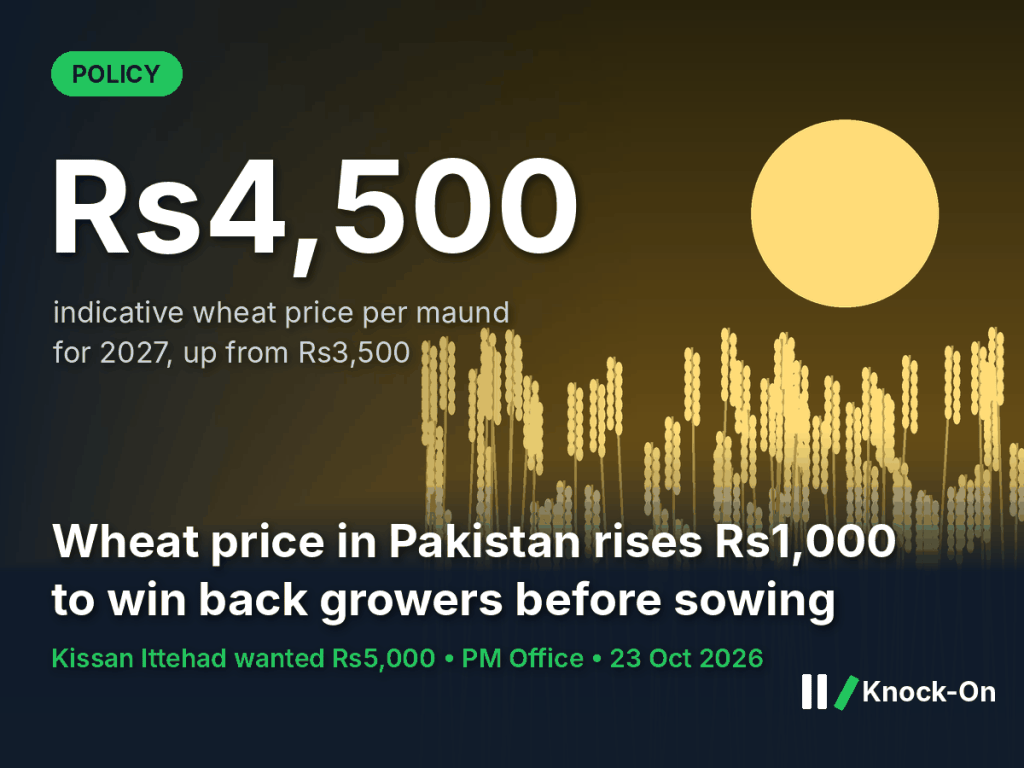
The wheat price in Pakistan for the 2027 crop will be Rs4,500 per 40kg maund, Prime Minister Shehbaz Sharif announced on Friday. The indicative price is Rs1,000 higher than last year’s Rs3,500. It arrives just as farmers decide how much land to sow for the next harvest, after two years in which Pakistan had to import wheat.
The short version
- The government set an indicative wheat price of Rs4,500 a maund for 2027, up from Rs3,500.
- That is a 28.6% rise (Knock-On calculation), but below the Rs5,000 that Pakistan Kissan Ittehad had demanded.
- The aim is to restore farmers’ interest in wheat and cut imports. Details of how the price will be enforced have not yet been announced.
- A higher grain price supports rural incomes but may add to flour costs for mills, bakers and households.
What happened
The Prime Minister’s Office said on 23 October that the Rs4,500 price reflects rising production costs, including higher fuel prices and inflation, and is intended to boost output in the coming season, according to Business Recorder. The decision was taken under the guidance of President Asif Ali Zardari and PML-N President Nawaz Sharif, in consultation with the chief ministers of Punjab and Sindh. “The new proposed price is expected to help farmers cover their production costs and earn a reasonable profit,” the Prime Minister was quoted as saying.
Dunya News described the figure as a proposed or indicative price rather than a confirmed procurement price, and said implementation details still need official clarification. Minute Mirror reported that Pakistan Kissan Ittehad had asked for Rs5,000 per maund, and had warned that growers could reconsider sowing wheat without a suitable price and clear crop policy. It also noted that Sindh began releasing government wheat at Rs12,500 per 100kg bag from 15 October to manage flour prices.
The new wheat price closes most of the gap farmers asked for
Wheat price, rupees per 40kg maund, as announced or reported on 23 Oct 2026
Why it matters
Wheat is Pakistan’s staple food. The wheat price in Pakistan feeds into the cost of flour, bread and naan, and it shapes whether farmers plant wheat or switch to other crops. The government’s stated concern is supply: it says Pakistan had to import wheat in each of the past two years, which costs scarce dollars at a time when diesel prices for tractors and trucks are already rising. A price signal before sowing is meant to keep land under wheat.
The other side is consumer prices. Flour has been one of the main drivers of inflation this year, as Knock-On reported when Pakistan’s flour price rose 32.6% in a year. A higher grain price next spring may keep that pressure alive.
The knock-on effects
First order: a better margin for growers
At Rs4,500 a maund, wheat would fetch Rs112.50 a kilogram, against Rs87.50 at last year’s price (Knock-On calculation). That gives growers more room to pay for fertiliser, diesel and seed. Farmers’ groups had said low earnings were forcing them to cut back on balanced fertiliser use.
Second order: input demand and rural spending
If more land is sown and farmers have more cash, demand for fertiliser, seed, tractors and farm credit should firm up. Fertiliser makers were already forecast to post higher profits, as covered in our look at fertiliser earnings. Rural consumer spending on motorcycles and household goods also tends to follow harvest incomes.
Third order: food inflation and the import bill
A higher grain price may feed into flour and bakery prices from the 2027 harvest onwards, which matters for the inflation outlook and therefore interest rates. Set against that, a larger domestic crop could reduce the need for wheat imports and save foreign exchange. Which effect dominates depends on the size of the harvest, which is a forecast, not a fact, at this stage.
Who could benefit
- Wheat growers in Punjab and Sindh, who get a clearer price signal before sowing.
- Fertiliser, seed and farm-machinery suppliers, if sowing and input use rise.
- Rural retailers and lenders, through stronger harvest-season cash flows.
Who may face pressure
- Flour mills, bakers and food processors, whose main raw material could cost more next year.
- Low-income urban households, for whom flour is a large share of spending.
- Provincial budgets, if governments need to buy or subsidise wheat to hold flour prices.
What to watch
- Official notification of how the price will apply, including any provincial procurement.
- The response of farmers’ groups such as Pakistan Kissan Ittehad, which had sought Rs5,000.
- Wheat sowing data in the coming weeks, and fertiliser offtake figures.
- The SBP monetary policy decision on 26 October, where food prices feed into the inflation outlook.
Sources
- Business Recorder, PM Shehbaz sets proposed wheat price for 2027 at Rs4,500 per maund, 23 October 2026
- Minute Mirror, PM Shehbaz sets indicative wheat price at Rs4,500 per maund for 2027, 23 October 2026
- Dunya News, Pakistan proposes wheat price of Rs4,500 per maund for 2027, 23 October 2026
This is analysis, not investment advice. Figures are as of 23 October 2026.



Leave a Reply