
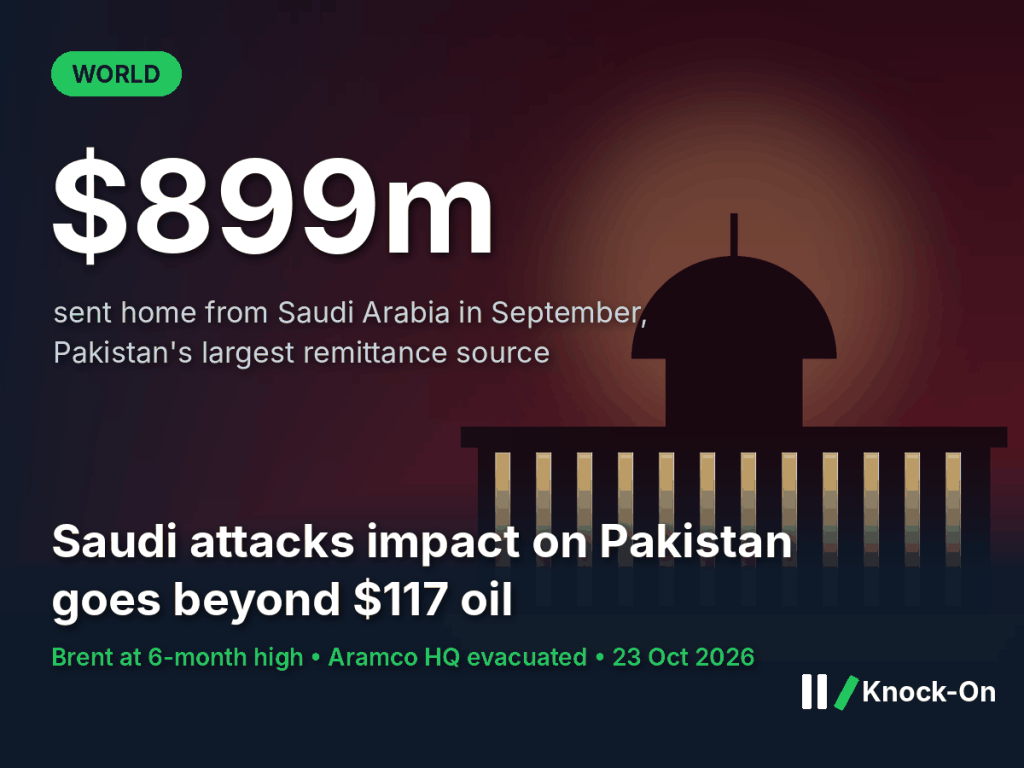
The Saudi attacks impact on Pakistan is being felt first at the fuel pump. Brent crude rose to about $117 a barrel on Friday, its highest since late April, after Houthi attacks inside Saudi Arabia and the evacuation of Saudi Aramco’s Dhahran headquarters. But Saudi Arabia matters to Pakistan for more than oil: it was the largest source of workers’ remittances in September, at $899m.
The short version
- Brent rose $4.01 to $117.18 a barrel in Friday trading and was heading for a third straight weekly gain, Reuters reported.
- Aramco ordered its Dhahran headquarters evacuated on Thursday as fighting between Saudi Arabia and the Houthis intensified.
- Gulf countries sent about $1.99bn of Pakistan’s $3.59bn in September remittances, roughly 55% (Knock-On calculation).
- Pakistan and Türkiye condemned the attacks on Saudi Arabia and called for dialogue.
What happened
Oil prices climbed through the week as fighting spread inside Saudi Arabia. According to Reuters, carried by Baird Maritime, Brent touched a session high of $117.38 on Friday 23 October, the highest since late April, and was on track for a 6.7% weekly gain. US crude rose to $103.22. Traders pointed to Houthi attacks in Saudi Arabia, Aramco’s evacuation order for its Dhahran headquarters and an oil spill off the UAE coast. “The market is concerned about these continued Iranian attacks on tankers that we’ve seen increase over the last week,” said Andrew Lipow of Lipow Oil Associates.
Gulf News, citing AFP and Saudi aviation authorities, reported that an attack on King Fahd International Airport in Dammam on 21 October killed two people and injured eight, several of them South Asian residents. The UAE blamed the Houthis; the Saudi aviation authority did not name an attacker. Washington ordered US embassy staff and families to leave Saudi Arabia. US President Donald Trump accused Iran of trying to push up oil prices ahead of the US midterm elections.
On Friday, Deputy Prime Minister and Foreign Minister Ishaq Dar met Turkish Foreign Minister Hakan Fidan in Istanbul, where both condemned the Houthi attacks on Saudi Arabia and called for dialogue and diplomacy, Business Recorder reported.
Why it matters
Pakistan imports most of its fuel, so every move in Brent passes into petrol, diesel and power costs within weeks. Al Jazeera notes that India and Pakistan are among the most exposed importers if Gulf supply is disrupted: cargoes from West Africa are 25 to 28 days away by sea, against two days from Fujairah. The second channel is less visible but just as important. Saudi Arabia, the UAE and the smaller Gulf states are where a large share of Pakistan’s workers’ remittances are earned, and those dollars help fund the country’s import bill.
Saudi Arabia is Pakistan’s biggest source of remittances
Workers’ remittances to Pakistan by source, September 2026, US$ million
Remittances from Saudi Arabia rose 19.7% from a year earlier to $899.1m in September, according to SBP data reported by ProPakistani. Together with the UAE, the two countries sent about $1.65bn, around 46% of the month’s total. Knock-On first flagged this exposure when Houthi attacks on Saudi Arabia began to threaten remittances and PIA’s Riyadh flights. A longer conflict on Saudi soil is a risk to Pakistan’s external accounts as well as its fuel bill.
The knock-on effects
First order: the Saudi attacks impact on Pakistan’s fuel prices
Higher Brent feeds into the next fortnightly fuel price review and into the cost of LNG and furnace oil for power. Diesel is already under pressure, as Knock-On reported when the diesel price in Pakistan rose to Rs391.75 a litre. The IEA says diesel is trading at nearly double the price of crude, according to Al Jazeera.
Second order: markets and interest rates
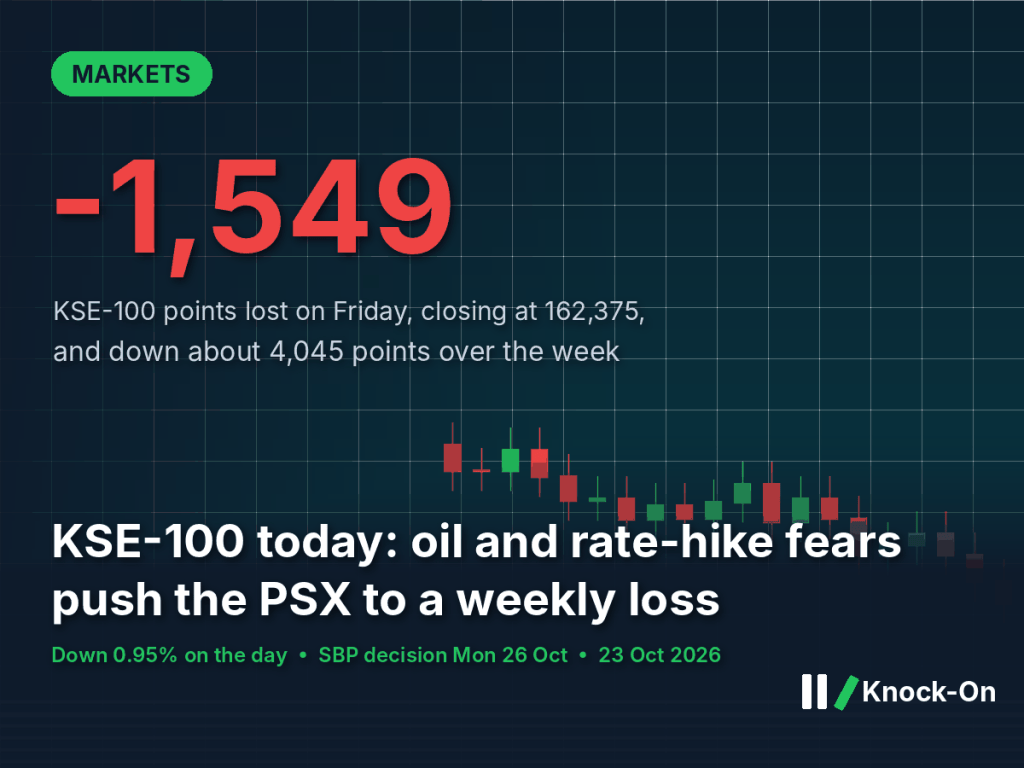
Dearer oil widens the import bill and lifts inflation expectations, which is why the KSE-100 ended the week 2.4% lower with oil above $110 and talk of a possible rate hike. The SBP decides on 26 October.
Third order: jobs and remittances
So far, the September data show remittances from Saudi Arabia still growing. The risk is that prolonged fighting slows construction, aviation and service work in Saudi Arabia, or prompts foreign workers to leave. That would hit household incomes in Pakistan and the dollar supply the rupee depends on. This is a risk, not a forecast: there is no data yet showing such an effect. The IMF’s downside scenario, covered in our story on the Iran war impact on Pakistan, already assumes oil at $130.
Who could benefit
- Oil and gas producers listed on the PSX, whose revenues are linked to international prices.
- Refiners with stocks bought earlier, which may book inventory gains when prices rise.
- Banks, if higher inflation keeps interest rates elevated for longer.
Who may face pressure
- Transporters, farmers and manufacturers that run on diesel and furnace oil.
- Airlines and travel firms serving Gulf routes.
- Households that depend on money sent home by relatives working in Saudi Arabia.
- The government’s budget, if fuel price relief is demanded while the levy is under negotiation.
What to watch
- Whether Aramco reports any disruption to operations or exports after the Dhahran evacuation.
- Brent’s opening on Monday, and the next domestic fuel price notification.
- The SBP policy rate decision on 26 October.
- October remittance data from the SBP in early November, especially the Saudi figure.
- Any Foreign Office travel or safety advisory for Pakistanis in Saudi Arabia.
Sources
- Baird Maritime (Reuters), Oil prices rise to highest since late April on Middle East fears, 23 October 2026
- Gulf News, Middle East War: Trump accuses Iran of raising oil prices ahead of US midterms as Saudi Aramco evacuates headquarters, 23 October 2026
- Al Jazeera, Are global oil reserves sufficient to withstand renewed US-Iran war?, 23 October 2026
- ProPakistani, 2 Gulf countries send $1.65 billion to Pakistan, 9 October 2026
- ARY News, Pakistan remittances rise 12.7% to $3.58 bln in Sep: Saudi Arabia remains top contributor, 10 October 2026
- Business Recorder, Pakistan, Türkiye call for dialogue, diplomacy to promote regional stability, 23 October 2026
This is analysis, not investment advice. Figures are as of 23 October 2026. Knock-On is not affiliated with any political party.


Leave a Reply