
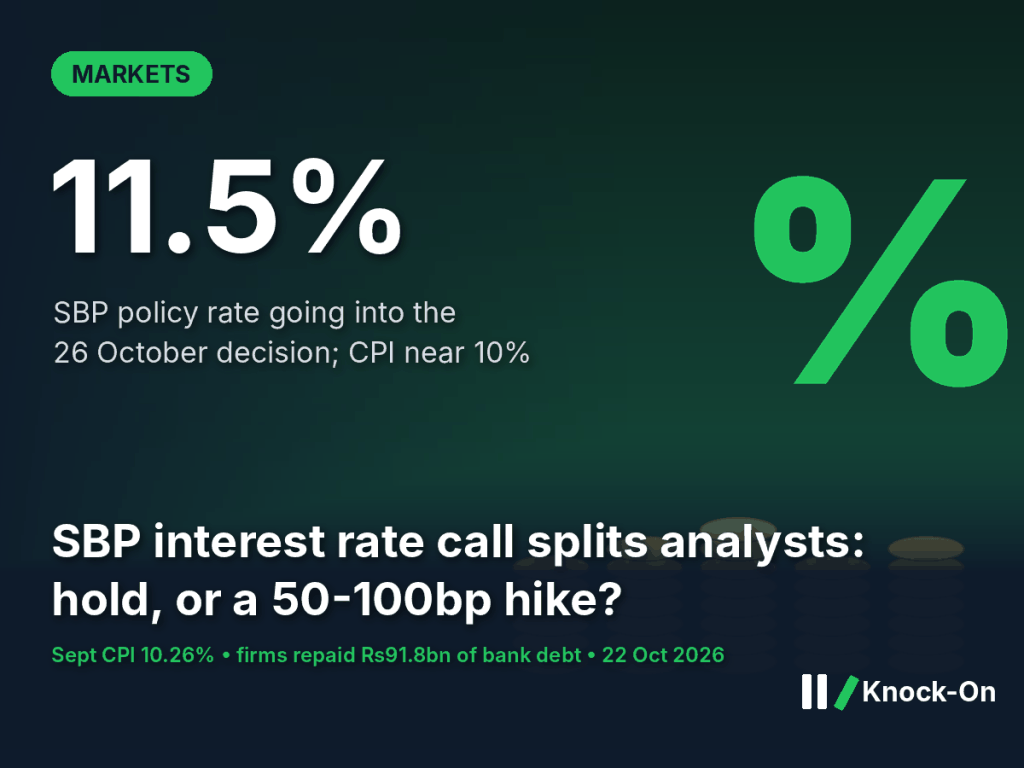
The SBP interest rate decision due on Monday, 26 October, has split Pakistan’s brokerages. The State Bank’s policy rate stands at 11.5%, headline inflation is running at about 10%, and analysts disagree on whether that gap is wide enough. Growth Securities expects a hike of 50 to 100 basis points if fuel prices stay high; AKD Securities expects a hold, The Express Tribune reported on Thursday. For businesses, the call lands at a time when they are paying down bank debt rather than borrowing to expand.
The short version
- The SBP’s Monetary Policy Committee meets on 26 October with the policy rate at 11.5%, unchanged at its last meeting on 14 September.
- Inflation was 10.26% in September and is forecast at about 10% for October, leaving a real interest rate of roughly 1.2–1.5%.
- Growth Securities sees a 50–100bp hike if fuel stays elevated; AKD Securities expects a hold and pushes rate cuts back to April 2027.
- Private businesses made net repayments of Rs91.8bn to banks between 1 July and 9 October, against Rs31.7bn a year earlier.
What happened
At its 14 September meeting the MPC kept the rate at 11.5%, with seven of its ten members in favour, Profit reported at the time. Inflation had jumped to 11.1% in August from 9.2% in July. It eased to 10.26% in September, according to the Pakistan Bureau of Statistics figures reported by ProPakistani. Growth Securities now forecasts October’s national CPI to rise 1.5% month on month, driven by electricity, petrol and food, with LPG alone projected up 6.2% in the month. Petrol has averaged Rs396.06 a litre, up 48.3% on a year earlier. As we explained in our petrol price levy breakdown, crude prices set much of that bill.
The policy rate sits only just above inflation
Headline CPI inflation, year on year, vs the SBP policy rate, %, July–October 2026
Why it matters
The SBP interest rate is the benchmark for working-capital loans, car and house finance, and the yields on government paper that banks prefer to buy. Growth Securities’ Nasheed Malik expects the real rate to reach 1.5% in October, from 1.2% in September, and sees inflation at 9–10% until March 2027 if petrol stays between Rs390 and Rs400 a litre. AKD Securities’ Mohammed Awais Ashraf argues that strong remittances, rising exports, record reserves and a $3bn Eurobond give the SBP room to hold. AKD has raised its oil assumption to $96.3 a barrel from $72.5 and expects real rates to average 3.4% over the next 12 months. Dubai crude has fallen to $107 from $127 since the last meeting, which weakens the case for a hike. Our earlier look at T-bill yields above the policy rate showed banks were already pricing in some risk of a rise.
The knock-on effects
First order: borrowing costs either freeze or rise
A hold keeps KIBOR-linked loan rates near current levels. A 50–100bp hike would raise the cost of every floating-rate loan, from textile working capital to car finance, within weeks.
Second order: the borrowing slump could deepen
Dawn reported that businesses retired a net Rs91.8bn of bank debt from 1 July to 9 October. By 11 September, net repayments had reached Rs364.5bn, so firms took about Rs273bn of net new credit in the following four weeks (Knock-On calculation). That tentative pick-up is what a hike would test. Manufacturer Amir Aziz told Dawn that weak purchasing power makes expansion hard to justify.
Third order: savers, the PSX and the budget
Higher rates support deposit and National Savings returns but weigh on share valuations and raise the government’s interest bill. A hold, by contrast, would keep pressure on the rupee and SBP reserves as the main shock absorbers if oil rises again.
Who could benefit
- Depositors and savers: a hike would lift returns on bank deposits and new government securities.
- Banks: higher rates usually widen spreads on their large holdings of government paper.
- Leveraged firms, if rates hold: companies with floating-rate debt avoid a jump in finance costs.
Who may face pressure
- Manufacturers and traders relying on KIBOR-linked working capital.
- Car and housing finance customers, and the builders and dealers who serve them.
- The federal budget, through a higher interest bill on domestic debt.
What to watch
- The MPC decision on 26 October 2026 and the SBP’s updated inflation outlook.
- October CPI from the PBS, expected in early November.
- Weekly SBP data on private-sector credit, to see whether borrowing keeps recovering.
- Oil prices and further changes to petrol and diesel prices.
Sources
- The Express Tribune, 10% inflation splits rate call predictions, 22 October 2026
- Dawn, Businesses repaying bank debt amid weak investment, 20 October 2026
- Dawn, Private sector credit offtake remains weak, 24 September 2026
- Profit, SBP keeps policy rate at 11.5% amid Middle East risks, 14 September 2026
- ProPakistani, Inflation remains high after 3 months, 1 October 2026
This is analysis, not investment advice. Figures are as of 22 October 2026.



Leave a Reply