
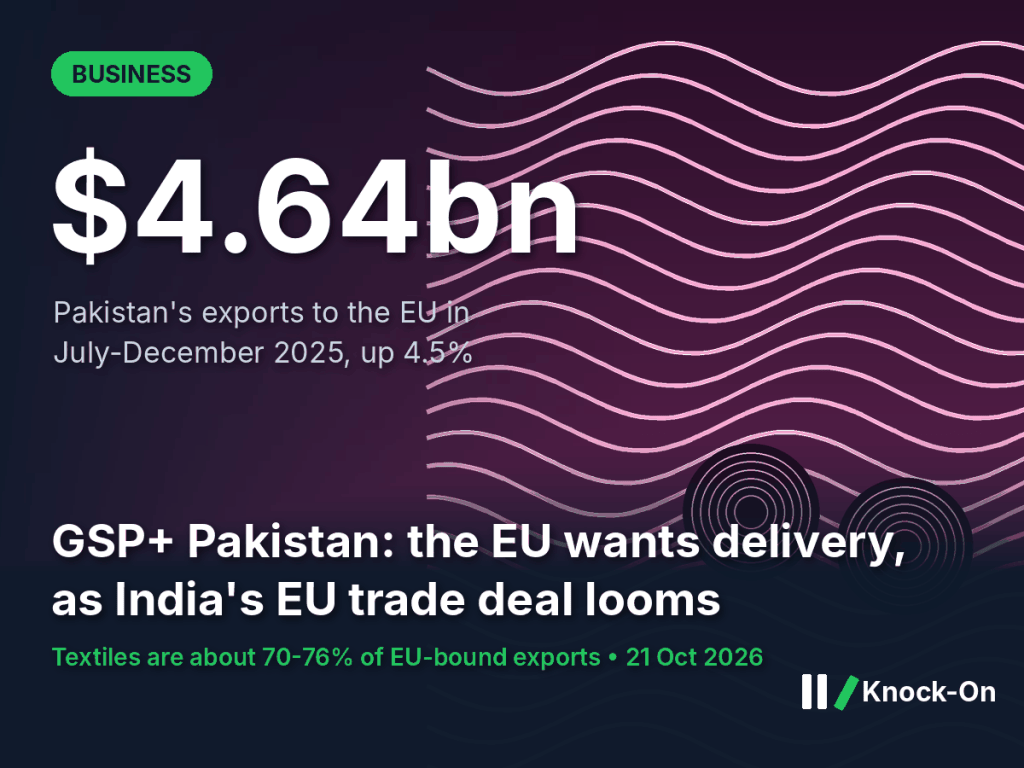
GSP+ Pakistan status, the EU trade preference that underpins much of the country’s textile trade with Europe, will depend on putting existing promises into practice rather than on new rules. That was the message from EU Ambassador Raimundas Karoblis to the Pakistan Textile Council in Karachi on Wednesday, ProPakistani reported. Exporters told him they also face a second threat: India’s free trade agreement with the EU, concluded in January, which could bring Indian textiles into Europe on similar terms.
The short version
- The EU says it is “not introducing new standards” but wants Pakistan to implement commitments it has already made under UN conventions.
- Textiles make up roughly 70–76% of Pakistan’s exports to the EU, according to the report.
- Exports to the EU reached $4.638bn in July–December 2025, up 4.5% on a year earlier, SBP data show.
- The textile council is assessing what the EU–India deal could do to Pakistani exports, at the Foreign Ministry’s request.
What happened
Karoblis met council leaders as Pakistan prepares for the next phase of GSP+, the EU scheme that gives qualifying countries preferential access to its market in return for implementing UN conventions on human rights, labour, environment and governance. He pointed to the EU’s assessment of Pakistan for 2023–2025, published on 16 July 2026, and said the Commission would first push for short-term improvements, then agree an action plan with measures, timelines and performance indicators. The emphasis, according to the report, is on effective implementation rather than ratifying conventions or passing laws.
Council chairman Fawad Anwar, who sits on the government’s GSP+ reapplication committee, called continued access vital for value-added textile and apparel exporters, jobs and tax revenue. Gul Ahmed CEO Zaki Bashir asked that the textile sector be assessed separately from national findings, while council CEO Muhammad Hasan Shafqaat sought clearer, proportionate rules on the EU’s Digital Product Passport and supply-chain due diligence.
Western Europe is Pakistan’s biggest EU market
Pakistan’s exports by region, $bn, July–December 2025 (EU total $4.638bn)
Why it matters
GSP+ Pakistan access is one of the few clear price advantages its exporters hold over larger rivals in Europe. Growth has been thin even with it: SBP data reported by Dawn show exports to all of Europe, including the UK, were $9.089bn in FY26, down 0.18% from $9.106bn. The EU–India agreement was concluded on 27 January 2026; the European Commission puts its liberalisation coverage at 99.3% on the EU side and says India will remove most tariffs on textiles and apparel immediately, though no date for the deal to take effect has been announced. Once it does, Indian mills could compete in Europe on terms closer to Pakistan’s. That pressure arrives as smaller Pakistani weavers are already shutting looms.
The knock-on effects
First order: compliance becomes a cost of selling to Europe
Exporters face more paperwork and audits on labour, environment and supply chains, including the EU’s Digital Product Passport. Large integrated mills can absorb this more easily than small units.
Second order: pricing power narrows
If Indian goods gain similar access, European buyers gain leverage to push down prices on Pakistani home textiles and apparel, squeezing margins already hit by high energy costs.
Third order: the export target gets harder
The government wants $100bn of exports by 2035. Losing ground in Europe would make that harder, raising the importance of new deals such as the Pakistan–US trade deal.
Who could benefit
- Compliant, large exporters: firms with audited supply chains can win orders from buyers that are tightening due diligence.
- Compliance and certification services: demand for audits, traceability and reporting should grow.
- European buyers: more competition between suppliers gives them more choice.
Who may face pressure
- Small and mid-sized textile and apparel units without compliance systems.
- Textile workers, if orders move to India or elsewhere.
- The current account, which relies on Europe as a major export market.
What to watch
- The European Commission’s action plan for Pakistan, with measures and timelines.
- The Pakistan Textile Council’s impact study of the EU–India agreement.
- Signature and ratification of the EU–India deal.
- Monthly SBP and PBS export data for EU markets.
Sources
- ProPakistani, Pakistan could lose EU trade benefits to India, 21 October 2026
- Profit, Pakistan’s exports to EU grow 4.5% to $4.638 billion, but competition with India intensifies, 10 February 2026
- Dawn, Exports to Europe fall in FY26 despite GSP+, 31 July 2026
- European Commission, EU–India free trade agreement concluded, 29 January 2026
This is analysis, not investment advice. Figures are as of 22 October 2026.

Leave a Reply