
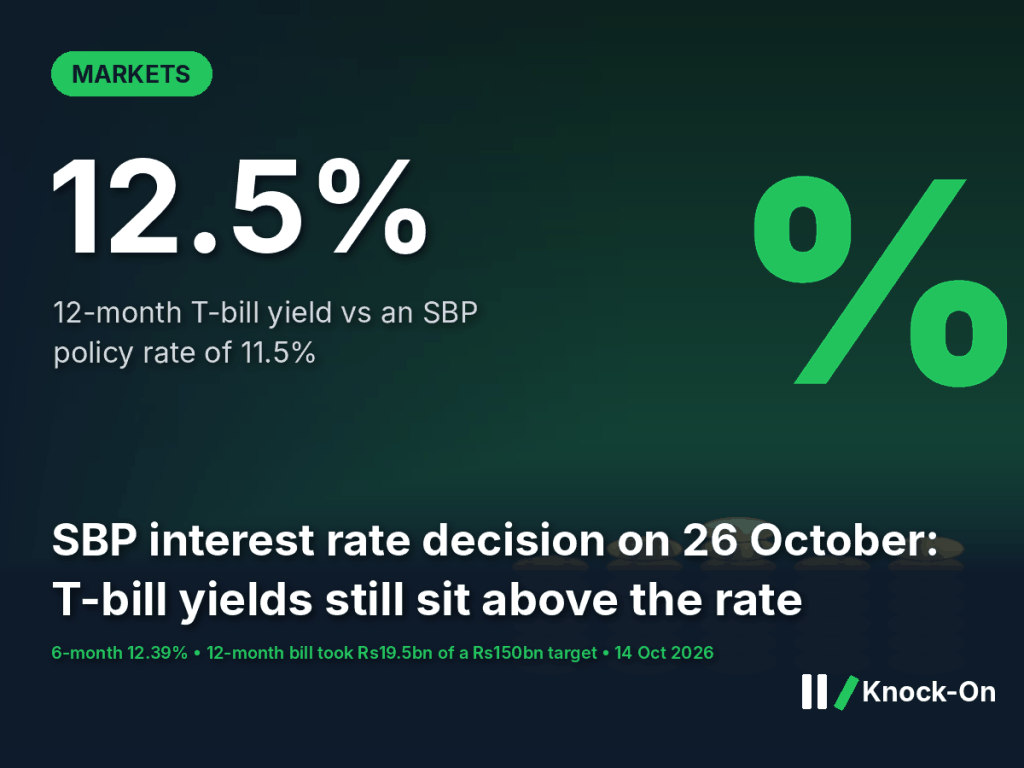
The SBP interest rate is 11.5%, but the government is still paying more than that to borrow for three months or longer. At Wednesday’s treasury bill auction, cut-off yields ran from 11.50% on one-month bills to 12.50% on 12-month bills, and the government raised Rs685.5bn, Dawn and Pakistan Era reported. The one-year bill drew only Rs19.5bn against a Rs150bn target. With the State Bank’s next monetary policy decision due on 26 October, the auction is the clearest market read on where borrowing costs are heading.
The short version
- T-bill cut-off yields on 14 October: 1-month 11.50%, 3-month 12.00%, 6-month 12.39%, 12-month 12.50%, against an 11.5% policy rate.
- The government raised Rs685.5bn against a Rs550bn target, but the 12-month bill took just Rs19.5bn of its Rs150bn target.
- Bids fell to Rs2.6trn from Rs2.7trn at the 1 October auction, Dawn reported.
- The SBP announces its next decision on 26 October; the next T-bill auction is on 28 October.
What happened
The government accepted Rs417.6bn in competitive bids and Rs267.9bn in non-competitive bids, Dawn reported. The six-month yield slipped 6 basis points to 12.39%, about 89 basis points above the SBP interest rate. According to Pakistan Era, which cites the SBP’s auction result, the 1-, 3- and 6-month bills were all taken above target, while the 12-month bill fell well short. Provincial governments took Rs200bn of three-month paper through non-competitive bids.
The longer the bill, the bigger the premium over the 11.5% policy rate
T-bill cut-off yield minus SBP policy rate, basis points, auction of 14 Oct 2026
Why it matters
When banks demand more than the policy rate to lend to the government for six months or a year, it usually means they do not expect the SBP interest rate to fall soon; that is our analysis, not a forecast. It fits the backdrop: the IMF now projects inflation of 9.9% this fiscal year, as set out in our report on the IMF inflation forecast, which would leave little room between inflation and an 11.5% policy rate. Financial experts quoted by Dawn said investors were wary because of the Gulf war and political uncertainty at home. For businesses, bank loans are priced off KIBOR and government paper, so yields at these levels keep working-capital loans expensive.
Banks piled into short bills and shunned the one-year
Amount accepted by tenor, Rs billion, auction of 14 Oct 2026 (target in brackets)
The knock-on effects
First order: the government rolls its debt short
Raising most of the money in three- and six-month bills means the same debt comes back for refinancing within months, at whatever rate prevails then. The next auction, on 28 October, targets Rs1,050bn, according to Pakistan Era.
Second order: an SBP interest rate cut looks less likely to reach borrowers
Bankers told Dawn that most private borrowing is for working capital rather than long-term investment. Even targeted schemes such as the drive to double SME financing to Rs2.2trn depend on banks finding private loans more attractive than risk-free government paper paying above 12%.
Third order: growth targets
The finance minister hopes for 4% growth, above the IMF’s 3.5% forecast, Dawn noted. Expensive credit makes that gap harder to close, as discussed in our analysis of the growth forecast.
Who could benefit
- Banks: earn up to 12.5% on government paper with no credit risk.
- Savers and money market funds: short-term returns stay above the policy rate.
- Cash-rich companies: treasury income on surplus cash remains high.
Who may face pressure
- Borrowing businesses: loan rates priced off KIBOR stay high.
- SMEs: banks have little reason to take on riskier private lending.
- The federal budget: interest costs stay elevated while debt is rolled over at short tenors.
What to watch
- 26 October: the SBP’s monetary policy decision.
- 28 October: the next T-bill auction, with a Rs1,050bn target.
- Early November: October inflation data from the PBS.
- Oil prices and the Gulf conflict, which feed directly into inflation.
Sources
- Dawn, Govt keeps treasury bill returns higher over policy rate, 15 Oct 2026
- Pakistan Era, SBP T-Bill Auction 14 October 2026: Cut-Off 11.50-12.50%, 15 Oct 2026
- Dawn, Pakistan’s growth during FY27 projected at 3.5pc, inflation at 9.9pc: IMF, 13 Oct 2026
This is analysis, not investment advice. Figures are as of 16 Oct 2026.

Leave a Reply