
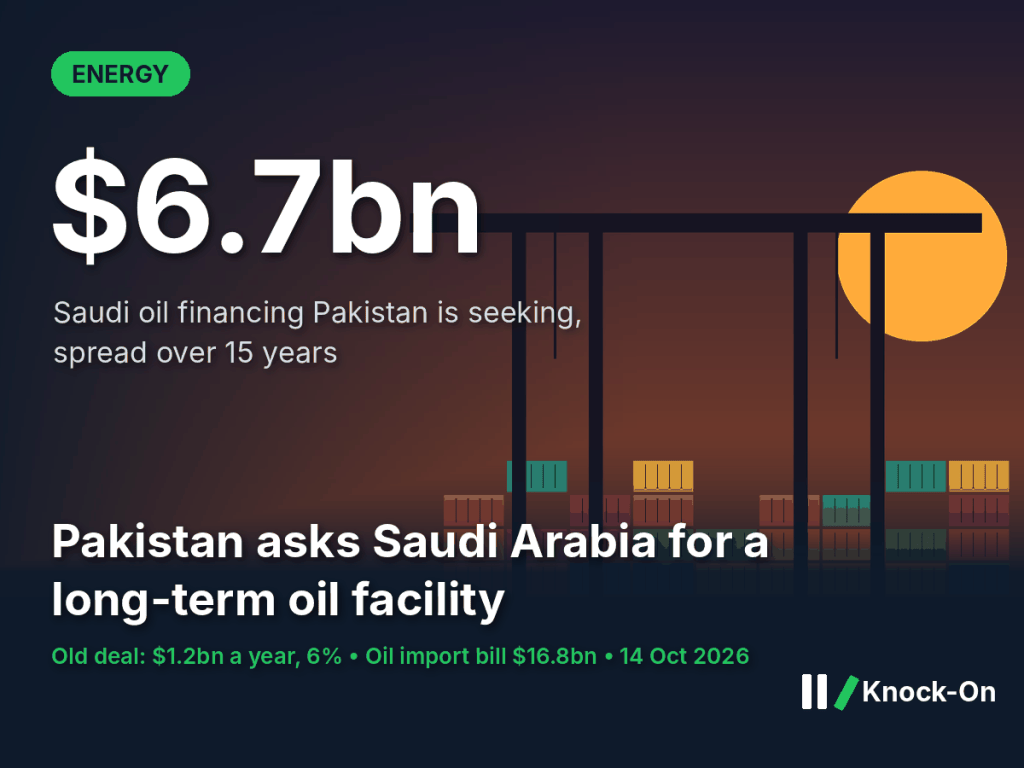
Pakistan has asked Saudi Arabia for a new Saudi oil facility worth $6.7 billion, to be spread over 15 years. Since 2019 the Kingdom has supplied oil on deferred payment one year at a time, most recently at $1.2 billion a year, and the last of those deals has expired. Finance Minister Muhammad Aurangzeb raised the request in Bangkok this week, as Pakistan’s oil bill climbs with prices driven up by conflict in the Gulf. Saudi Arabia has not yet answered.
The short version
- Pakistan wants a $6.7 billion concessional oil financing facility over 15 years from the Saudi Fund for Development (SFD).
- The previous one-year facility was $1.2 billion a year at 6% interest, according to economic affairs officials.
- The petroleum import bill was $16.8 billion last fiscal year, and crude import costs rose another 40% in July and August.
- The IMF has not counted any Saudi oil facility in its inflow projections for this year or next.
What happened
On Tuesday, Aurangzeb met SFD chief executive Sultan Abdulrahman Al-Marshad on the sidelines of the World Bank and IMF annual meetings in Thailand, The Express Tribune reported. He raised reviving the $1.2 billion deferred-payment oil facility, and Pakistan is now seeking a longer, $6.7 billion arrangement over 15 years. The aim is to reduce Pakistan’s immediate external financing needs rather than roll over short-term support each year.
The Finance Ministry did not comment on the oil facility, and adviser Khurram Schehzad did not respond to questions, according to the Tribune. People familiar with the talks said Saudi Arabia was examining the request. The Finance Ministry said both sides discussed trade, investment, refinery upgrades and a new pipeline of SFD-backed projects, and that the SFD reaffirmed its support “within its mandate”, ProPakistani reported.
The SFD has provided about $6.7 billion for oil imports since 2019. The last one-year facility was signed in February 2025 and expired in April. Separately, Saudi Arabia has extended $3 billion of short-term financing through the SFD, which was rolled over for three months in July.
The old Saudi deal covered about 7% of one year’s oil bill
US$ billion; import bills are for FY2025-26
Why it matters
Pakistan’s oil bill is large and rising. The petroleum import bill grew 5.8% to $16.8 billion last fiscal year, crude import costs jumped 32% to $7.2 billion, and crude costs rose a further 40% in July and August, according to the Tribune. Every barrel bought on deferred terms is a dollar that does not leave the reserves straight away. A Saudi oil facility of $6.7 billion would equal about 40% of last year’s petroleum bill (Knock-On calculation), although spread over a much longer period.
The financing gap is large. The IMF estimates Pakistan’s gross financing needs for FY2027-28 at nearly $30 billion, and its latest staff report does not include any Saudi oil facility in projected inflows for FY2026-27 or FY2027-28. A deal would therefore be extra room, not money already counted. The request follows Pakistan’s push for a better rating, covered in our look at why Pakistan’s credit rating hopes now point to double-B, and its effort to widen supply, including possible crude oil imports from Libya.
The knock-on effects
First order: less pressure on dollars for fuel
Deferred payment lets oil arrive now and be paid for later. That eases the monthly demand for dollars from fuel imports, one of the main pressures on the rupee and on banks opening letters of credit for oil cargoes.
Second order: more predictable planning
One-year deals leave a gap each time one expires, as now. A 15-year facility would let the government and refiners plan supply further ahead, which matters while prices change daily at the pump; see our explainer on the petrol price in Pakistan under daily pricing.
Third order: debt still has to be repaid
Deferred oil is borrowing. The previous facility carried 6% interest, and the terms of any new deal are not known. Longer financing spreads the cost out but does not remove it, and repayments would fall on future budgets.
Who could benefit
- Importers of fuel and crude: a facility would reduce the need to find dollars upfront for each cargo.
- Businesses paying for imports: less demand for dollars from oil can ease pressure on the rupee.
- Refiners: the talks also covered refinery upgrades, according to the Finance Ministry.
Who may face pressure
- The reserves, if the answer is no or slow: without deferred terms, every cargo is paid for in cash.
- Transporters and fuel-heavy industries: they still face high world prices, whatever the financing.
- Future budgets: repayments and interest on a large facility fall due over many years.
What to watch
- Saudi response: whether the SFD agrees to the 15-year request, a renewed one-year deal, or neither.
- Terms: the interest rate and repayment schedule, compared with the 6% on the previous facility.
- IMF Executive Board: approval of the staff-level agreement that would release about $1.2 billion.
- Oil import data: whether the 40% rise in crude costs seen in July and August continues.
Sources
- The Express Tribune, Govt seeks 15-year Saudi oil facility, 14 October 2026
- ProPakistani, Pakistan Wants New $7 Billion Saudi Oil Deal, 14 October 2026
- Dawn, Aurangzeb discusses targeted fuel subsidies in meeting with senior IMF official, 14 October 2026
This is analysis, not investment advice. Figures are as of 15 October 2026.


Leave a Reply