
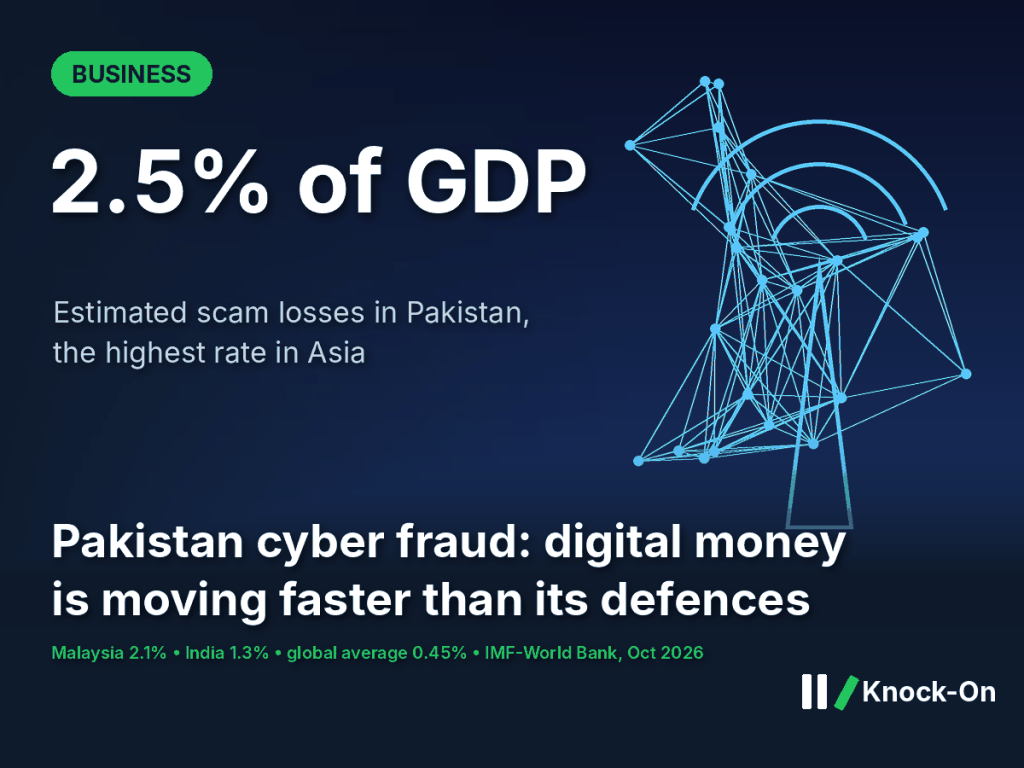
Pakistan cyber fraud losses are estimated at 2.5% of GDP, according to a paper released by the managements of the International Monetary Fund (IMF) and the World Bank Group at their Annual Meetings in Bangkok this week. That is the highest rate in Asia and more than five times the global average of 0.45%. For businesses that have moved sales, payroll and supplier payments onto mobile wallets and instant transfers, the finding turns fraud from a back-office nuisance into a cost of doing business.
The short version
- An IMF-World Bank paper puts Pakistan’s estimated scam losses at 2.5% of GDP, against 2.1% for Malaysia and 1.3% for India.
- The global average is 0.45% of GDP, so Pakistan’s rate is about 5.6 times higher (Knock-On calculation).
- The paper says fraudsters increasingly trick customers into authorising payments themselves, helped by AI, deepfakes and instant payment systems.
- It recommends shared intelligence, rapid intervention and stronger consumer protection. The method behind the 2.5% estimate has not been published in the summaries reported so far.
What happened
The paper, titled “Bangkok Blueprint in Action”, was developed with the Bank of Thailand and draws on anti-fraud measures in Hong Kong, Malaysia, Singapore and Thailand, Business Recorder reported on 15 October. It states that “Pakistan is facing mounting exposure to cyber-enabled financial fraud, with estimated scam losses equivalent to 2.5 percent of GDP”. It adds that digital finance “has expanded access, innovation, and efficiency, but it has also enabled fraud to occur at greater speed, scale, and sophistication.”
The wider “Bangkok Blueprint for Fraud-Resilient Financial Services” was launched on 14 October. Reuters, via Yahoo Finance, reported that it is meant to guide regulators and financial institutions but is not formal IMF-World Bank policy guidance. At the launch, Bank of Thailand Governor Vitai Ratanakorn said Asia accounted for 67% of global fraud losses in 2024.
Pakistan loses more of its GDP to scams than anyone else in Asia
Estimated scam losses, % of GDP, IMF-World Bank paper, October 2026
Why it matters
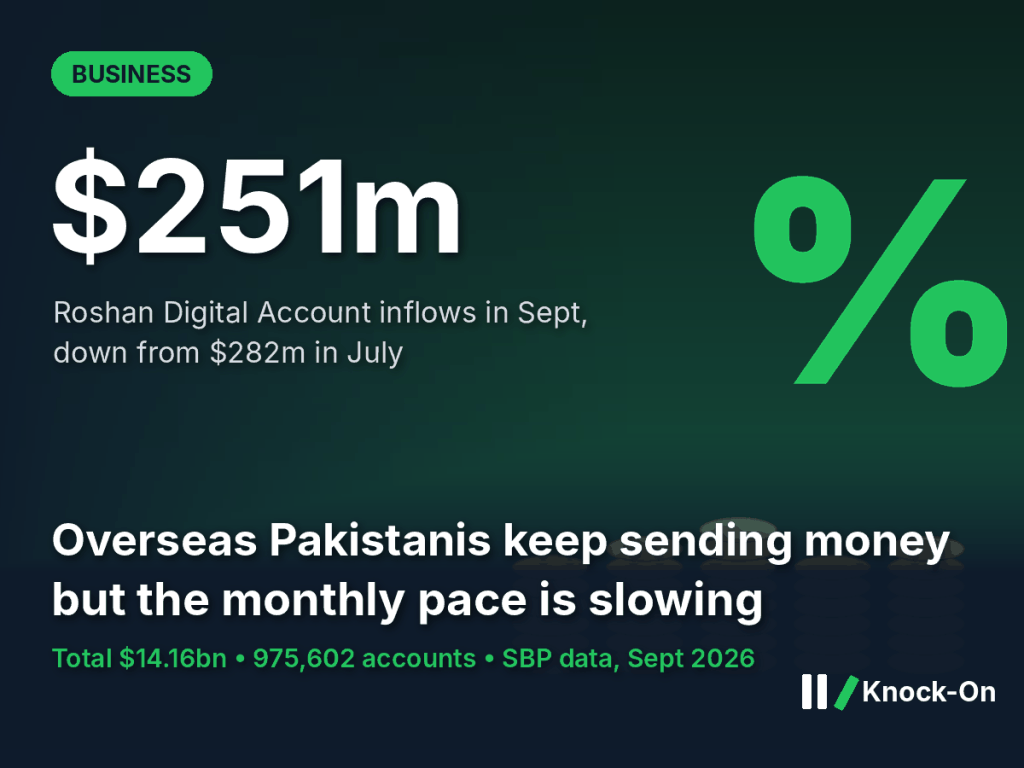
Pakistan cyber fraud is growing alongside the channels the government wants more people to use. Mobile wallets, branchless banking and instant transfers have brought first-time users into the financial system, and PhoneWorld notes that these users are a target for impersonation scams. The same rails carry diaspora money through schemes such as the Roshan Digital Account, whose inflows slowed in September, and they are meant to carry the extra small-business credit behind the Rs2.2trn SME financing target. If customers lose trust in digital payments, both goals get harder.
The paper’s point about authorised fraud matters for who pays. When a customer is tricked into approving a transfer, the loss often sits with the customer or the business, not the bank. A treasury clerk who pays a fake supplier invoice is a balance-sheet loss for the firm.
The knock-on effects
First order: higher compliance costs for banks and wallets
Regulators are already moving. PhoneWorld reports that the PTA has tightened SIM verification and that the SECP has set up a Corporate Intelligence Unit to detect illegal schemes early. Banks, wallets and telecom operators can expect more spending on verification, transaction monitoring and data-sharing.
Second order: more friction for customers
Rapid intervention usually means holds on suspicious transfers, payment limits for new accounts and extra checks. These protect users but slow payments for merchants and freelancers who depend on instant settlement, including the IT and trading firms behind the recent rise in new company registrations.
Third order: the cost of trust
A high fraud rate can keep cash in use and make investors cautious about fintech. Pakistan’s push for a cashless economy depends on users believing their money is safe online.
Who could benefit
- Cybersecurity and identity-verification providers, if banks, wallets and telecoms raise spending on fraud controls.
- Banks with strong fraud systems, which may win deposits and merchants if trust becomes a selling point.
- Consumers, if the recommended consumer-protection measures are adopted.
Who may face pressure
- Mobile wallets and branchless banking operators, which face tighter checks and possible liability debates.
- Small businesses and freelancers that rely on instant payments and have little in-house fraud protection.
- Telecom operators, whose networks carry many impersonation scams and which face stricter SIM rules.
What to watch
- Whether the full paper sets out how the 2.5% estimate was calculated. PhoneWorld cautions that reporting differences between countries can shift rankings.
- Any response from the State Bank, PTA or SECP on shared fraud databases or rules on who repays victims.
- Fraud controls on instant payments and new wallet accounts as digital adoption grows.
Sources
- Business Recorder, Highest in Asia: Pakistan facing mounting exposure to cyber-enabled financial fraud: report, 15 Oct 2026
- PhoneWorld, Cyber-Enabled Fraud Costs Pakistan 2.5 Percent of GDP, Highest in Asia, Says IMF-World Bank Paper, 15 Oct 2026
- Reuters via Yahoo Finance, IMF, World Bank launch ‘Bangkok Blueprint’ to fight cyber fraud, 14 Oct 2026
This is analysis, not investment advice. Figures are as of 15 October 2026.

Leave a Reply