
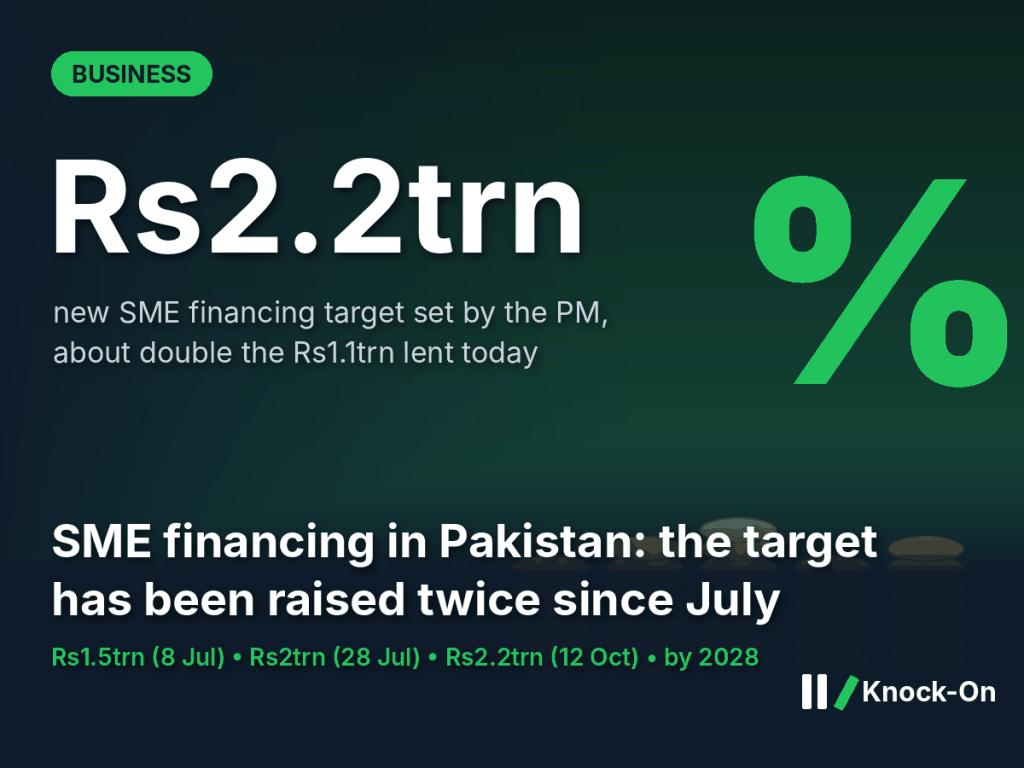
SME financing in Pakistan has a new and bigger target. At a reform meeting at the Small and Medium Enterprises Development Authority (SMEDA) on Monday, Prime Minister Shehbaz Sharif directed that bank lending to small and medium enterprises be roughly doubled, from about Rs1.1 trillion now to Rs2.2 trillion by 2028, Business Recorder reported. It is the third target set for SME lending since July, and each has been larger than the last. For small firms that struggle to borrow, the question is whether banks will follow.
The short version
- The prime minister has set a Rs2.2 trillion target for SME financing by 2028, about double the current Rs1.1 trillion.
- In July the targets were Rs1.5 trillion (State Bank, 8 July) and then Rs2 trillion (PM’s Office, 28 July).
- SMEDA is being reshaped to help entrepreneurs get bank loans, with new offices, an AI helpline and an Alibaba training deal for 10,000 SMEs.
- Hitting the target by June 2028 would need lending growth of about 38% a year, a Knock-On calculation.
What happened
According to Business Recorder, the prime minister stressed the need to empower entrepreneurs through better access to finance at Monday’s meeting, attended by several federal ministers. SMEDA was told to develop a nationwide strategy to raise awareness of business loans and explain how to apply. Experts are to prepare sector feasibility studies for SMEs in local languages, new SMEDA offices are being opened, an AI-powered helpline is being built, the SME digital portal is being reformed, and a memorandum of understanding with Alibaba is to train 10,000 SMEs over two years.
The goal has moved quickly. On 8 July, State Bank of Pakistan Governor Jameel Ahmad told the Pakistan Banking Summit: “Together with the government, we have set a target of increasing SME financing to Rs1.5 trillion,” with 750,000 SME borrowers, by June 2028, Arab News reported. On 28 July, the PM’s Office said bank SME financing stood at Rs1.15 trillion in June 2026 and set a June 2028 target of Rs2 trillion, with borrowers rising from 324,000 to 775,000 and SMEs’ share of bank lending from 9.9% to 13%, according to APP.
The SME lending target has nearly doubled in three months
Bank financing to SMEs, Rs trillion: actual (June 2026) and targets set in 2026
Why it matters
SMEs make up more than 90% of Pakistani businesses, contribute about 40% of GDP and about a quarter of exports, and employ about 78% of the non-agricultural workforce, Arab News reported, yet they receive under a tenth of bank lending. Raising SME financing in Pakistan from Rs1.15 trillion to Rs2.2 trillion within two years implies growth of about 38% a year (Knock-On calculation, assuming a June 2028 deadline). That is ambitious at a time when the IMF forecasts inflation of 9.9% in 2027, which makes cheaper loans less likely.
The knock-on effects
First order: banks are pushed to lend to smaller firms
The July plan already set out a scoring system for banks’ business lending and an annual award for the bank that lends most to SMEs, overseen by a steering committee led by the finance minister with the SBP governor as co-chair. A higher target raises the pressure on banks that have preferred lending to the government and large companies.
Second order: more documented businesses
Bank loans require accounts, records and registration. If credit becomes easier to get, more small firms have a reason to formalise, which overlaps with the government’s push to widen the tax net, as seen in the retailers’ fixed tax scheme.
Third order: credit quality becomes the test
Rapid lending growth to newer, smaller borrowers can raise default risk. How banks price that risk, and whether they get credit guarantees or other support, will decide whether the target produces lasting businesses or bad loans.
Who could benefit
- Small manufacturers and exporters: working-capital loans are their main constraint.
- New founders: the many firms being registered, as in September’s 5,241 new companies, need finance to grow.
- Banks with SME franchises: lenders already active in small-business credit are best placed to grow it.
Who may face pressure
- Banks focused on government securities: scoring and public rankings expose low SME lending.
- Undocumented businesses: firms without records may find the new credit out of reach.
- SMEDA: it must deliver offices, helplines and feasibility studies at scale.
What to watch
- The State Bank’s quarterly SME finance data, to see whether lending is moving above the June level of Rs1.15 trillion.
- Whether the SBP formally adopts the Rs2.2 trillion figure and its deadline.
- Details of the Alibaba training programme and the AI helpline launch.
- Interest rates: the cost of borrowing will matter as much as the volume of credit.
Sources
- Business Recorder, PM orders doubling of SME financing to Rs2.2trn, 13 Oct 2026
- APP, PM orders faster SME loan access, approves three-tier governance structure to double business financing by 2028, 28 Jul 2026
- Arab News, Pakistan eyes increasing SME financing to $5.4 billion by June 2028, 8 Jul 2026
This is analysis, not investment advice. Figures are as of 13 Oct 2026.





Leave a Reply