
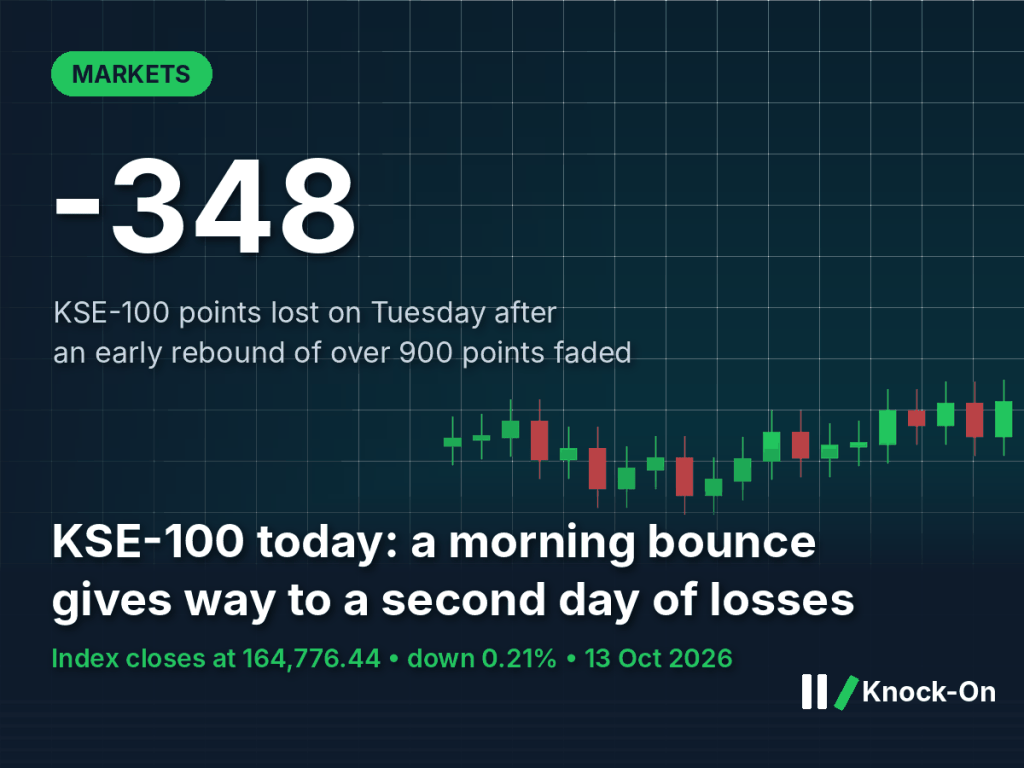
The KSE-100 today showed how fragile confidence is at the Pakistan Stock Exchange. The benchmark index opened Tuesday with a rebound of more than 900 points, recovering almost half of Monday’s sell-off, but the buying faded and the KSE-100 closed at 164,776.44, down 347.97 points or 0.21%. Two sessions after the federal government imposed emergency rule in Khyber Pakhtunkhwa, the index is about 2,313 points below Friday’s close, and a widening conflict in the Gulf is adding to the pressure.
The short version
- The KSE-100 closed at 164,776.44 on Tuesday 13 October, down 347.97 points (0.21%), according to Business Recorder.
- In the morning the index had been more than 900 points higher, near 166,069, before selling returned.
- Over two sessions the index has lost about 2,313 points (1.4%) since Friday, a Knock-On calculation.
- Political uncertainty over KP and attacks on Saudi Arabia, which closed Riyadh airport until 17 October, are the main pressures.
What happened
On Monday, the first session after emergency and governor’s rule were imposed in KP, the KSE-100 fell 1,964.87 points (1.18%) to 165,124.41, the close shown on the PSX data portal. We set out the business costs of that decision in our analysis of emergency rule in KP and the PSX.
Tuesday began with bargain hunting. Business Recorder reported the index more than 900 points higher in early trade, with buying in automobile assemblers, cement, commercial banks, oil and gas exploration companies and oil marketing companies, and index-heavy names including Lucky Cement, DG Khan Cement, HBL, MCB, Meezan Bank, NBP, OGDC, Mari and PSO trading higher. The gains did not last. By the close the KSE-100 today stood at 164,776.44, a second straight daily loss.
Tuesday’s bounce recovered almost half of Monday’s loss, then faded
KSE-100 change in points versus the previous close, 12–13 Oct 2026
The regional backdrop was weak. Reuters, carried by Business Recorder, reported that Asian equities fell on Tuesday as the Middle East conflict kept oil prices high: MSCI’s Asia-Pacific index outside Japan fell about 2% early, South Korea’s KOSPI slid 6% and Japan’s Nikkei dropped 2.6%. Brent crude was near $105.9 a barrel, close to a two-week high, before easing to about $105.35 later in the day. In Islamabad, Law Minister Azam Nazeer Tarar and Information Minister Attaullah Tarar told foreign media that the KP emergency was driven by security concerns and the lack of a joint counterterrorism strategy with the PTI-led provincial government. The PTI has said it wants counterterrorism policy based on a joint federal-provincial agreement.
Why it matters
A rebound that cannot hold tells companies that investors still want a discount for political and geopolitical risk. That matters beyond trading screens: the KSE-100 sets the price at which listed firms can raise equity, and it is the benchmark for the retail investors and funds that have driven the market for most of the year. It also comes as the IMF now forecasts Pakistani inflation at 9.9% in 2027, which weakens the case for cheaper borrowing that has supported share prices.
The knock-on effects
First order: KSE-100 today stays hostage to headlines
Traders are reacting to each development in KP and the Gulf rather than to company results. Volume was concentrated in low-priced and speculative shares; LSE Financial Services’ right shares, Waves Home Appliances and WorldCall Telecom led the volume table, Business Recorder reported.
Second order: fundraising and listings get harder to price
Companies planning share sales, rights issues or listings face a more cautious market. Volatile days make it harder to agree a price with investors and can push issuers to delay or offer bigger discounts.
Third order: the Gulf link reaches the real economy
The attacks on Riyadh airport matter to Pakistan through oil prices, travel and the flow of money from workers in Saudi Arabia, a risk we examined in our piece on Saudi Arabia, the Houthi attacks and remittances. Higher fuel import costs feed through to transport, power and inflation.
Who could benefit
- Long-term buyers: lower prices give investors with a longer horizon better entry points, if the political situation stabilises.
- Oil and gas producers: exploration companies such as OGDC and Mari attracted buying as crude stayed above $100.
- Brokers: volatile sessions usually lift trading activity and commission income.
Who may face pressure
- Companies planning to raise equity: a nervous market raises the cost of new capital.
- Businesses with KP operations: investors are pricing in uncertainty over how the province will be run.
- Fuel-intensive sectors: airlines, transport and manufacturers face higher costs while Brent stays above $100.
What to watch
- The National Assembly and Senate sessions summoned for 13 October on the KP emergency, and any votes that follow before the 21 October approval deadline.
- Riyadh airport, closed until 17 October under a notice to airmen, and further attacks in the Gulf.
- Brent crude: a sustained move back below $100 would ease pressure on Pakistan’s import bill.
- Whether the KSE-100 can recover Friday’s close of about 167,089, or slips further below 165,000.
Sources
- Business Recorder, PSX: KSE-100 down 347.97 points, 13 Oct 2026
- Pakistan Stock Exchange, Indices: KSE100, 12 Oct 2026
- Business Recorder, Govt says Khyber Pakhtunkhwa emergency aimed at unified counterterrorism policy, 13 Oct 2026
- Business Recorder (Reuters), Airlines cancel flights to Saudi Arabia after Riyadh airport attacks, 13 Oct 2026
- Business Recorder, Oil falls as Russia diesel supply prospects counter Gulf supply risks, 13 Oct 2026
- Business Recorder, Governor’s rule, emergency in KP: President summons NA, Senate sessions today, 13 Oct 2026
This is analysis, not investment advice. Figures are as of 13 Oct 2026. Knock-On is not affiliated with any political party.






Leave a Reply