
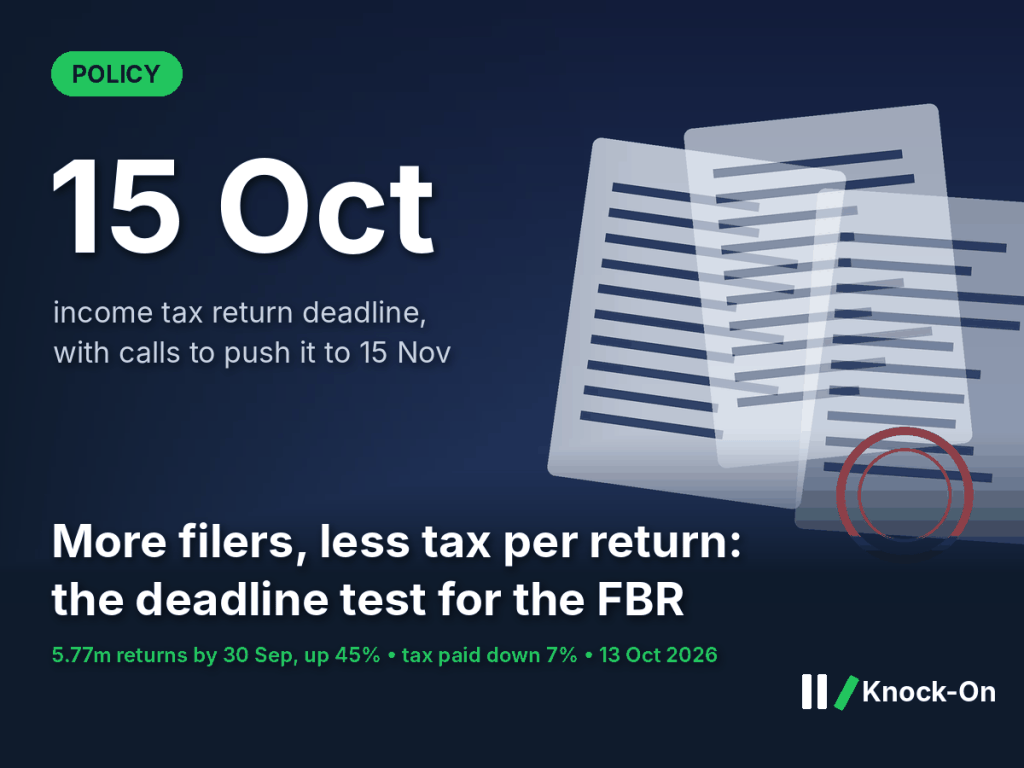
The income tax return deadline for tax year 2026 is Thursday, 15 October, and tax advisers are asking the Federal Board of Revenue (FBR) to push it back again, to 15 November. The FBR has already extended it once, from 30 September. Its own numbers show why the date matters: far more people are filing than a year ago, but the tax paid with those returns has fallen.
The short version
- The filing deadline for tax year 2026 returns and wealth statements is 15 October, after a 15-day extension.
- The Pakistan Tax Advisers Association has asked for a further month, citing a slow IRIS portal, new return columns and load-shedding.
- By 30 September, 5.767 million returns had been filed, up 45%, but tax paid with them fell 7% to Rs77.3 billion.
- Corporate payments with returns dropped from Rs49 billion to Rs39.1 billion.
What happened
On 12 October, Javed Iqbal Qazi, chairman of the Pakistan Tax Advisers Association, wrote to the FBR chairman asking for the income tax return deadline to be extended to 15 November, Business Recorder reported. He said tax practitioners had completed about 60-65% of their work. The reasons given include very slow functioning of the IRIS filing system, load-shedding, new columns in the return forms, time taken by tax payments through banks, manual returns for low-income taxpayers not yet uploaded, and taxpayers’ financial difficulties. Separately, Ismail Suttar, chairman of the Salt Manufacturers Association of Pakistan, asked for a “suitable additional period”, citing technical glitches on IRIS.
The FBR moved the original 30 September date to 15 October under Section 214A of the Income Tax Ordinance after requests from trade bodies and tax bar associations, Dawn reported. At that point the FBR had received 5.767 million returns, against 3.980 million a year earlier. Tax paid with those returns was Rs77.3 billion, down from Rs83.3 billion. Individuals paid 11% more (Rs34.5 billion) and associations of persons 16% more (Rs3.7 billion), but corporate payments fell from Rs49 billion to Rs39.1 billion.
More filers, but each return brings in about a third less tax
Average tax paid per income tax return filed by 30 September, rupees
Why it matters
The income tax return deadline is more than a paperwork date. Many new filers are joining the tax net with little or no tax due, while the fall in corporate payments suggests weaker profits or more tax already settled through withholding. For the FBR, which is under pressure to widen the base under Pakistan’s IMF programme, a second extension would delay the data it needs to chase non-filers. For businesses, the status of being a filer affects withholding rates on banking, property and vehicle transactions, so missing the date has a direct cost. The FBR is also pushing retailers into its fixed tax scheme, where Dawn reports only about 600,000 of 4.3 million retailers file returns.
The knock-on effects
First order: a rush before the income tax return deadline
Unless the FBR announces an extension, companies, partnerships and individuals have two days left. Tax practitioners say the IRIS portal is slow, so last-minute filers risk missing the date while waiting for the system.
Second order: revenue targets and enforcement
Lower payments with returns leave a gap the FBR may try to close through enforcement. It has already set a 31 December deadline for automated production monitoring in 17 industries, and retailers who do not file face staged penalties of Rs10,000, Rs25,000 and Rs50,000 under the Tax Asaan scheme.
Third order: pressure for new tax measures
If collections lag, the risk is more indirect taxes or new levies later in the year. With the IMF now forecasting 9.9% inflation, that would add to costs for consumers and firms.
Who could benefit
- Late filers, if the FBR grants another extension.
- Tax advisers and accountants, who face peak demand for their services.
- New filers, who move into lower withholding rates on everyday transactions.
Who may face pressure
- Businesses and individuals who miss the deadline and lose filer status.
- The FBR, whose return-based collections are behind last year.
- Retailers and sectors targeted by new monitoring and enforcement.
What to watch
- Whether the FBR extends the 15 October deadline, and by how long.
- The final count of returns and tax paid once the deadline passes.
- The 31 December deadline for production monitoring systems in 17 industries.
Sources
- Business Recorder, Filing of Income Tax returns: FBR chairman urged to further extend deadline to Nov 15, 13 October 2026
- Business Recorder, Income tax returns: FBR urged to grant more time for submission, 13 October 2026
- Dawn, FBR extends return filing deadline to Oct 15, 1 October 2026
- ProPakistani, FBR Extends 2026 Tax Return Deadline, 30 September 2026
This is analysis, not investment advice. Figures are as of 13 October 2026.






Leave a Reply