
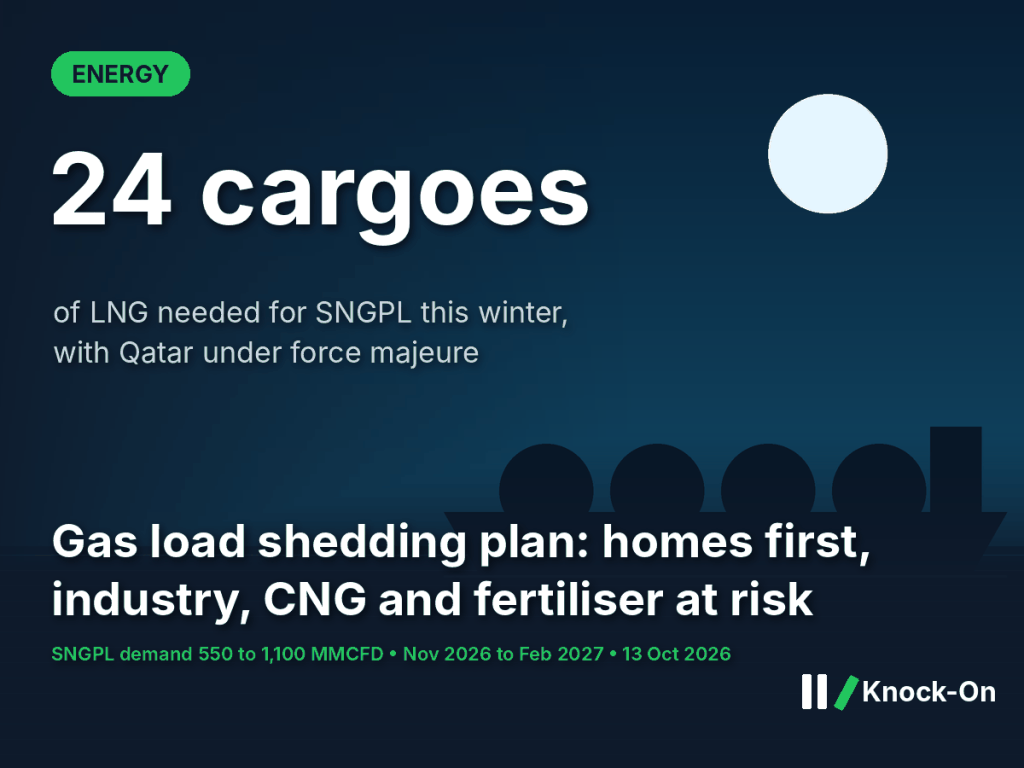
Pakistan’s gas load shedding plan for this winter puts households first and leaves industry, captive power plants, fertiliser factories and CNG stations at the back of the queue. The Petroleum Division has asked the Prime Minister-led Cabinet Committee on Energy (CCoE) to approve a four-month plan for November 2026 to February 2027, according to Business Recorder. The plan rests on buying about 24 LNG cargoes for the SNGPL network while QatarEnergy, Pakistan’s main long-term supplier, has been under force majeure since March.
The short version
- The draft winter gas plan gives homes top priority, with supply from 5pm to 10pm and the best pressure at cooking times.
- Industry, captive power, fertiliser plants and CNG stations may be curtailed if shortages bite or LNG cargoes do not arrive; CNG cuts are expected mainly in December and January.
- Winter demand on SNGPL is projected to double, from about 550 to 1,100 MMCFD.
- The plan still needs CCoE approval; no final decision has been taken on closing fertiliser plants or importing urea.
What happened
The Petroleum Division’s proposal, reported on 13 October, covers the four coldest months. It estimates that SNGPL needs about 24 LNG cargoes: nine for the power sector and 15 for domestic demand, including two contingency cargoes. Demand on SNGPL is projected to rise from about 550 to 1,100 million cubic feet a day (MMCFD), and on SSGCL from 300 to 500 MMCFD.
Winter doubles the gas demand on SNGPL
Projected demand, million cubic feet a day (MMCFD), normal vs winter 2026-27
To find the gas, the division proposes seeking at least four QatarEnergy cargoes a month through special arrangements, booking one SOCAR cargo a month at no more than $20.969 per MMBtu, and asking PSO to arrange one cargo a month with Shell LNG and/or Oman Trading International from December. Recent spot tenders show how tight the market is: September bids came in at $26.712 and $26.969 per MMBtu, and a third round drew no bids at all.
Why it matters
Gas load shedding in Pakistan is a cost to business in two ways. Factories that lose gas switch to costlier fuels or the grid, and those that pay for spot LNG face higher bills. The Petroleum Division estimates a Rs45 billion shortfall if spot cargoes are used for households, which it says would need a rise of more than Rs300 per MMBtu across the Sui companies. Using contracted cargoes for homes instead would push the cost onto electricity through fuel cost adjustments, adding to the pressures already in the 2027 electricity tariff debate.
The knock-on effects
First order: gas load shedding for industry and CNG
Industrial users and captive power plants on the SNGPL network should plan for interrupted supply between November and February. CNG stations face the deepest cuts in December and January, which means higher running costs for vehicles that depend on CNG.
Second order: urea supply in the rabi season
Three LNG-fed fertiliser plants are in scope: Fauji Fertilizer Bin Qasim, Fatima Fertilizer and Agritech. Closing them could cut about 109,000 tonnes of urea a month in December and January. A preliminary comparison suggests supplying them with LNG costs more than importing urea at $415 a tonne; another analysis at $445 a tonne puts the subsidy at about Rs5.32 billion. That matters for the sector’s fertiliser earnings outlook and for farmers’ input costs.
Third order: the import bill and the rupee
Missing Qatari cargoes have, oddly, saved foreign exchange: the division estimates net savings of about $786 million up to September. Winter buying reverses that, with November–December imports projected at about $1.036 billion. With Gulf supply already disrupted, as covered in our look at Pakistan’s crude oil imports, energy costs remain the main external risk.
Who could benefit
- Households on the gas network, who get first call on supply during cooking hours.
- LPG and alternative fuel suppliers, if industry and CNG users look for substitutes during curtailments.
- Urea importers, if the government chooses imports over keeping LNG-fed plants running.
Who may face pressure
- Factories and captive power users on SNGPL, especially in Punjab.
- CNG station owners and transporters that run on CNG.
- LNG-based fertiliser makers and, through prices, farmers.
- Sui companies and the Power Division, which carry the cost of whichever cargo choice is made.
What to watch
- The CCoE decision on the winter plan, before supply curtailments start in November.
- Whether QatarEnergy agrees to special arrangements for four cargoes a month.
- A decision on fertiliser plant closures versus urea imports for December and January.
- Any gas price change by OGRA to cover the Rs45 billion shortfall.
Sources
- Business Recorder, Winter gas load management plan: PD seeks PM-led CCoE’s nod, 13 October 2026
This is analysis, not investment advice. Figures are as of 13 October 2026. The winter plan is a proposal and has not yet been approved.






Leave a Reply