
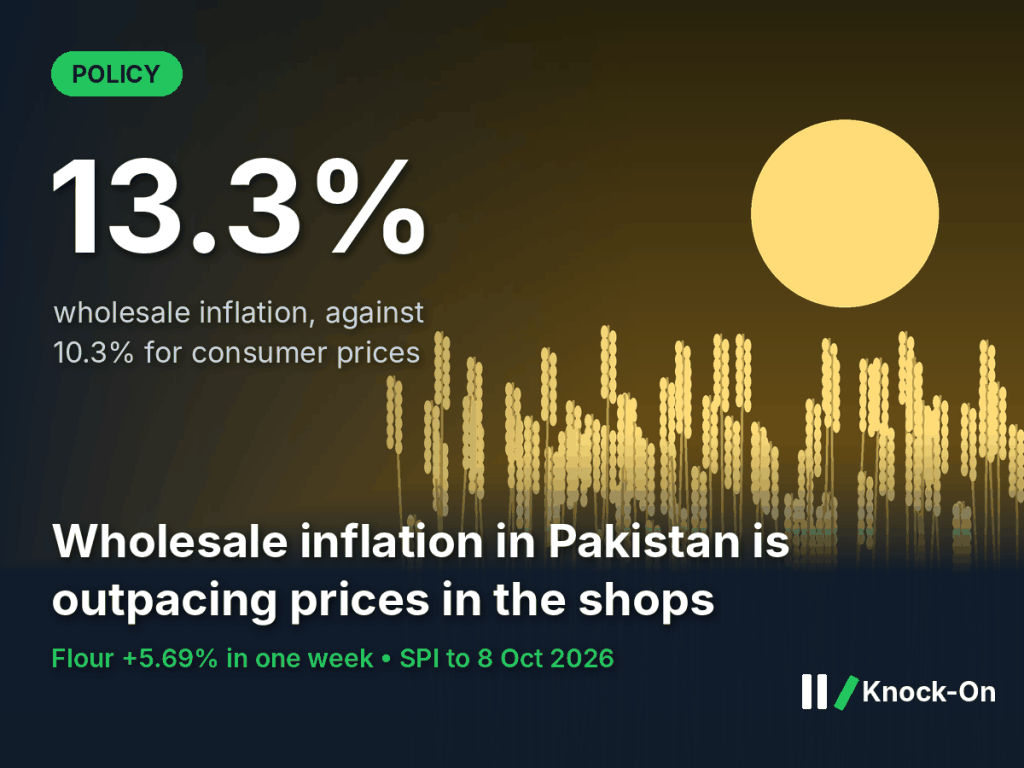
Pakistani businesses are paying more for what they buy faster than they are able to charge their customers. Wholesale price inflation reached 13.3% year on year, the National Price Monitoring Committee was told on Thursday, while consumer inflation was 10.3% in September. A day later, official weekly data showed wheat flour up 5.69% in a single week. For food processors, bakeries, restaurants and retailers, the gap between those numbers is a margin squeeze.
The short version
- Wholesale Price Index (WPI) inflation is 13.3% year on year, against consumer inflation (CPI) of 10.3% in September, down from 11.1% in August.
- The weekly Sensitive Price Indicator (SPI) rose 0.57% in the week to 8 October and is 11.97% higher than a year ago.
- Energy leads the annual increases: LPG up 68.55%, electricity up 58.59%, petrol up 47.52% and diesel up 42.52%. Wheat flour is up 32.60%.
- Sindh will release government wheat at Rs12,500 per 100kg from 15 October, up from an issue price of Rs8,000. Chakki owners in Hyderabad have rejected the new price.
What happened
Planning Minister Ahsan Iqbal chaired the National Price Monitoring Committee on Thursday, 8 October. According to Business Recorder, the committee was told that WPI inflation had risen to 13.3% and that average CPI inflation for July to September was 10.2%. The minister expressed serious concern about essential prices, particularly wheat flour, and told provinces to act against unjustified gaps between wholesale and retail prices, especially in Lahore and Karachi.
On Friday the Pakistan Bureau of Statistics published the SPI for the week to 8 October. Of 51 items, 20 rose in price, 6 fell and 25 were unchanged. Wheat flour (+5.69%), chicken (+4.93%) and gram pulse (+3.99%) led the weekly increases. Diesel fell 1.37% on the week.
In Karachi, Dawn reported that millers raised flour prices by Rs6 a kilogram on Thursday, taking the increase over the past few days to Rs20. Fine flour now costs Rs176 a kilogram at the mill. The Sindh government plans to release wheat at Rs12,500 per 100kg bag from 15 October. The Hyderabad Atta Chakki Owners Social Welfare Association says the market price of wheat rose from Rs13,100 to Rs14,300 per 100kg after the new issue price was announced, and has asked for it to be reset to Rs8,000.
Why it matters
The WPI tracks prices further up the supply chain than the CPI does. When it runs three percentage points ahead of consumer inflation, businesses in the middle are absorbing costs they have not yet passed on. The items rising fastest are inputs that almost every business uses: fuel, cooking gas, electricity and flour.
Energy and flour are rising far faster than overall prices
Year-on-year change, %. SPI items for the week to 8 October 2026; WPI and CPI as last reported
The pressure is also political. The committee asked for transport fares to be compared with those after the last fuel price increase, asked why DAP fertiliser prices remain high despite lower international prices, and ordered an inspection report on ghee, edible oil and milk products within a week. Dawn reports that short-term inflation has been in double digits for several consecutive weeks, largely because of petroleum prices.
The knock-on effects
First order: higher input bills
Bakeries, restaurants, caterers and food manufacturers pay more for flour, LPG and power straight away; the flour price is up 32.6% in a year. Transport-heavy businesses face higher fuel costs on every delivery, and builders are paying more too, with the cement price up Rs201 a bag in a year.
Second order: harder pricing decisions
Firms that pass on costs now risk scrutiny from provincial price-control drives aimed at wholesale-retail gaps. Firms that hold prices accept thinner margins. Weaker household budgets may also shift demand towards cheaper brands and smaller pack sizes.
Third order: the cost of borrowing
Persistent double-digit weekly inflation makes an early cut in interest rates harder to justify. That keeps working-capital loans expensive just as businesses need more cash to fund the same volume of stock.
Who could benefit
- Businesses holding stock bought earlier, which can sell at today’s prices.
- The tax authorities, since tax analysts quoted by Dawn say higher prices raise sales tax collections.
- Firms with strong brands or fixed-price supply contracts, which can protect margins more easily.
Who may face pressure
- Bakeries, flour-based food makers and restaurants, through flour and LPG costs.
- Flour mills and chakki owners, caught between wheat costs and official price pressure.
- Retailers and transporters, if price-control enforcement tightens.
- Sellers of non-essential goods, as household budgets go to food and energy.
What to watch
- 15 October: Sindh’s release of government wheat at Rs12,500 per 100kg, and whether mill flour prices ease.
- Mid-October: the inspection report on ghee, edible oil and milk products ordered by the price committee.
- Friday 16 October: the next weekly SPI release.
- Early November: October CPI, which will show how much of the wholesale increase has reached shoppers.
Sources
- Business Recorder, NPMC informed: WPI-based inflation jumps 13.3pc YoY, 9 October 2026
- Business Recorder, Weekly SPI inflation rises 0.57pc, 10 October 2026
- Dawn, Costly food, petroleum fuel weekly inflation, 10 October 2026
- Dawn, Flour millers deliver another price shock, 9 October 2026
- Dawn, Hyderabad chakki owners reject Rs12,500 wheat issue price, 9 October 2026
- Dawn, Minister orders food price monitoring amid surge, 9 October 2026
This is analysis, not investment advice. Figures are as of 10 October 2026.






Leave a Reply