
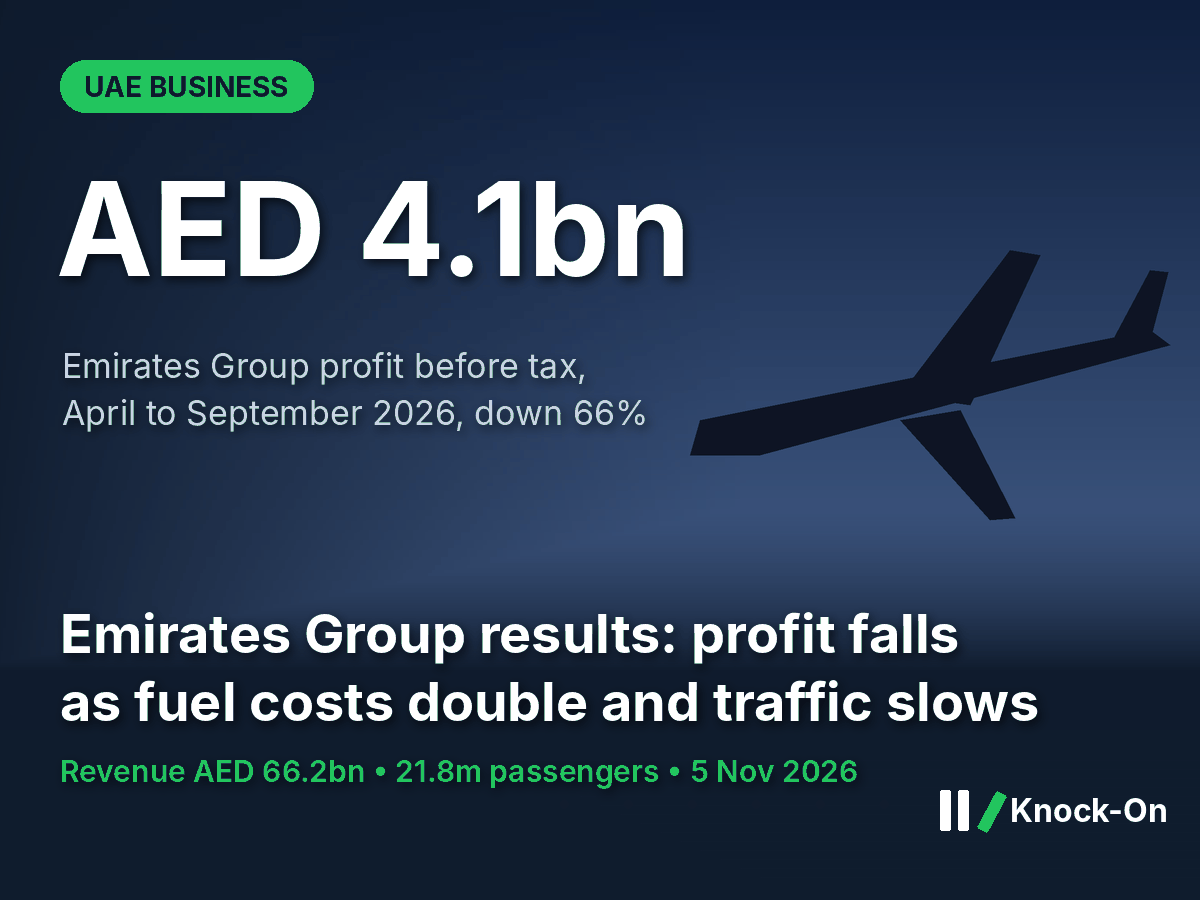
The latest Emirates Group results show how hard the past six months have been for Dubai’s biggest travel business, and why that matters for hotels, retailers and suppliers across the UAE. The group made a profit before tax of AED 4.1bn in the six months to 30 September 2026, down 66% on a year earlier, as passenger numbers fell by more than a fifth and jet fuel prices doubled. It stayed profitable, kept AED 54.1bn in cash and is back to running 91% of its usual network.
The short version
- Group revenue fell 12% to AED 66.2bn and profit before tax fell 66% to AED 4.1bn for April to September 2026.
- Emirates airline carried 21.8 million passengers, down 22%, and its seat factor slipped to 72.0% from 79.5%.
- Cargo was the bright spot: cargo revenue rose 52% while tonnage was almost flat.
- Fewer visitors and fewer meals and shopping baskets on board flow straight through to UAE hotels, caterers and retailers.
What happened
Emirates Group, which owns Emirates airline and the airport and travel services company dnata, published its half-year figures on 5 November. The group said the period carried the full six-month impact of what it described as intermittent airspace restrictions and closures across the region, together with high fuel prices. Global jet fuel prices doubled compared with the same period last year, the group said, although hedging gains of AED 7.1bn limited the rise in its net fuel cost to 13%. Fuel made up 34% of operating costs.
The airline’s revenue fell 13% to AED 56.9bn and its profit before tax fell 68% to AED 3.7bn, from a record AED 11.4bn a year earlier. Capacity, measured in available tonne kilometres, was cut by 10%. dnata’s revenue fell 7% to AED 11.0bn and its profit before tax halved to AED 410m. The group’s cash balance stood at AED 54.1bn on 30 September, compared with AED 59.6bn on 31 March, and it employed 128,237 people, 2% fewer than in March.
Revenue dipped 12%, but airline profit fell by two-thirds
Emirates Group revenue and Emirates airline profit before tax, AED bn, six months to 30 September
Why it matters
Emirates is the main way many visitors reach Dubai, so its passenger numbers are a good guide to footfall in hotels, malls and attractions. The group itself pointed to lower UAE tourism and reduced traffic at Dubai’s airports. A seat factor of 72% means more empty seats on each flight, which usually pushes airlines to compete harder on fares. Rising costs are a wider theme: the UAE PMI for October showed firms raising selling prices at a record pace.
The knock-on effects
First order: fewer travellers through Dubai
Some 6 million fewer passengers than a year earlier (a Knock-On calculation from the 22% fall) means fewer hotel nights, taxi rides and retail sales. The group’s own consumer businesses show it: Emirates Flight Catering’s revenue from outside customers fell 51% to AED 273m, and leisure retail revenue fell 13% to AED 1.2bn.
Second order: cargo keeps trade moving
A 52% rise in cargo revenue on almost unchanged volumes suggests air freight space has been scarce and priced higher. Freight forwarders and traders using Dubai as a hub have kept goods moving, but at a higher cost per kilo. Five new Boeing 777 freighters added in the half should add capacity.
Third order: suppliers watch spending plans
The group kept investing, taking nine new Airbus A350s and refurbishing 12 aircraft. With AED 54.1bn in cash, it has room to keep spending on fleet and cabins, which supports maintenance, fit-out and technology suppliers, even as dnata’s lower turnover squeezes ground-handling contractors.
Who could benefit
- Air freight and logistics firms that secured cargo space, as cargo revenue rose by half.
- Corporate travellers, who may find more seats available as capacity returns to the network.
- Aviation suppliers tied to new aircraft, connectivity upgrades and cabin refurbishment.
Who may face pressure
- Hotels and tour operators that depend on long-haul leisure visitors.
- Airport retailers, caterers and ground-handling contractors, whose volumes follow passenger numbers.
- Businesses with high fuel exposure, as energy costs feed through supply chains; see our note on UAE fuel prices for November.
What to watch
- Network recovery: whether Emirates moves above the 91% of its network it was running on 30 September.
- December fuel prices: the UAE’s monthly fuel price announcement at the end of November.
- Airport capacity: new terminal space at the Northern Emirates’ hub, covered in our story on the Sharjah Airport expansion.
- Full-year results: the group’s figures for the year to 31 March 2027, which it said it approaches with “measured optimism”.
Sources
- Emirates Group, Emirates Group announces half-year profit for 2026-27, 5 November 2026
- Gulf News, Emirates Group records Dh4.1 billion profit, 5 November 2026
This is analysis, not investment advice. Figures are as of 5 November 2026.


Leave a Reply