
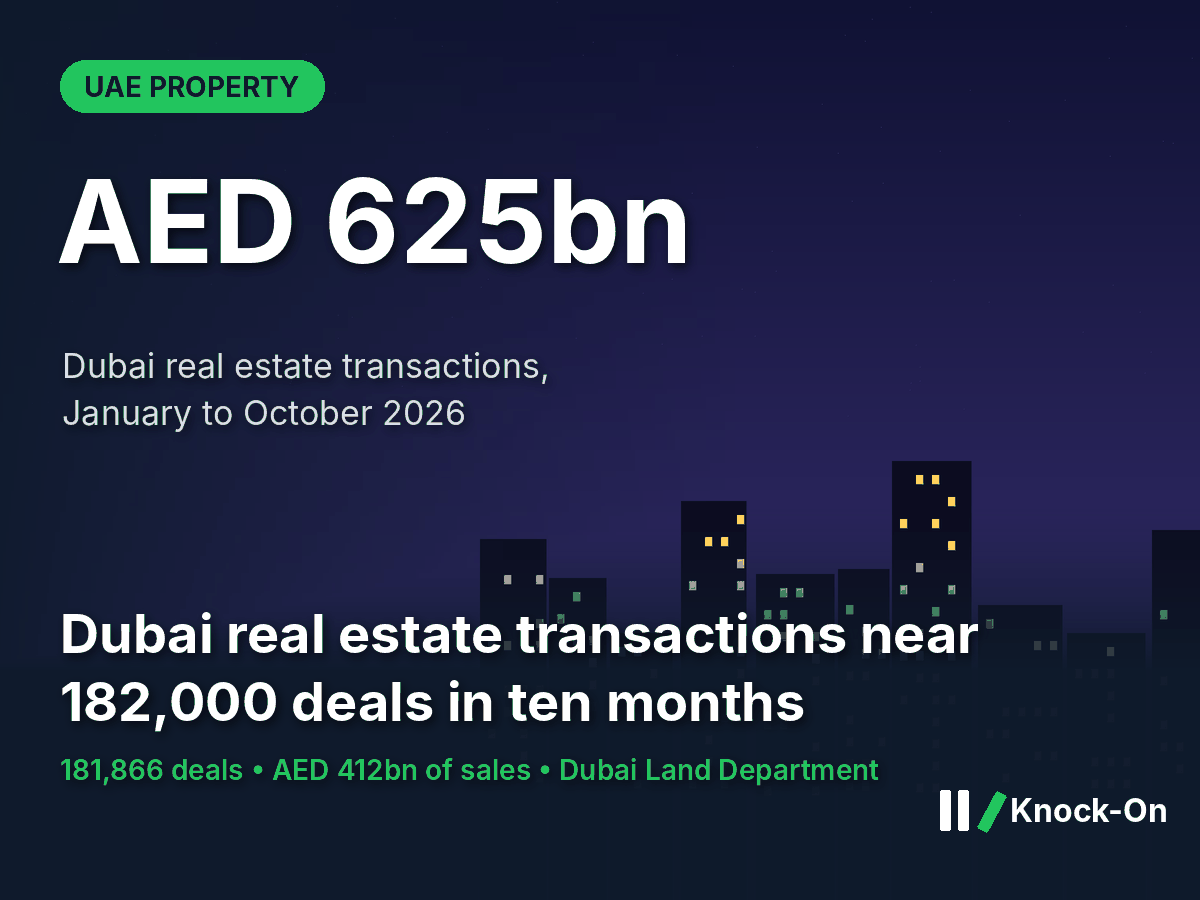
Dubai real estate transactions reached AED 625bn in the first ten months of 2026, across 181,866 deals, according to Dubai Land Department data reported by Emirates 24|7. Sales made up AED 412bn of that total. For the businesses that earn their living from property, including brokers, mortgage lenders, developers, contractors and fit-out firms, the market is still moving at a steady pace of about AED 50bn a month.
The short version
- Dubai recorded AED 625bn of real estate transactions from January to October 2026, including AED 412bn of sales.
- Business Bay, Airport City and Al Yalayis 1 were the best-selling areas.
- In the week of 26 to 30 October alone, transactions totalled AED 12.26bn ($3.3bn), with 2,579 sales.
- October looks similar to September, at roughly AED 51bn (Knock-On calculation).
What happened
On 31 October Emirates 24|7 reported Dubai Land Department figures showing AED 625bn of real estate transactions and AED 412bn of sales over ten months. A month earlier, figures citing the same department put the January to September total at AED 574.12bn across 165,018 transactions, with September alone at AED 50.78bn and 16,490 deals, MU Private Office noted.
Comparing the two cut-off dates suggests that October brought roughly AED 50.9bn and 16,848 transactions. This is a Knock-On calculation from two reports, not an official monthly figure. The last week of the month shows how that business breaks down. Arabian Business, using Dubai Land Department data, reported AED 7.44bn of sales, AED 3.51bn of mortgages and AED 1.31bn of gifts. The largest single deal was an apartment on Palm Jumeirah sold for AED 55m.
Sales drive six in every ten dirhams of Dubai property deals
Dubai real estate transactions by type, AED billion, 26–30 October 2026
Why it matters
Dubai real estate transactions are a running measure of activity for a large part of the UAE economy. Each sale brings fees for brokers and conveyancers, valuation work, and often a mortgage. It is followed by spending on fit-out, furniture, utilities connections and service charges. A steady month-on-month pace of about AED 50bn tells businesses that this flow of work is holding up as the year closes.
Mortgages are worth watching. AED 3.51bn of mortgage registrations in a single week shows that bank finance is a meaningful part of the market, so lenders’ appetite and interest rates feed straight through to deal volumes. Our UAE property section will track the monthly figures.
The knock-on effects
First order: fees and commissions
Brokerages, conveyancers and valuers are paid per deal. A market running at more than 16,000 transactions a month keeps their pipelines full, especially in high-volume areas such as Business Bay.
Second order: lending and construction
Mortgage lending supports bank loan books. Sales that keep pace also support developers’ launch plans, which in turn keep contractors, building-material suppliers and engineering firms busy.
Third order: costs for tenants and occupiers
Strong buying activity tends to support property values. Businesses that rent offices, warehouses or staff housing should plan for that at renewal time. Running costs matter too: see our story on UAE fuel prices for November.
Who could benefit
- Brokers and property services firms: commission income follows deal volumes.
- Banks and mortgage brokers: AED 3.51bn of mortgages in one week points to steady demand for home finance.
- Fit-out, furniture and facilities businesses: every handover creates follow-on spending.
Who may face pressure
- Tenants, including businesses: firm prices can feed into rents at renewal.
- First-time buyers: competition for well-located units can keep prices high.
- Contractors with fixed-price work: busy order books can push up the cost of labour and materials.
What to watch
- Weekly Dubai Land Department figures: usually reported at the end of each week, including the first full week of November.
- Full-year 2026 totals: expected in early January 2027.
- Mortgage activity: whether interest rates move, which would affect financed purchases.
Sources
- Emirates 24|7, Dubai real estate reaches Dh625 billion in 10 months: 181,866 transactions and Dh412 billion in sales, 31 October 2026
- Arabian Business, Dubai real estate sector recorded $3.3bn of transactions last week, including $15m Palm Jumeirah apartment, 31 October 2026
- MU Private Office, Dubai property transactions in the first nine months of 2026, 1 October 2026
- Dubai Land Department, Real estate transactions
This is analysis, not investment advice. Figures are as of 2 November 2026.


Leave a Reply