
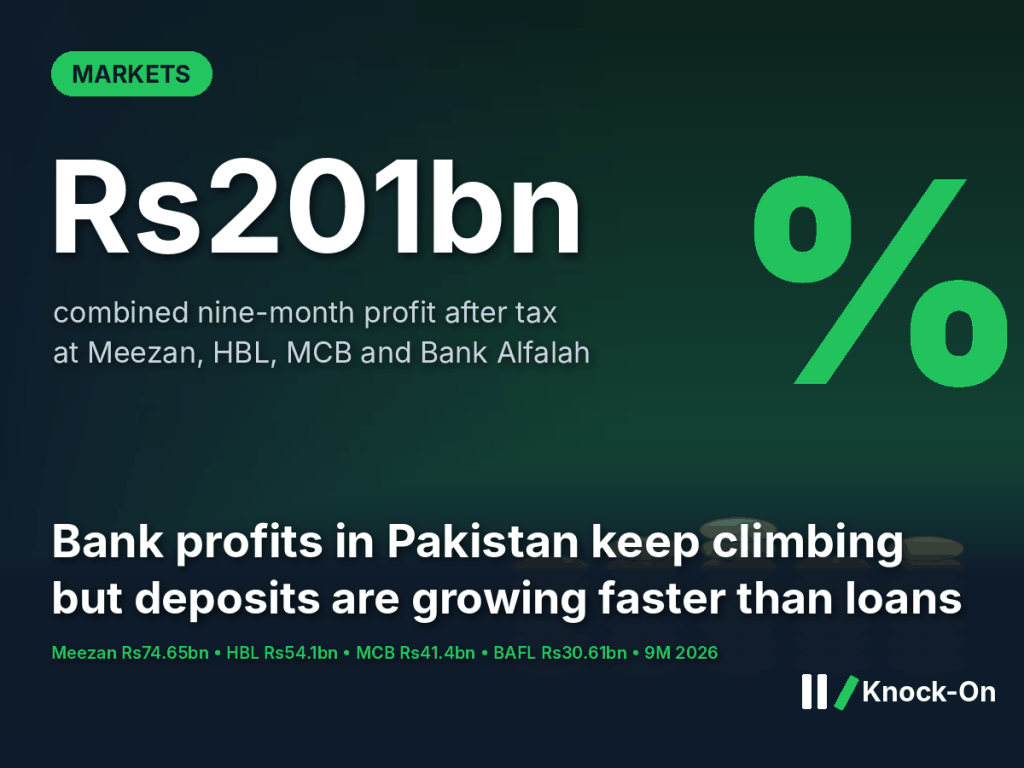
Bank profits in Pakistan kept rising in the first nine months of 2026, results released this week show. Meezan Bank, HBL, MCB Bank and Bank Alfalah together earned about Rs201bn after tax, a Knock-On calculation from their filings. The numbers land two days before the State Bank’s interest-rate decision on 26 October, and they show a sector that is collecting deposits much faster than it is lending them to business.
The short version
- Meezan Bank earned Rs74.65bn after tax in nine months, up 5.9%; Bank Alfalah’s profit rose 42.8% to Rs30.61bn.
- HBL reported a record quarterly profit before tax of Rs41.9bn and Rs54.1bn after tax for nine months.
- MCB’s deposits grew 22.2% this year, but its loans grew 11%; across the industry, deposits rose 9.1% and loans only 3%.
- The SBP decides on its 11.5% policy rate on Monday, 26 October.
What happened
Pakistan’s largest banks announced results for January to September 2026 on 22 and 23 October. Meezan Bank, the largest Islamic bank, reported profit after tax of Rs74.65bn against Rs70.52bn a year earlier, with earnings per share of Rs41.02 and an interim dividend of Rs8, according to Investify. HBL reported nine-month profit before tax of Rs115bn and after tax of Rs54.1bn, with EPS of Rs36.84 and a Rs6 interim dividend, Business Recorder said. Its total assets rose 16% to Rs8.9trn.
MCB Bank earned Rs41.4bn after tax on a standalone basis, with EPS of Rs34.95 and dividends of Rs27 a share announced for the year so far, ProPakistani reported. Bank Alfalah’s profit after tax rose 42.8% to Rs30.61bn, helped by capital gains and higher net interest income, and its EPS rose to Rs9.71 from Rs6.80.
Meezan out-earns HBL by more than Rs20bn
Profit after tax, January–September 2026, Rs bn
Why it matters
Bank profits in Pakistan are coming mainly from deposits and government paper, not from new business loans. MCB said its deposits grew 22.2% to Rs2.71trn in nine months while its gross advances grew 11% to Rs819bn; for the industry, it put deposit growth at 9.1% and advance growth at 3%. HBL’s advances of Rs2.2trn equal about 37% of its Rs5.9trn deposits, a Knock-On calculation. That matches what we reported before the SBP interest rate decision on 26 October: businesses have been repaying bank debt rather than borrowing.
Industry deposits are growing three times faster than loans
Growth since end-2025, first nine months of 2026, %
The knock-on effects
First order: dividends and bank shares
Higher profits support cash dividends, which matter to PSX investors after a week in which the KSE-100 fell 2.4%. Bank shares carry heavy weight in the index, so results can steady it, though Dawn reported that UBL, HBL and National Bank were among the biggest drags on 22 October.
Second order: the rate decision cuts both ways
A rate hike would usually lift bank yields on government securities, while a cut would squeeze margins. Industrialists quoted by Business Recorder warned that a hike would raise the cost of doing business and urged a cut to support SMEs and farmers. Meezan’s operating expenses rose 16.5%, faster than its 7% income growth, so cost control will matter whichever way rates move.
Third order: credit for the real economy
Banks with surplus deposits face pressure to lend more to private business. Bank Alfalah said its loan growth came from SME, agriculture and consumer lending, and HBL reported Rs199bn of consumer loans and over Rs119bn of farm financing. Whether that spreads depends on rates and on demand from firms that have so far preferred to repay.
Who could benefit
- Bank shareholders, through interim dividends from all four banks.
- Depositors, as banks compete for current and savings accounts.
- SMEs and farmers at banks that are expanding those loan books.
Who may face pressure
- Borrowers on floating rates if the SBP raises its policy rate.
- Banks with fast-rising costs if rates are cut and margins narrow.
- Businesses that still struggle to get working-capital loans despite banks’ cash surplus.
What to watch
- 26 October: the SBP Monetary Policy Committee decision on the 11.5% rate.
- Results from UBL, National Bank and other lenders in the coming days.
- Whether loan growth picks up in the final quarter, and how T-bill yields move after the decision.
Sources
- Investify, Meezan Bank reports Rs74.65bn nine-month profit, declares Rs8 dividend, 22 October 2026
- Business Recorder, HBL posts 9M’26 profit before tax of Rs115bn, 23 October 2026
- ProPakistani, MCB Bank Announces Rs. 41 Billion 9-Month Profit, 22 October 2026
- Business Recorder, BAFL posts 42.8pc growth in profit after tax YoY, 23 October 2026
- Business Recorder, Industrialists warn against policy rate hikes, 23 October 2026
- Dawn, Middle East tensions dent investor confidence, 23 October 2026
This is analysis, not investment advice. Figures are as of 23 October 2026.

Leave a Reply